Jonathan Griffin

Criticism and essays on art and culture

Month: January, 2023

Alonzo Davis

Parrasch Heijnan
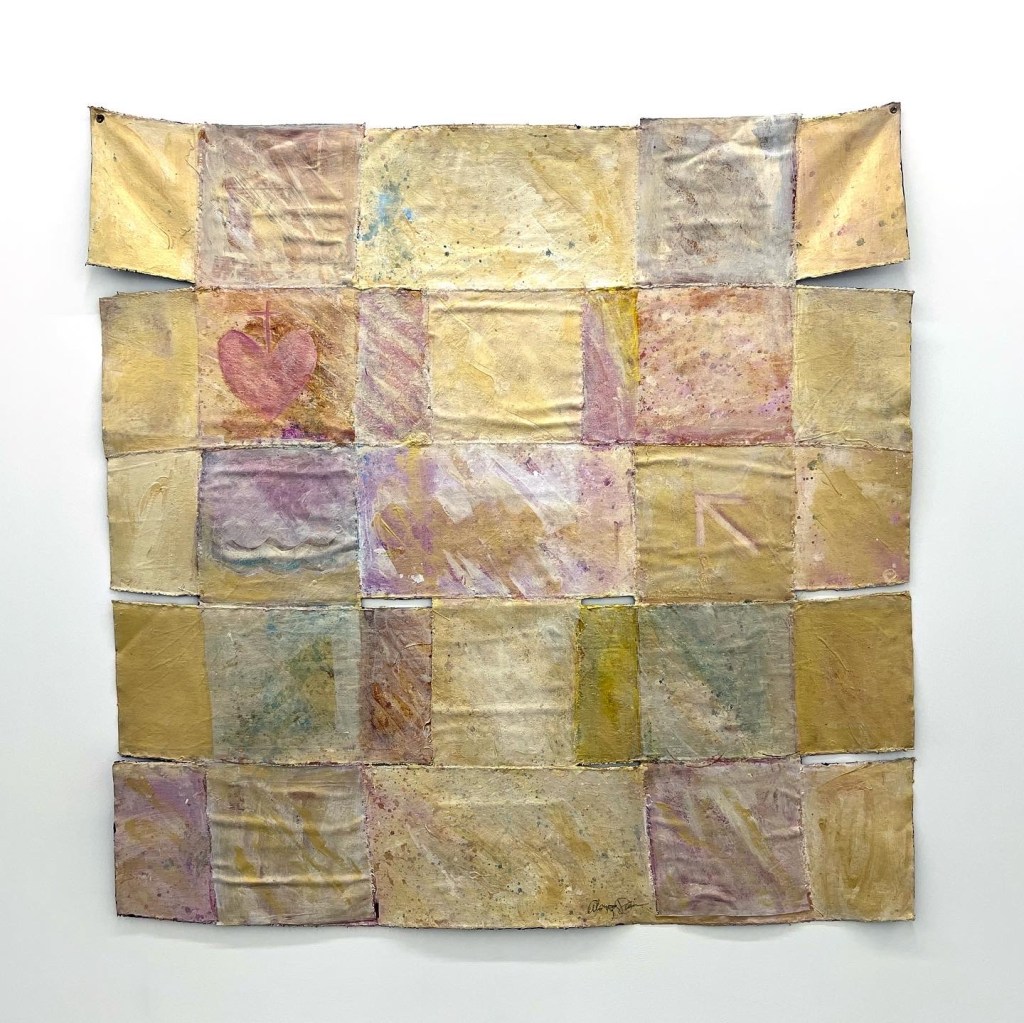
Alonzo Davis, King’s Peace Cloth, 1985, acrylic on woven canvas, 1.4 × 1.4 m. Courtesy: the artist and Parrasch Heijnen, Los Angeles

If you had dipped even a toe in the Black art world of 1970s and ’80s Los Angeles, you would have known the Brockman Gallery. Opened in 1967 by artist brothers Alonzo and Dale Davis, it occupied a storefront in Leimert Park, a middle-class enclave in South Los Angeles, and showed mainly Black artists. (Non-profit Art + Practice now runs its public programmes in the space.)  Canonical figures exhibited there, including David Hammons, Senga Nengudi, John Outterbridge, Noah Purifoy and Betye Saar, making the Brockman Gallery easily as important – and arguably more interesting – than the world-famous Ferus Gallery, even though it remains little known outside its community. In 1987 Alonzo Davis stepped away from the gallery – and from Los Angeles – to concentrate on his art practice. Given his contribution to the city, it’s shocking that this is his first solo exhibition in LA since 1984.

Read the rest of this entry »

Bernice Bing

A Lady and a Road Map, 1962, by Bernice Bing (American, 1936– 1998). Oil on canvas. Asian Art Museum of San Francisco, Museum purchase, 2020.26. © Estate of the Artist. Photograph © Asian Art Museum of San Francisco.

Once upon a time, everybody knew Bingo. In San Francisco in the 1970s, it’s said she couldn’t walk down the street in North Beach or Chinatown without someone calling out her name. Bernice Bing, the statuesque artist known to most as Bingo, was easy to spot in her sharp zoot suits, boots and jet-black hair. She was born in Chinatown in 1936; when it became the heart of the Beat movement in the 1950s, she found herself at the centre of a community that was not only wildly hedonistic but also close-knit, pluralistic, non-judgemental, socially progressive and spiritually visionary. Later, she worked with at-risk youth in the area, including gang members whom she persuaded to take part in art workshops. She helped found the South of Market Cultural Center (SOMAR, now known as SOMArts), which she ran in the 1980s. Why, then, is Bing – who died in 1998 – so little known today?

Read the rest of this entry »