Christopher Wool
by Jonathan Griffin
When Donald Judd began buying up property in Marfa, a remote West Texas town in a terrain of grassy high desert strewn with cattle ranches and sudden squat hills, he was looking for a new context for his art. More specifically: He was looking to free himself from the predominant context for art in that time (the 1970s) and place. “The art world in New York is terrible and has been terrible for a long time,” he later said. “I am very much against the museums and the critics and the business in New York.”1 In Marfa Judd aimed to install his work in perfect conditions and leave it there in perpetuity.
Judd didn’t renounce the city entirely, of course, and retained a building at 101 Spring Street, in SoHo, where he stayed while in town. But Texas became his home until his death, in 1994. (He is buried on his ranch, Las Casas, eighty miles outside Marfa.) “To me, [Marfa]’s not the middle of nowhere; . . . it’s the center of the world.”2
Christopher Wool—an artist born in Boston and raised in Chicago but indelibly associated with New York City, where he’s lived on and off for around fifty years—first came to Marfa in 2006, for a residency at the Chinati Foundation. (He later served for several years on Chinati’s board.) In 2007 he and his wife, the painter Charline von Heyl, bought a ranch-style home on the edge of town. Wool told his friend Richard Prince that he liked Marfa because it was the opposite of New York: “open and uncluttered . . . you pay attention to things like the weather.” He had never lived in such a rural place before. “I wanted to put myself in an environment that I had no experience with.”3
While in residence at Chinati Wool picked up a ball of tangled wire and was amused by how much it resembled his recent abstract line drawings. He had come to attention in the mid-1980s with paintings in black enamel on aluminum, made using off-the-shelf patterned rollers. Other works employed large letter stencils to transpose ominous words or phrases: “SELL THE HOUSE SELL THE CAR SELL THE KIDS,” ran an early one, quoting the unhinged Captain Colby’s letter home in Francis Ford Coppola’s film Apocalypse Now (1979). “HELTER SKELTER” was another, recalling Charles Manson’s paranoid theory of impending race war.
In the 1990s Wool began painting with a spray gun, inscribing large, looping knots of line onto canvases, often on top of wiped-out smears or screen-printed puddles. His work had always been recursive and recombinatory, overlaying earlier motifs or marks with new gestures in a way that can seem either cynically nihilistic or boundlessly generative. But these new abstract gestures, despite their allusions to urban graffiti and negational scribbles (crossings out, erasures, defacement), also seemed to open up a more lyrical seam for Wool to explore.
When I met Wool in Marfa this September, at his exhibition See Stop Run, on view for two years in a building specially leased for the purpose, he was reflective of this change in his work, and in himself. “When I started,” he told me, “I had so much excitement and so many ideas, and I had so little skill and so little experience. So I made black-and-white pattern paintings, because it’s basically the most simple visual thing you can do. It’s taken me a long time to free myself from those restrictions.” Though he talks of “ups and downs” over the course of his career, he’s a rare example of an artist who has maintained relevance and popularity despite changing fashions. “Success helps,” he admits. “I was naturally insecure about my work. I started very young.”
Wool wore black jeans, a black western shirt with pearl snaps, and a Wilson baseball cap through the back of which he tucked his thick white ponytail. Though hesitant in speech, and often trailing off mid-thought (“The problem for me with interviews is I don’t speak in sentences!”), he nevertheless seemed relaxed and content, surrounded by work from across his four-decade career in a space that was entirely his domain.
See Stop Run follows a widely acclaimed show of the same title that Wool organized in New York in 2024. With the help of the curator Anne Pontégnie, with whom Wool has a long-standing working relationship, he secured a lease on the nineteenth floor of an empty office building at 101 Greenwich Street in Lower Manhattan, with windows overlooking the site of the former World Trade Center, Trinity Church, and New York Harbor. The exhibition was put together independently of any of Wool’s galleries and none of the work was for sale.
In New York, the checklist spanned from an early iron sculpture of 1986—a turdlike sausage titled Muscle and made just a year after Wool’s first solo show—through enamel pattern paintings from the mid-’90s and a series of black-and-white photographs, Incident on 9th Street (1997), documenting the wake of a devastating fire in Wool’s studio, to a glut of work made in the prolific years since 2020: oil paintings over inkjet prints on paper, silkscreens on linen, a splendid large mosaic, and, notably, a series of new sculptures made from tangles of wire and enlarged cast-bronze and steel iterations of the same.
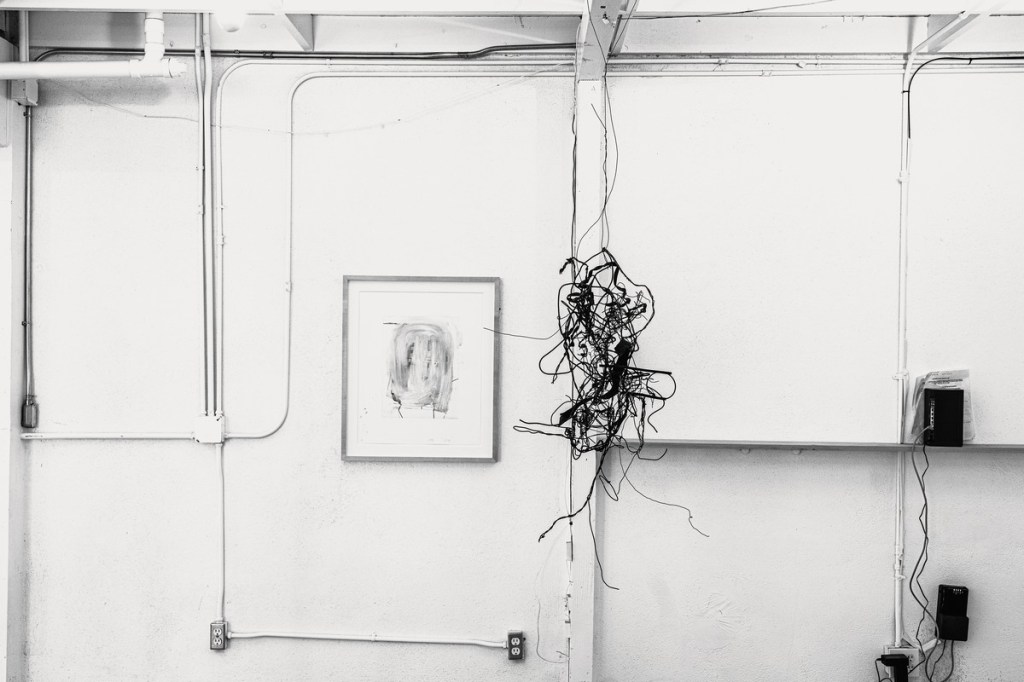
At 101 Greenwich Street, the significance and the aesthetic of the derelict exhibition space was almost overwhelming. Loose electrical cables dangled from the ceiling, sprayed and scribbled contractor notes and daubs of plaster peppered the walls, and drywall went unpainted. Pontégnie admitted that sometimes the visual rhymes with Wool’s work were almost too much.4
Wool has always been an artist of the street—a latter-day flaneur—as his important photo series East Broadway Breakdown (2003) makes clear. He explained to me that he takes photos over long periods during which bodies of work gradually coalesce. These he collates into exactingly produced books that he considers artworks in themselves. In the mid-1990s, Wool began taking photographs of the Lower East Side at night, revealing the sleeping city in all its squalor and dejection. Stray dogs pad past puddles of what looks like oil, dumpsters overflow with trash, and the camera’s flash glares off the windows of vacant storefronts. He titled the series in a nod to albums by two jazz saxophonists: Sonny Rollins’s 1966 East Broadway Run Down and Arthur Blythe’s 1979 Lenox Avenue Breakdown.
Wool arrived in New York at the peak of the 1970s financial crisis and witnessed the inner city at its lowest ebb. “The city was a wreck,” he said. “But it was very exciting, there was a lot going on. In retrospect it was a great time.” Wool’s early work illustrates how punk—as a visual style, as an attitudinal position, as a mode of address—was totally imbricated with the economics of that moment. It was a time of despondency and cynicism about the future as well as a sense of great creative opportunity. “I think part of what was so exciting about that time, art-wise, was that we were realizing what the end of modernism was leaving us with,” Wool said.
Despite the Wall Street boom in the 1980s and the efforts of Mayor Ed Koch to crack down on crime and improve the quality of life for New York’s residents, the dark times of the prior decade had a long tail. The AIDS crisis—which Wool calls “the most political period in my lifetime”—devastated the city’s creative and subcultural communities. Gentrification affected neighborhoods unevenly, leaving areas like the Lower East Side unkempt and unregulated, even through the prosperous 1990s. As a setting for Wool’s work, 101 Greenwich Street was doubly poignant as a symbol of New York’s continuing modernization and economic growth but also of that growth’s fragility. While the 1907 building’s latest developers tout it as “a timeless icon of downtown Manhattan reimagined for today’s creative workforce” and a “vision for the future,” when Wool first toured it much of it was empty following the collapse of in-office work during the pandemic.5
At the first iteration of See Stop Run, it seemed to me that Wool was perhaps the most quintessential New York artist since Andy Warhol, and that the palimpsest quality of downtown’s surfaces—pasted-over advertising, plywood hoardings, empty storefronts, signage, careless plastering, hasty paint jobs, graffiti, puddles, ambiguous spillages—had long informed his work. This roughness, and its signification of a persistent past and a future possibility, is at the core of Wool’s artistic position. An admission: When I learned that See Stop Run would decamp to Marfa after New York, I had clean forgotten that alongside Incident on 9th Street the earlier show had included another photo series, Westtexaspsychosculpture, printed in 2018 and shot between 2008 and 2017. Westtexaspsychosculpture shows yards and farms in and around Marfa: water tanks, cinder blocks, piles of tires, stacks of pallets, untidy electrical cables. Shot mostly in sharp daylight, these are the rural, Texan counterpoints to Wool’s nocturnal downtown photographs. Though I’d initially failed to detect it, they signaled a shift in focus for the artist, precipitated by his move to Marfa. The immediate, urban associations of the 101 Greenwich Street show had been so pungent that they overwhelmed all consideration of a wider context for the work.
“When I first got here, I started thinking about sculpture, because of the outdoors, the space, materials,” Wool told me. “But I really didn’t know what to do, so I started taking photographs that I thought of as notes on sculpture.” The Westtexaspsychosculpture pictures describe a scruffy country vernacular, and a way of dealing with the problem of an excess of stuff—usually inexpensive, often bulky—that is common among folk with ample space but little money. Leftover materials are stacked, just in case they might one day be useful again. Old vehicles are parked, seldom used, until nature reclaims them. Retired indoor furniture is left unceremoniously outside, turning the yard into a dusty extension of homes’ living spaces. Marfa is not a wealthy town, and despite its recent phase of gentrification and prettification, its working-class, immigrant community is more prevalent than the second-home owners and Insta-tourists.
Judd casts an unavoidable shadow. “I can’t do a show here in Marfa without thinking about Judd,” says Wool. Westtexaspsychosculpture wittily subverts Judd’s precision and fastidiousness while reflecting his affinity for stacks and grids and for workaday materials such as plywood and galvanized steel. “I found them humorous,” Wool said of the photographs. “So I kept going.”
Another series of black-and-white photos, Yard (2018), stretches in a Judd-like line down one wall of See Stop Run in Marfa. In Yard, Wool has double-exposed (or, rather, overlaid in Photoshop) pictures from Westtexaspsychosculpture with another series shot in Texas, Road (2018). The resulting images drift toward the illegible and the surreal. The neatness of their black frames and white mats reminded me of Judd’s 15 untitled works in concrete (1980–84), which I had visited that morning at the Chinati Foundation. Installed north-south along a one-kilometer axis, 15 untitled works in concrete generates seemingly infinite effects with a strict economy of means. The unruly weeds that sprout around these boxlike sculptures, and the views of the landscape, power lines, buildings, and road that their apertures frame—not to mention views of other pieces in the series—introduce aleatory effects that imbue Judd’s version of Minimalism with a brimming fullness. “Art is everything at once,” Judd once wrote.6
See Stop Run, in its Marfa iteration, is installed in a prominent building on the town’s main drag known as the Brite Building, named after a local ranching family. The exhibition is actually split across two adjacent units, both generous, high-ceilinged rooms formerly occupied by the Ayn Foundation, the nonprofit led by Heiner Friedrich (founder, with Philippa de Menil and Helen Winkler, of the Dia Art Foundation in 1974). For nearly two decades before closing in 2024, the Ayn Foundation displayed a series of paintings by Maria Zerres, inspired by and memorializing the attacks of September 11, 2001, as well as paintings from Warhol’s 1984–86 series The Last Supper. In different ways, both haunt Wool’s show.
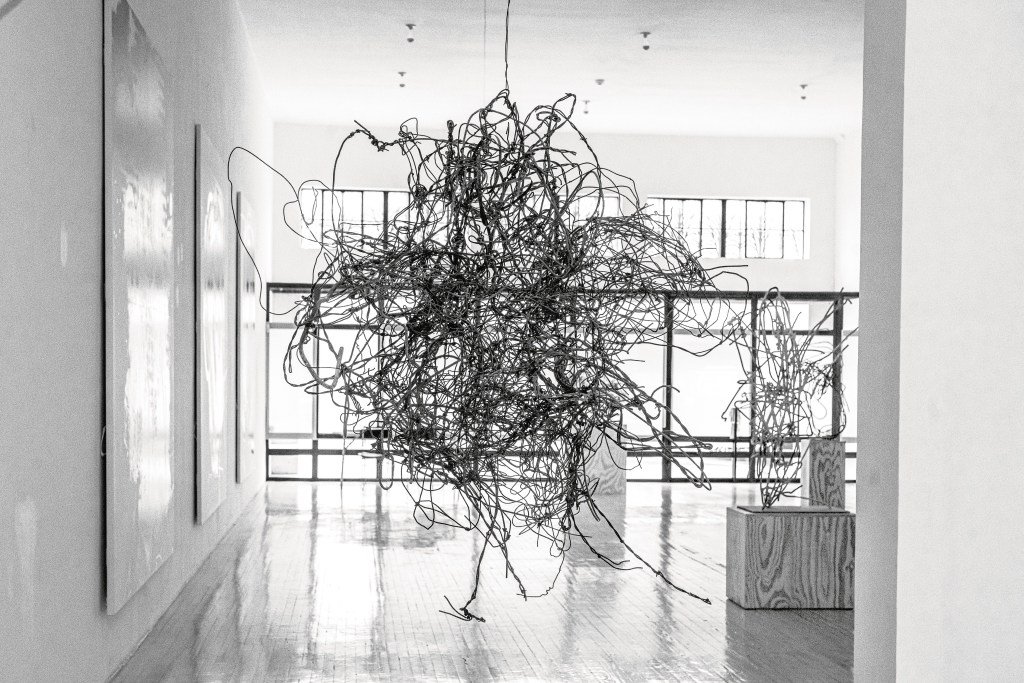
The Brite Building is less decrepit than the nineteenth floor of 101 Greenwich Street, but Wool has done little to clean up its rough edges. In a low-ceilinged space at the back of one gallery, the kinked black cable from a Wi-Fi router and the knotted pull string of a ceiling light echo the form of an adjacent hanging sculpture made from various gauges of discarded wire that Wool picked up around his property in Marfa. Wool told me that on Texan ranchland it is very common to find fencing wire bunched up and discarded on the ground. That these snarls of wire often resemble tumbleweeds is both a formal and a functional coincidence.
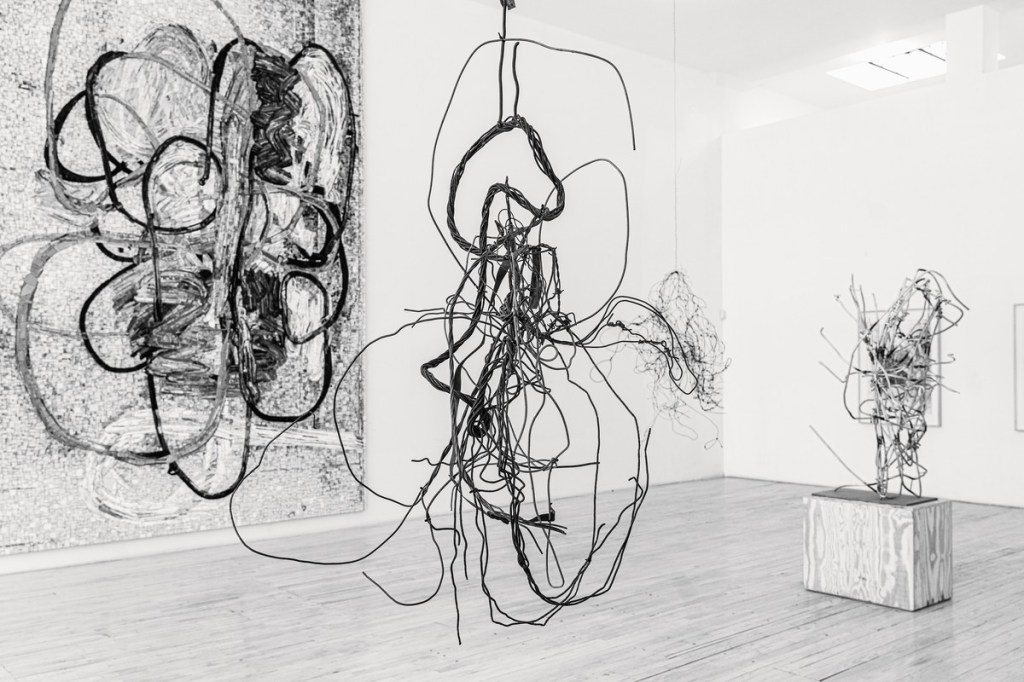
While the first pieces of wire that Wool collected were small enough to fit in one hand—ready-made sculptural compositions that required no improvement—his ambition for the works soon grew and he began to weave them together from multiple found elements. One untitled piece from 2023 at the high-ceilinged Brite Building was too tall to fit 101 Greenwich. It is an ascendant interplay of several kinds of line—including two gauges of barbed wire—that whispers in all directions at once, as if dissipating into the air around it. In this exhibition, prints, paintings, and photographs on the wall—works that themselves are usually combinations of two or more layers of mark-making or mediums—are nearly always visible through these hanging sculptures, which cast additional complex schema of linework across them.
The scope of Wool’s sculptures expanded in another direction, too. He discovered that, using new scanning technology, it was possible to digitally capture a bundle of wire and then output that scan at any scale desired as a 3D print with no loss of detail. His foundry then cast the enlargements in bronze or steel, reassembling the intricate tangles one section at a time. In the biggest of these pieces, the welded joints and the detailed numerical coding system remain visible. These acknowledgments of the labor involved in their construction contrast with the throwaway gestures that they monumentalize.
Visitors to See Stop Run at the Brite Building are directed to two additional locations a short drive away. In the overgrown yard of the Marfa Book Co.—an art-book publisher and event space—an untitled cast-steel sculpture that Wool made in 2017 rises eighteen feet above long grass and a collapsed picket fence. (Wool calls the location “the most photogenic yard west of the Mississippi.”) A few blocks in the other direction, on a dead end at the edge of town, a dark-painted, single-story log cabin sits shaded by trees. Its unfussy yard extends almost seamlessly into rangeland beyond, hemmed only by a barbed-wire fence. This is Wool’s first house in Marfa (he more recently moved closer into town, and also acquired a ranch an hour or so away in the Davis Mountains), and is the location of three large-scale outdoor sculptures.
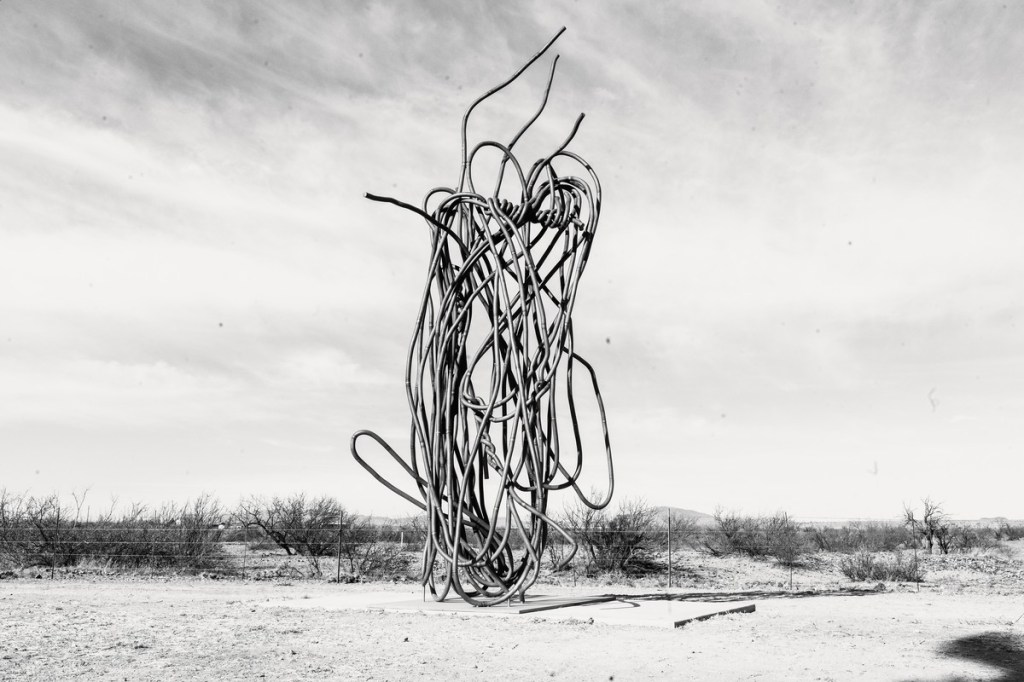
Unlike the piece at the Marfa Book Co., whose gentle, spare loops evoke (at giant proportions) Alexander Calder’s wire sculptures from the 1920s, the works in Wool’s own backyard are dense and chaotic. They twist and kink in a manner that makes no sense for such imposing, leaden objects. They sit among trees and bushes but look like nothing specific in nature, nor do they obviously refer to anything humanmade. The greatest flash of recognition that they impelled in me was when I noticed their crisp flat shadows on their pale concrete bases, as unmistakable as Christopher Wool drawings.
Wool’s early work can feel like a hard refusal of possibility, not just for painting but for American culture at large. Over the past decade his work has become more open, more accepting of light and color and happy accident and—unthinkable four decades ago—beauty. Alongside black and white, Wool now regularly includes pink in his paintings, a shade serendipitously picked up by the copper patina that his fabricators use to unify the surfaces of his cast-metal sculptures.
Here, in the expansiveness of the Texan high desert, with blue mountains hunched on the horizon and barbed wire cutting across the scrub and dirt that stretch for miles between, Wool’s sculptures make the case for remaining attentive and open to things that are very small, very large, and everything in between. They connect an artist’s scribble to a rancher’s intuitive handling of wire, a material that indelibly changed the American West and today still enforces frontiers and borders. (Marfa is forty miles, as the crow flies, from Mexico.) They relate Wool’s autographic line—the expression of his unique physiognomy, his muscle memory, and his absorption of the history of abstraction—to histories of modern industrial materials and to forms generated in the nonhuman world. They are old and they are new; they are of their time and place and they are universal. They are everything at once.
1 Donald Judd, in “Interview with Hans Keller for the television program Roerend Goed: Summer 1993,” in Donald Judd Interviews, ed. Flavin Judd and Caitlin Murray (New York: Judd Foundation and David Zwirner Books, 2019), pp. 837–38.
2 Ibid., p. 837.
3 Christopher Wool, quoted in Richard Prince, “WOOLWLOOOLOWOOWLLOWOOWOLOOLWLOOW” in Katherine Brinson, Christopher Wool, exh. cat. (New York: Solomon R. Guggenheim Foundation, 2013), p. 241.
4 See Adriane Quinlan, “Christopher Wool Turned an Empty Office into a Gallery,” Curbed, February 22, 2024. Available online at www.curbed.com/article/christopher-wool-empty-office-financial-district-101-greenwich.html(accessed October 1, 2025).
5 “A Modern Renaissance, Downtown,” 101 Greenwich building website. Available online at www.101greenwich.com/building (accessed October 1, 2025).
6 Donald Judd, “Marfa, Texas,” 1984, in Donald Judd Writings, ed. Flavin Judd and Caitlin Murray (New York: Judd Foundation and David Zwirner Books, 2016), p. 444.
First published: Gagosian Quarterly, Winter 2025
 Jonathan Griffin