Jonathan Griffin

Criticism and essays on art and culture

Category: Feature

Ruth Asawa

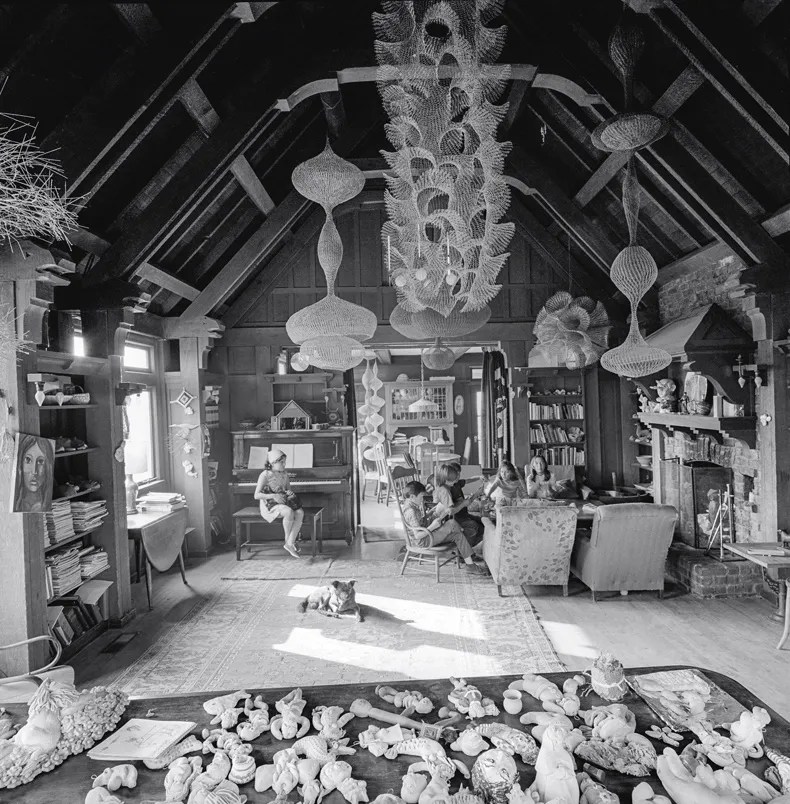
The living room of Ruth Asawa’s home in the Noe Valley neighbourhood of San Francisco, photographed by Rondal Partridge in 1969. Photo: © 2025 Rondal Partridge Archive

The black-and-white photograph shows a wood-panelled room with a pitched roof of dark redwood beams. A low table is pushed cosily up against a large brick hearth, and around it several children sit in easy chairs, one reading, others busily engaged in craft activities. At a piano, a girl strokes a cat, while a dog basks in the sunlight that slants across a large rug. This peaceful scene is the San Francisco living room of the artist Ruth Asawa (1926–2013), photographed in 1969. Asawa is nowhere to be seen, but her art is everywhere. Most conspicuous are the hanging wire sculptures for which Asawa is best known. Resembling elaborate lanterns or lighting fixtures, or biomorphic models of seed-pods or chrysalises, or complex fishing nets, or baskets, these sculptures fill the darkened space beneath the high rafters with miasmic, playful movement, catching the light as it filters through the window.

Read the rest of this entry »
Thomas Wilfred

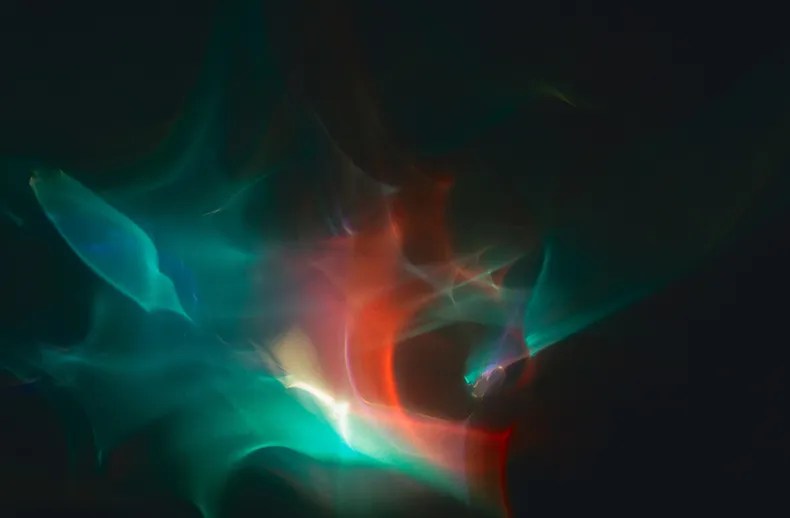
Lumia Suite, Op. 158 (1963–64), Thomas Wilfred. Museum of Modern Art, New York

Between 1964 and 1981, visitors to New York’s Museum of Modern Art (MoMA) could sit in a darkened room and contemplate opalescent wisps of colour drifting slowly across a screen. The installation, tucked in the museum’s basement, was a favourite among regulars. At times, the screen – eight feet wide and six high – was filled with diaphanous skeins of pale yellow, green, blue or pink, while at other times the light dwindled, letting most of the picture fall into darkness. It was mesmeric, unlike anything else in the museum. Unlike, probably, anything yet made in the history of humankind.

Read the rest of this entry »

Refusing Identification, Not Identity: Contemporary Positions in Abstraction

Teresa Baker, Flow (2023). Acrylic, buckskin, yarn, and artificial sinew on artificial turf, 110 × 74 inches. © Teresa Baker. Image courtesy of the artist and de boer, Los Angeles/Antwerp. Photo: Jacob Phillip.

Sometimes, you only notice something when it’s gone. In the past few months, I have become aware of the absence, in a growing number of artists’ work, of narrative—in particular, narrative about these artists’ biographies or identities. Much of this work is abstract, often purely abstract, and it seems that more and more people, myself included, are lately being drawn to this type of nonobjective and nonliteral work. Historically, abstraction in visual art developed along two parallel avenues: the distortion of things seen in the world (Paul Cézanne, Pablo Picasso) and the invention of entirely nonobjective forms (Kazimir Malevich, Wassily Kandinsky, Hilma af Klint). The contemporary work I have been noticing is, by and large, aligned with the latter stream of abstraction. In something of a departure from the dominance of identity-centered figuration in recent years, much contemporary abstraction is being made by artists of color who are resistant to foregrounding their identities through narrative. As mixed-media artist Teresa Baker described her abstract paintings to me, she noted that it is work that “should speak for itself. I shouldn’t have to give words to it.” Her position is echoed by Rema Ghuloum, a painter based in Los Angeles, who told me: “I really want the work to speak for itself.”

Read the rest of this entry »

Ei Arakawa

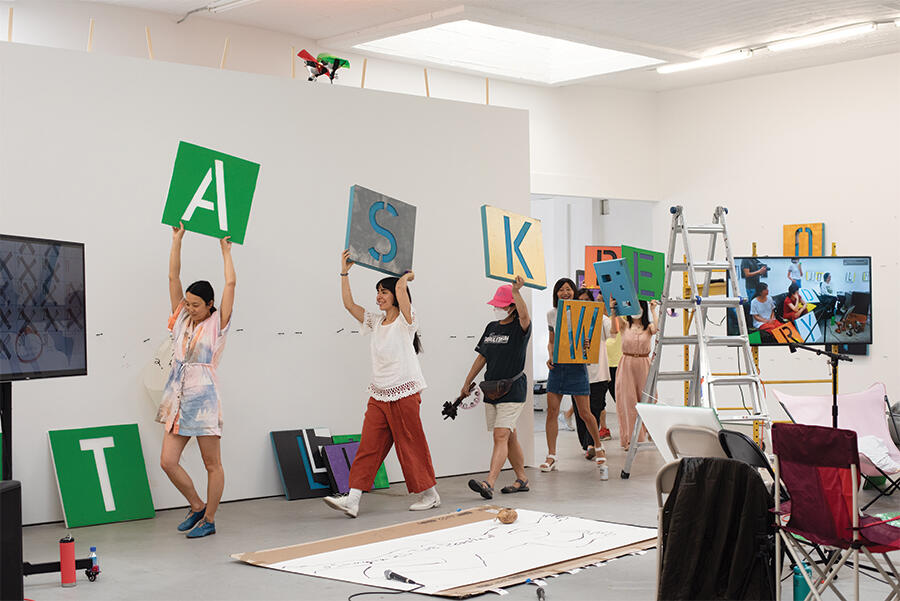
Ei Arakawa, GET BACK / GET OUT, 2022, performance view. Courtesy: the artist; photograph: Roxie Fuller

A confession: the last time Ei Arakawa performed in Los Angeles, I was out of town. I had it in my diary, but when I realized I couldn’t make it, I wasn’t particularly upset. Besides the event’s title – GET BACK / GET OUT – and the scheduled date, 9 April 2022, the email from the artist’s gallery, Reena Spaulings Fine Art, had offered scant details of what to expect. One piece of information stood out: ‘2 – 6pm (open rehearsals and performance)’. The performance, it seemed, would not be differentiated from its rehearsal. I’d attended too many proudly shambolic, deskilled art performances before, I thought, and I wasn’t so sad to miss another. I was wrong.

Read the rest of this entry »

Bernice Bing

A Lady and a Road Map, 1962, by Bernice Bing (American, 1936– 1998). Oil on canvas. Asian Art Museum of San Francisco, Museum purchase, 2020.26. © Estate of the Artist. Photograph © Asian Art Museum of San Francisco.

Once upon a time, everybody knew Bingo. In San Francisco in the 1970s, it’s said she couldn’t walk down the street in North Beach or Chinatown without someone calling out her name. Bernice Bing, the statuesque artist known to most as Bingo, was easy to spot in her sharp zoot suits, boots and jet-black hair. She was born in Chinatown in 1936; when it became the heart of the Beat movement in the 1950s, she found herself at the centre of a community that was not only wildly hedonistic but also close-knit, pluralistic, non-judgemental, socially progressive and spiritually visionary. Later, she worked with at-risk youth in the area, including gang members whom she persuaded to take part in art workshops. She helped found the South of Market Cultural Center (SOMAR, now known as SOMArts), which she ran in the 1980s. Why, then, is Bing – who died in 1998 – so little known today?

Read the rest of this entry »

Faith Ringgold

American People Series #20: Die (1967), Faith Ringgold. Museum of Modern Art, New York. © Faith Ringgold

When the Museum of Modern Art in New York reinstalled its collection in 2019, amid widespread critical acclaim for the institution’s revisionist canon, one pairing in particular hit the headlines: Faith Ringgold’s American People Series #20: Die (1967) hanging next to Pablo Picasso’s Les Demoiselles d’Avignon (1907).

Read the rest of this entry »

Buck Ellison

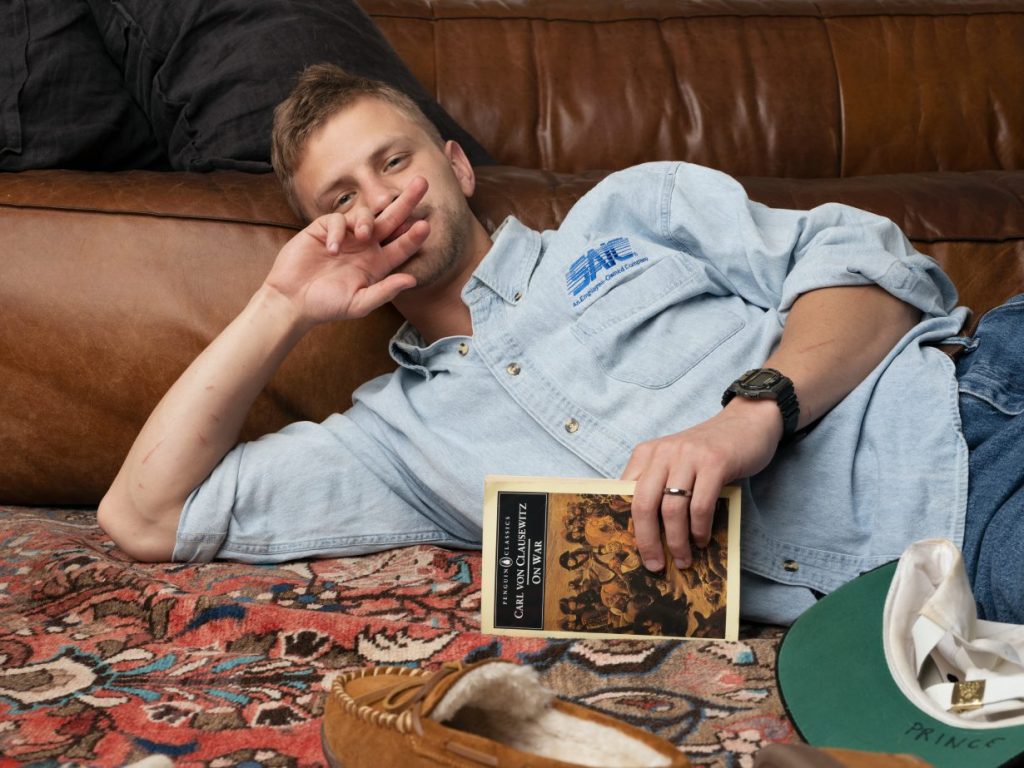
‘Rain in Rifle Season, Distributions from Split-Interest Trusts, Price Includes Uniform, Never Hit Soft, 2003’, 2021, archival pigment print, 102 × 135 cm. All images courtesy of the artist

The handsome blonde man in the photograph reclines on a wrinkled Persian rug, an arm’s length from the camera. His smiling eyes gaze fondly into ours. Maybe he’s about to say something. But what?

Read the rest of this entry »

Ben Sakoguchi

Detail from ‘Towers’, 2014, © Courtesy the artist/Bel Ami

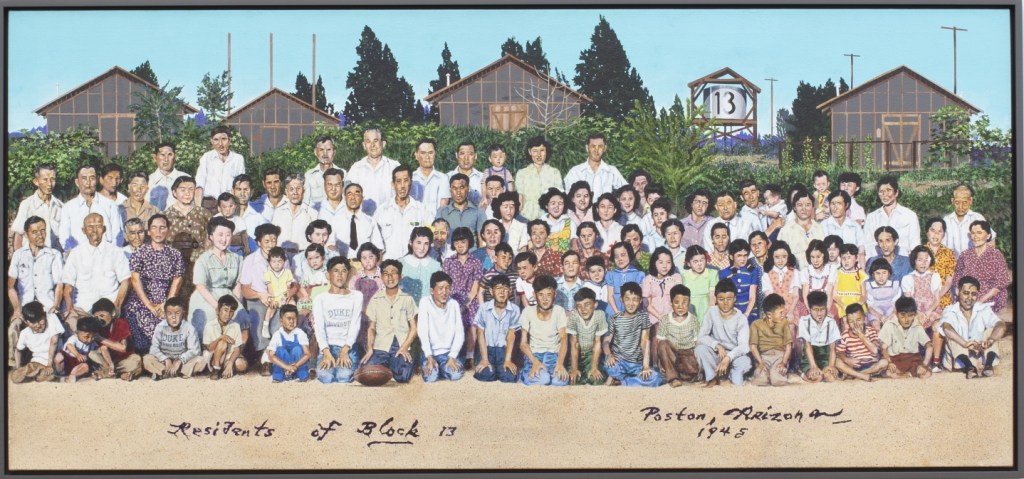
“Pop & me in front of our brand new grocery store,” reads the inscription on a small acrylic painting, part of Ben Sakoguchi’s multi-panel “Postcards from Camp” (1999-2001). In the picture, a man in a long white apron holds a toddler in front of a neat shopfront underneath the date of the scene, 1940, and the ominous words “Before camp . . . ”

Read the rest of this entry »

Ulysses Jenkins

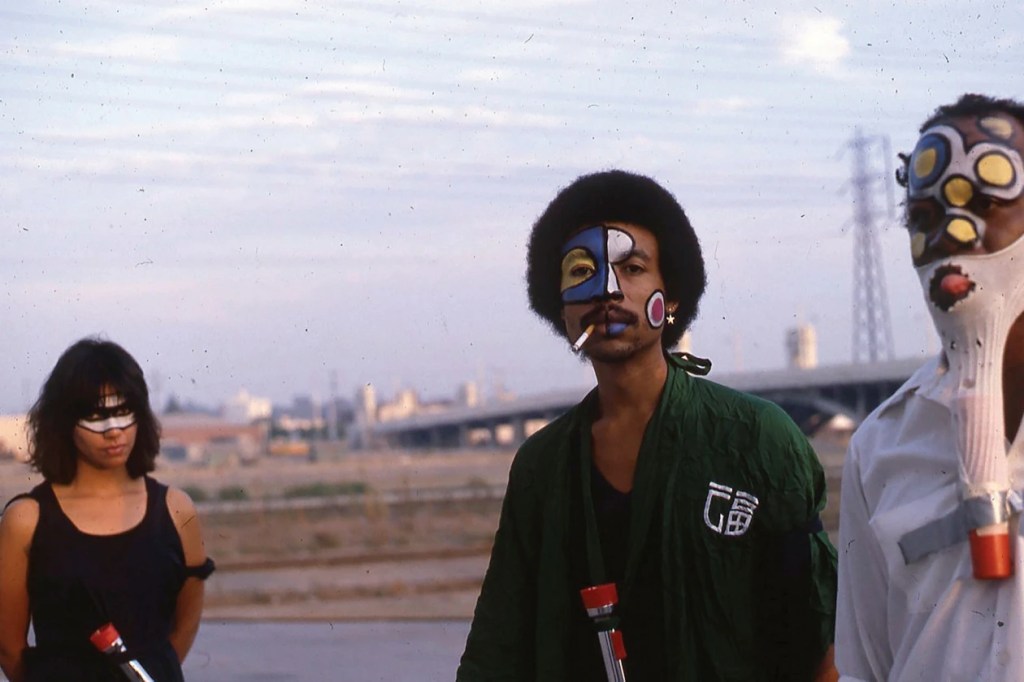
A photo taken during a rehearsal for Ulysses Jenkins’s ‘Without Your Interpretation’ (1984) © Courtesy the artist

In the early 1970s, a young muralist named Ulysses Jenkins was encouraged by a friend to come down to the boardwalk in Venice, Los Angeles, to check out a videomaking workshop. The Sony Portapak — the first portable consumer video camera — had come on to the market in the late 1960s and was still very expensive. New owners often ran workshops, renting out their equipment to try to recoup some of their costs.

Read the rest of this entry »

Howardena Pindell

Howardena Pindell, Untitled #100, 1979, Mixed media on board, 13 1/2 x 10 1/2 inches, Courtesy: Garth Greenan, New York

Many – if not all – artists eventually acquire origin stories, formative experiences to which all their subsequent artistic achievements can plausibly be traced. Tony Smith had his night-time drive on the unfinished New Jersey Turnpike; Louise Bourgeois had her father’s affair; Andy Warhol had his time drawing ads for shoes. Such stories become more meaningful as they recede in time, ossifying with use and reuse.

Read the rest of this entry »