Jonathan Griffin

Criticism and essays on art and culture

Category: Feature

Fluid Nature

This slideshow requires JavaScript.

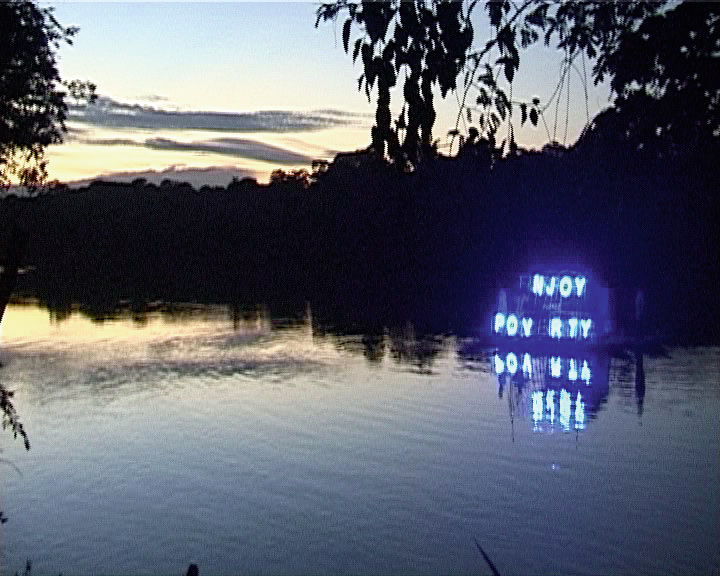
Los Angeles is a city that prefers to be pictured than encountered face to face. Its streets are a ceaseless Babel of disagreeing voices and signs, but, seen from any of the hills that overlook the expansive valley basin, its disparate neighbourhoods knit together into an intricate blanket, still and quiet. Particularly at night, this panorama confirms diverse L.A. archetypes: the technological Sublime, the suburban sprawl, or the majestic, multi-ethnic metropolis. Even the ocean, which laps the city’s southwest edge, is itself a picture – a dry backdrop that, with the aid of a setting sun and some silhouetted palm trees, instantly flattens into a postcard or a t-shirt. Few ever venture onto the water in order to look back at the land.
Read the rest of this entry »

Atrocity Exhibition

Contemporary art and cruelty from Renzo Martens in the Congo to Adel Abdessemed in the slaughterhouse

Renzo Martens, Episode III (2009)

In 1976, a New York-based group calling themselves Artists Meeting for Cultural Change distributed posters with the headline ‘ARTISTS UNITE!’. They were protesting against the selection of artists in an exhibition titled ‘Three Centuries of American Art’; ‘STOP RACISM & SEXISM’ the poster demanded. Why is it so hard to imagine artists galvanising themselves into equivalently forthright activism today? Not only have most contemporary artists lost faith in the potential of art to effect social or political change, a significant number are actually responding to our current moment by deliberately increasing the total sum of human misery. Cruelty, it seems, has become an artistic position. How exactly did this come about?

Read the rest of this entry »

Ian Kiaer

From Room to Room


Part of Ian Kiaer’s installation Endless House Project: Ulchiro Endnote / Pink (2008) consists of a paper and matchstick construction small enough to fit in the palm of your hand. It resembles a building of some kind; if not a conventional house then perhaps a shop or a commercial premises, with an upper level that juts out over the ground. Most of its walls are created from rectangular images, each one a cell cut from a Manga comic strip, each one joined to its neighbour by way of scarified globs and hairy tendrils of glue, dispensed, it appears, via a hot-melt glue gun.

Read the rest of this entry »

Cyprien Gaillard

New Romantic

Paris-born, Berlin-based artist Cyprien Gaillard could be described as an archaeologist of recent history. In his films, photographs, collages, sculptures and performances, the Sublime sits alongside the profane, and brutality is underscored by moments of quiet beauty.

Jonathan Griffin: Where is wilderness today and how do you value it?

Cyprien Gaillard: My father was a fly fisherman. He would take me on trips to a river in Oregon, and I would spend my time looking for a parking lot or road so I could skateboard. I think my early relationship to architecture was informed by that.

Read the rest of this entry »

Pietro Roccasalva

Through the Looking Glass

Pietro Roccasalva says he doesn’t believe in chronologies, at least not where his work is concerned; every image or idea that arises is the reflection of another that came just before it or a premonition of one to follow. He likes to think of his oeuvre as ready-formed – a magnificent hall of mirrors.

Read the rest of this entry »

Group Material

Arroz con Mango (What a Mess)

Frustrated by what they saw as the conservatism of the flourishing art market at the start of the 1980s, a group of New York artists chose to work collaboratively on projects ‘dedicated to social communication and political change’. Despite numerous arguments, resignations and changes of direction over their 16-year history, Group Material made a body of work that continues to be influential and inspirational for a younger generation of artists and curators.

Read the rest of this entry »

Eric Bainbridge

Tales of Everyday Madness

I worried for weeks about where to meet Eric Bainbridge. I envisaged talking to him in surroundings that are significant for him and his work, somewhere that might lead our conversation in unexpected but fruitful directions. Should I travel up to Hartlepool, the town in the north-east shoulder of England near where he was raised, and where he now lives for part of the week in a cottage by the sea? Or would it be better to visit the art school in nearby Sunderland, where he has taught for the past nine years, and where his office currently doubles as a studio, allowing cups of tea and tangerines to drift into his sculptural combinations? When this became too complicated to arrange, I considered something closer to home: a trawl through London’s second hand shops, where I imagine he finds much of his raw material, or a trip to an out of town D.I.Y. store (it turns out that Greg Hilty already had this idea for an essay he wrote on Bainbridge’s work in 1990).1 Perhaps a market would be appropriate, or, given his interest in the global circulation of goods, a spot out on the Thames estuary where we could watch cargo ships dock and unstack their coloured metal containers. Read the rest of this entry »

Matthew Monahan

A tour across the aesthetic landscape of Matthew Monahan’s figurative sculptures, prints and drawings would make stops in the caves of Lascaux, at archaeological digs in peat bogs, sealed tombs of ancient Egypt and Babylon, Easter Island and the temples of Greek and Roman antiquity – not to mention contemporary Japan, Amsterdam, China and Los Angeles. Read the rest of this entry »

Marcus Coates

‘Why do cats understand what you say?’ ‘Where does hair go when you go bald?’ ‘How can the city control illegal bicycle parking?’ These are just some of the questions that Marcus Coates has attempted to answer by descending into the ‘lower world’ and consulting the birds and animals that he encounters there. Usually they respond in cryptic clues; uncharacteristic behaviour is what he is looking out for, which he then does his best to interpret for his audience on his return. Read the rest of this entry »