Jonathan Griffin

Criticism and essays on art and culture

Category: Review

Support Group

Cottage Home, Los Angeles

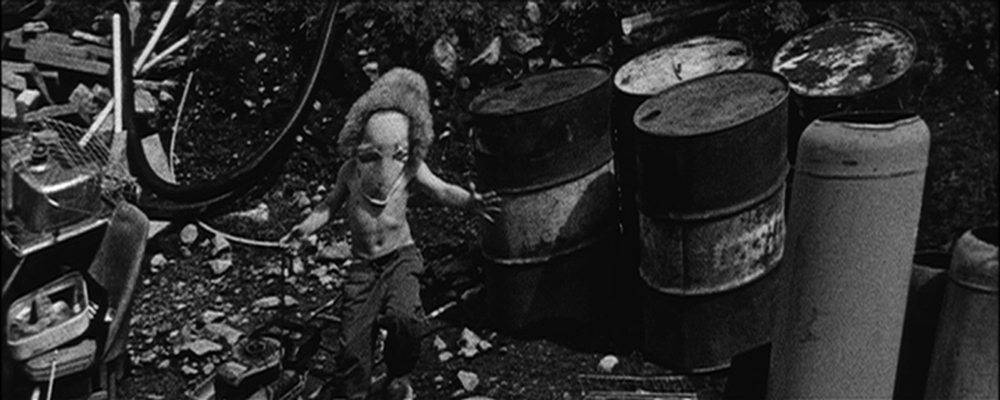
‘it’s all about …’ trilled the perky, lower case script, ‘gaylen gerber!’. The text ran across two billboards affixed to the exterior of Cottage Home, the former cinema that has served as a project space for three commercial galleries: Kathryn Brennan Gallery, China Art Objects and Thomas Solomon Gallery. For what it’s worth, ‘Support Group’ took place at the instigation of the latter, although Solomon’s contribution seems to have been limited to inviting critic Michael Ned Holte to curate the show, which featured none of Solomon’s gallery artists. This was just the first sequence in a complicated game of authorial ‘pass the parcel’, in which no one, it seemed, quite knew who would be the one with the package in their hands when the music stopped.

Read the rest of this entry »

Bob Law


Karsten Schubert and Thomas Dane Gallery, LondonIn 1959, Bob Law lay in a Cornish field and wondered how to describe the space he was in. His solution was a series of drawings in which figurative elements – such as trees or houses – are arranged along a doddery pencil line at the perimeter of the paper. A year later, Law had distilled this approach to his signature device: the rectangular perimeter alone, bounding empty space, sometimes accompanied by a date, a title or his name, always in block capitals. Read the rest of this entry »

Duncan Campbell

Chisenhale Gallery, London

I might as well park it out front: to most people, the name DeLorean will forever be linked to time travel- specifically to the car modified for that purpose by ‘Doc’ Brown in the Back to the Future films (1985–1990). In Duncan Campbell’s film Make It New John (2009), we travel back to the late 1970s, when flamboyant American motor industry supremo John DeLorean elected to manufacture his new company’s only car – the DMC-12 — in West Belfast.

Read the rest of this entry »

Ben Rivers


A Foundation, Liverpool, UK

Ben Rivers makes films about latter-day hermits and pioneers – usually men – who have chosen to exist at an ideological and geographical remove from the rest of society. The London-based artist journeys into the depths of private, imperfect, perhaps misguided but defiantly hopeful worlds. His use of a wind-up Bolex camera and hand-processed film seems not just to be a matter of interpretation, but the only appropriate response to the jerry-rigged and hamstrung lifestyles he is permitted to witness. Read the rest of this entry »

Nasreen Mohamedi

Milton Keynes Gallery, UK

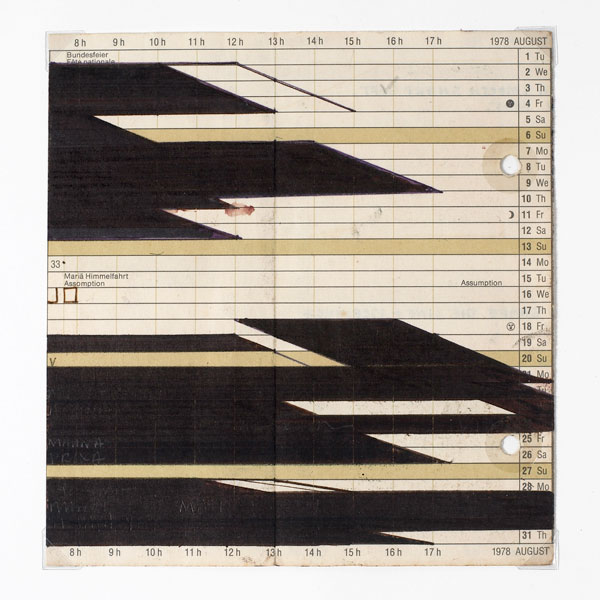
The only dated works in the exhibition ‘Nasreen Mohamedi: Notes’ at Milton Keynes Gallery are the four pages cut from the artist’s diaries. On Friday 3 December 1971, Mohamedi records: ‘EVE BLACKOUT. WAR BEGINS.’ The words are, however, nearly obscured by the page’s ornamention: over the top of the capital letters are tight rows of ruled pencil lines, occasionally punctuated by coin-sized discs of black ink and filled-in rectangles.

Read the rest of this entry »

Trisha Donnelly

Modern Art Oxford

A sign insisted that access to Trisha Donnelly’s exhibition at Modern Art Oxford was gained via the museum’s front stairs; the three spaces that the show inhabited were clearly intended to be experienced in sequence. An optimist might therefore have expected an unfolding narrative, a progression of scenes, or an installation that, in having a front, a best side, signals awareness of the viewer who stands before it. Instead, the untitled installation of diverse objects that filled the galleries hovered uneasily at the edges of the rooms or in corners, like shy children pushed reluctantly into a party.

Read the rest of this entry »

Alina Szapocznikow

Broadway 1602, New York

While it can be a lazy writer’s crutch to defer too readily to biography, the course of Polish artist Alina Szapocznikow’s extraordinary and painful life is integral to understanding her awkward, restlessly experimental and often darkly hilarious art. A potted history of her life would include the early deaths of her father and brother, her imprisonment during World War II in Auschwitz, Bergen-Belsen and Theresienstadt, her studies in art schools in Prague and Paris after the war and finally her tragic death from breast cancer at the age of 47 in 1973. Read the rest of this entry »