Jonathan Griffin

Criticism and essays on art and culture

Category: Review

K.r.m. Mooney

Reserve Ames, Los Angeles

_MG_28903

Since it is impossible to say—in the work of K.r.m. Mooney just as in the world—where one thing ends and another begins, it seems appropriate to start by considering the structure that houses this exhibition. An ancient wooden shed, it was once a garage for the large Craftsman home it sits behind, built in 1906. Wide sliding barn-like doors open onto patched timber walls and a cracked concrete floor stained from years of dripping motor oil. Weeds sprout through some of the cracks and papery pink bougainvillea petals blow in from the garden. As a concession to the aesthetic formalities of the white cube, a pristine white rectangle of wall divides the front gallery from the storage area behind. Read the rest of this entry »

Made in L.A.: a, the, though, only

Hammer Museum, Los Angeles

IMG_6644

Huguette Caland, installation view, Hammer Museum, Los Angeles. Photograph: Jonathan Griffin

One of the best things about ‘Made in L.A. 2016: a, the, though, only’, is that – title notwithstanding – it is quite possible to forget that the work in the exhibition was made in LA. Now in its third edition, the biennial is still finding its purpose, torn as it is in different directions. Tasked with showcasing emerging and under-recognized artists, each iteration’s curators are widely expected to reflect back at the city an image of itself that is, at once, recognizably authentic but also unfamiliar, transcendent and subjective. Read the rest of this entry »

Elaine Cameron-Weir

Venus, Los Angeles

12-snakewithsexualinterestinowntail_ECWE015_install_hr

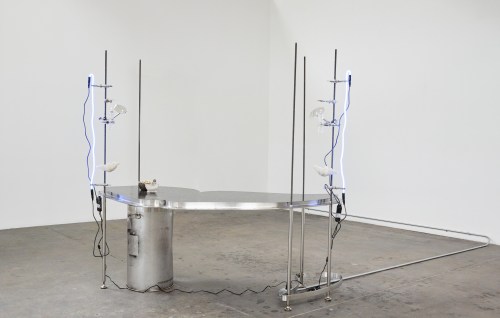
The 14,500 square-foot former warehouse occupied by Venus, two blocks east of the Los Angeles River, is one of the largest spaces for showing art in the city. For certain artists, it must seem problematically vast. Earlier this year, Marianne Vitale responded to the building’s challenge by filling it with 60 tonnes of railway track and stacks of massive pine posts. The fine sculptures of Elaine Cameron-Weir, however, typically operate at the level of the jeweller’s worktable or the scientist’s lab bench. Her exhibition Snake With Sexual Interest in Own Tail could be read as an essay on the elasticity of our perception of scale. Surprisingly, in this outsize building, it worked. Read the rest of this entry »

Walk Artisanal

3716 Eagle Rock Boulevard

mastersxfrontx001xRVDx0920xjpg.1800

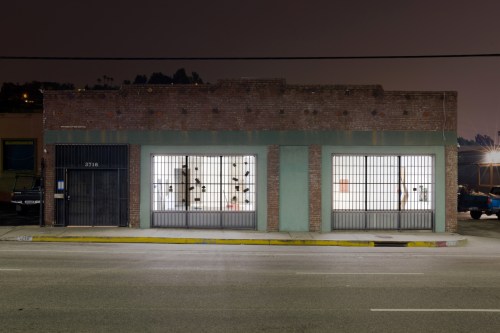
It’s no secret that the eastside of Los Angeles is gentrifying fast, and that most of us in the contemporary art community wring our hands in weak perplexity over the part that we play in the process. Nevertheless, many residents of Glassell Park were happy to see a new coffee shop open on Eagle Rock Boulevard in early 2015. Yelp reviewers have approved of the “clean and creative atmosphere.” (“Super chill place and the quality of people is very high as well,” wrote Anthony E.) Notwithstanding the “rude” servers, the clientele seems broadly to approve of the new establishment. Read the rest of this entry »

The Ocular Bowl

Kayne Griffin Corcoran Gallery, Los Angeles

2556_large

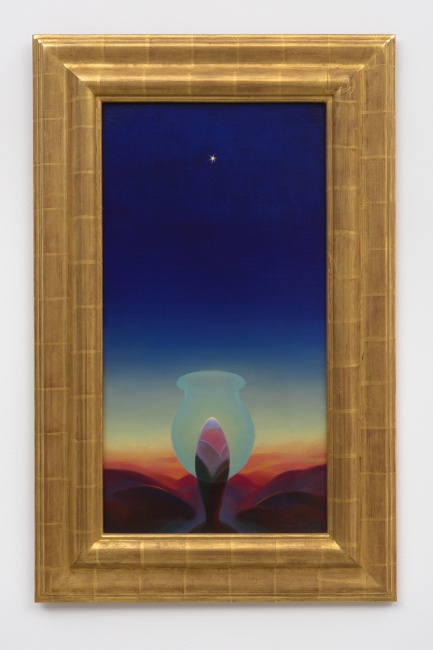
Agnes Pelton, Star Gazer, 1929

The eye, wrote Jacques Lacan in his essay ‘The Line and the Light’, ‘is a sort of bowl’ which light is wont to overflow. ‘A whole series of organs, mechanisms, defences’arerequired to deal with this excess; the shrinking pupil, in bright conditions, ‘has to protect what takes place at the bottom of the bowl.’ Read the rest of this entry »

Evan Holloway

David Kordansky Gallery, Los Angeles

EH-15-022g

It is possible to argue—and, indeed, I heard it argued while visiting this exhibition—that Evan Holloway belongs to the first generation of artists in Los Angeles that did not look outside of California, to New York or to Europe, to define their work, whether through aspiration or through contradistinction. If that sounds like hyperbole, it may not be as far-fetched as it initially seems. In any case, it is undeniable that in the late 1990s, a loose group of L.A. artists—including Holloway, Liz Craft, Jason Meadows, Jeff Ono and Kristin Calabrese—emerged with a distinctly homegrown vernacular. Read the rest of this entry »

Amy Yao

Various Small Fires, Los Angeles

Yo

Every day, about US$1.2 billion worth of cargo flows in and out of the Port of Los Angeles. It is the busiest container port in the US, seconded by the Port of Long Beach, which directly adjoins it. Amy Yao, whose studio is situated near the ports, has to contend with queues of thundering lorries every time she drives to work. Some of their cargo found its way, circuitously, into her exhibition ‘Bay of Smokes’, as indeed it probably does into most exhibitions by most artists in the country. Read the rest of this entry »

Diana Thater

Los Angeles County Museum of Art

img-thater_121518380324.jpg_x_1600x1200

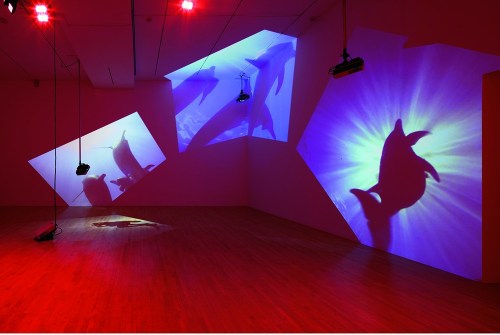
In Diana Thater’s survey “The Sympathetic Imagination,” organized by the National Gallery’s Lynne Cooke and LACMA’s Christine Y. Kim and gathering work made between 1992 and the present, the artist floods many of her exhibition spaces with colored light. This technique and its philosophical implications may remind visitors of James Turrell’s use of light in his 2013-14 LACMA retrospective. Color is fundamentally illusory;  it is humans who make the sky blue, thanks to the cones in our retinas. Further, in an environment saturated with blue light, every other perceptible color is revealed to be contingent. The absolute purity of nature is impossible, Thater shows; all is culture, or something between nature and culture. Read the rest of this entry »

Martin Kersels

Redling Fine Art, Los Angeles

Barry-Manilow

Brown furniture, they call it. It’s the stuff that nobody wants: wooden wardrobes, dining tables and armoires, too bulky for the contemporary home, once family heirlooms but now superseded by disposable Ikea furniture. When an artist needs some wood, the source closest at hand is usually not the lumberyard but the thrift store. Read the rest of this entry »

Frances Stark

Hammer Museum, Los Angeles

Frances Stark 2010_-_Pull_After_Push

I don’t believe it is cruel or unfair to say that a museum is probably not the natural home for Frances Stark’s work. The artworks that she has made over the past 24 years (the timespan covered by this retrospective) are many things – epistolary, diaristic, notational, self-referential, accretive, serial, slapdash, intricate – but they are not, in the main, the kinds of forms that museums are traditionally built to house. Read the rest of this entry »