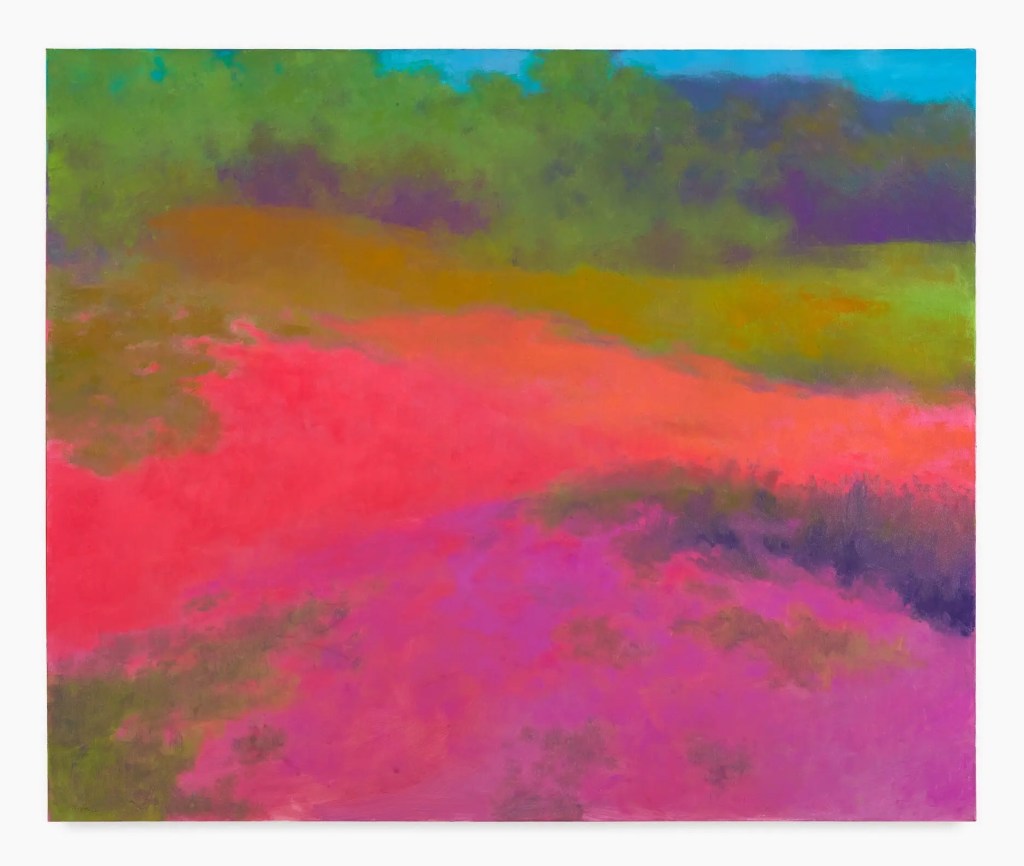
Pamela’s Aura, 2004, Courtesy Richard Mayhew and Venus Over Manhattan, New York
The painter Richard Mayhew, who recently celebrated his 99th birthday, has lived through as broad a swath of this nation’s history as anyone you might hope to meet.
Sitting at a patio table outside his cedar-shingled suburban home in Soquel, near Santa Cruz, Mayhew leaned back in his chair and reflected on his long life.
“I drove across the United States six times,” he said. “Three over, and three back, from New York to San Francisco. I was always looking.”
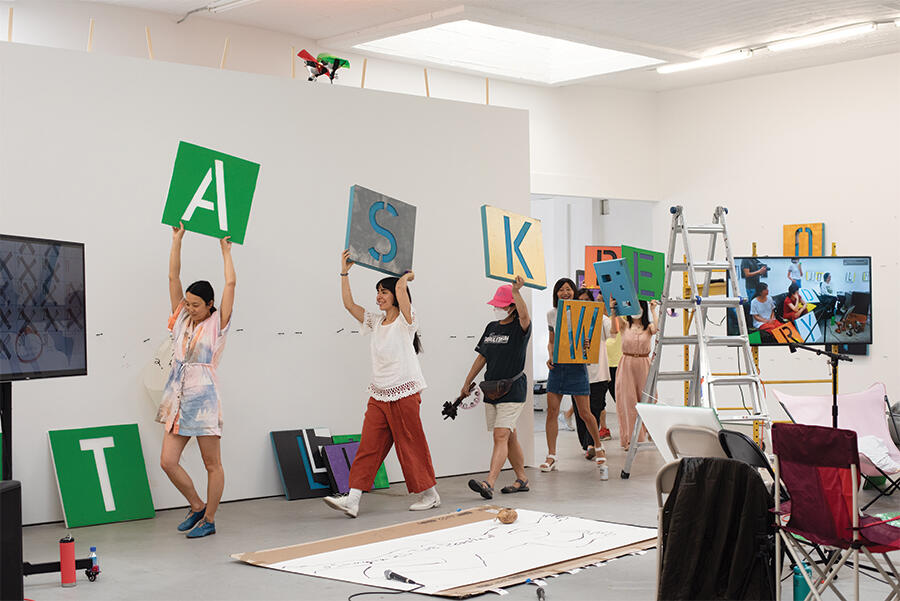
Ei Arakawa, GET BACK / GET OUT, 2022, performance view. Courtesy: the artist; photograph: Roxie Fuller
A confession: the last time Ei Arakawa performed in Los Angeles, I was out of town. I had it in my diary, but when I realized I couldn’t make it, I wasn’t particularly upset. Besides the event’s title – GET BACK / GET OUT – and the scheduled date, 9 April 2022, the email from the artist’s gallery, Reena Spaulings Fine Art, had offered scant details of what to expect. One piece of information stood out: ‘2 – 6pm (open rehearsals and performance)’. The performance, it seemed, would not be differentiated from its rehearsal. I’d attended too many proudly shambolic, deskilled art performances before, I thought, and I wasn’t so sad to miss another. I was wrong.
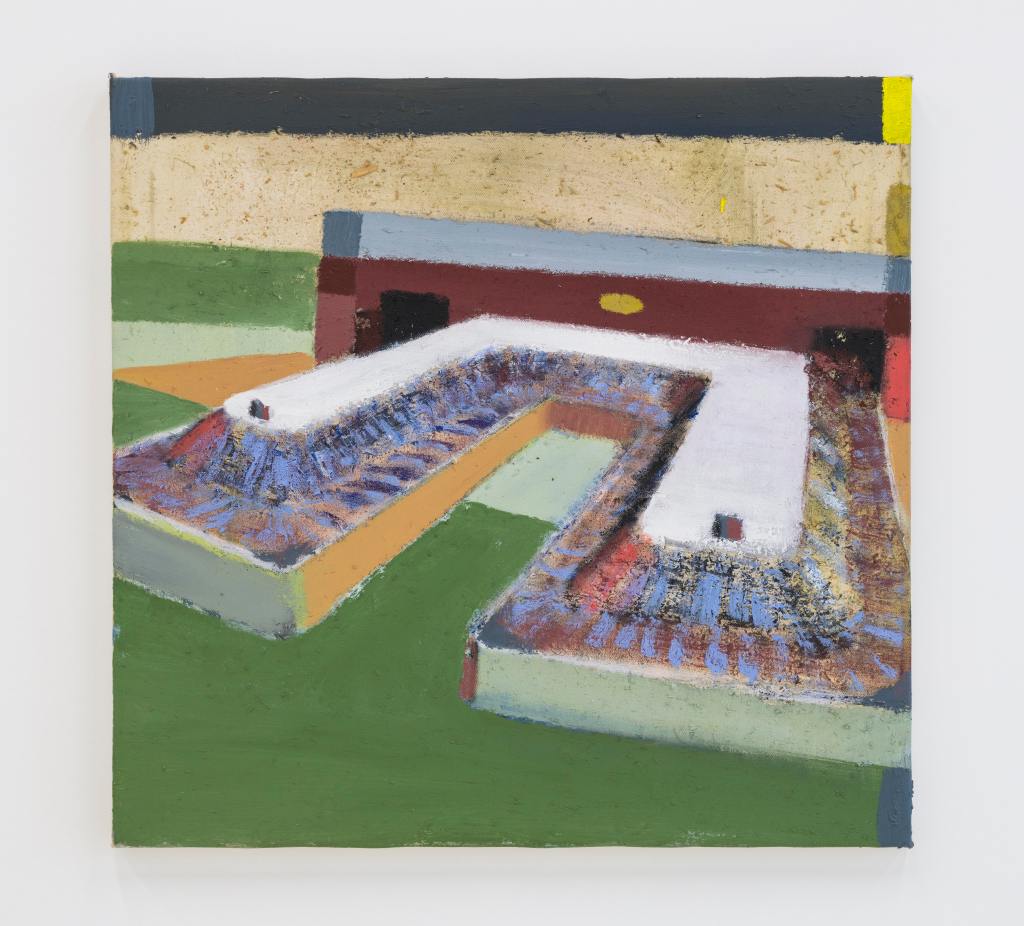
Merlin James, Arrivals, 2007-08. Acrylic and mixed materials on canvas, 25 5/8 x 26 5/8 inches. Image courtesy Sikkema Jenkins & Co, New York, Chris Sharp Gallery, Los Angeles, and the artist
My attention is more or less guaranteed by any exhibition that offers, within the initial sweep of its first gallery, a painting of an airport luggage carousel; a near-monochrome canvas, composed from grubby, rectilinear sections; a close-up picture of a blowjob; and a boisterous abstraction incorporating a tail-wagging dog and a swipe of glitter.
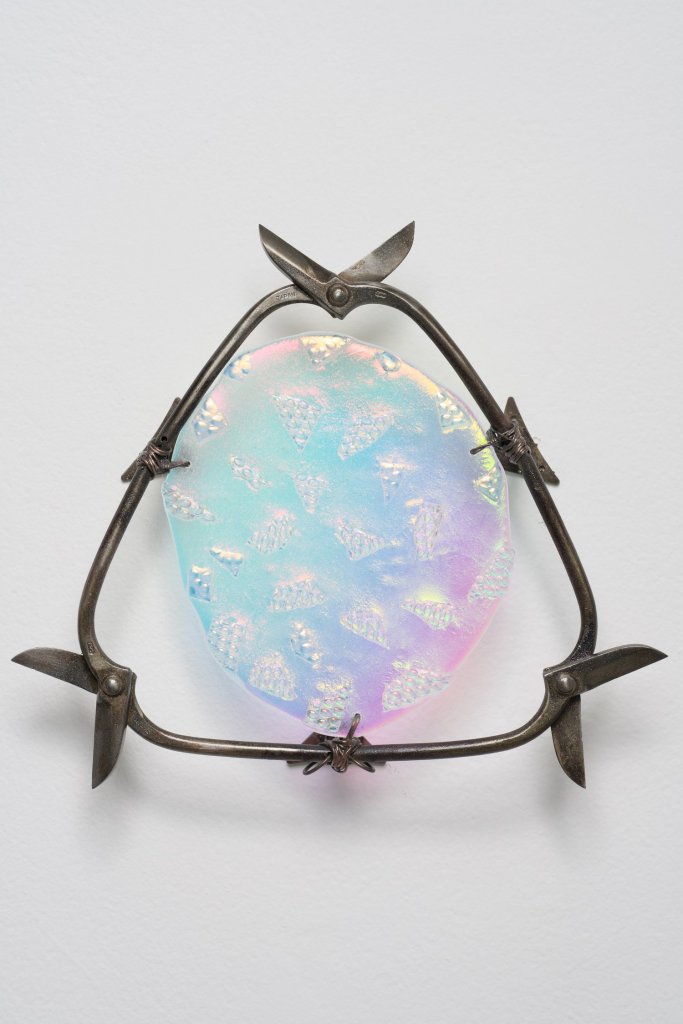
noé olivas, Prayers of Protection (2023) Garden shears, cooper, dichroic glass, metal 12 x 13 x 2 1/4 inches. Courtesy: noé olivas and Charlie James Gallery, Los Angeles; Photo by Yubo Dong/ofstudio
At the Charlie James Gallery, in the Chinatown neighborhood here, a surprising exhibition of spiritually reflective and esoteric artwork opened recently. Surprising because the artists, Patrisse Cullors and noé olivas, are known for their activism and social engagement, and because the works in the show, “Freedom Portals,” reject the strident, declamatory tenor of much political art.
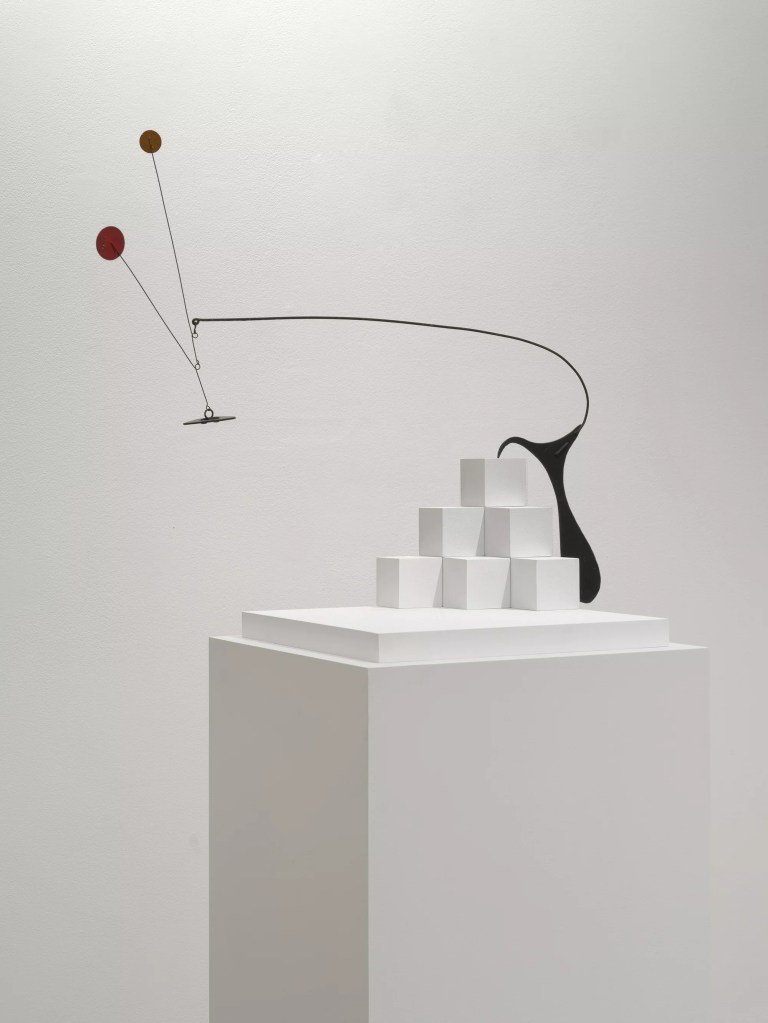
Richard Tuttle’s work in sculpture, drawing, installation and poetry is delicate and attenuated, rarely exceeding the bounds of carefully measured economy. Subtlety and ambivalence have long defined his oeuvre. This month in Los Angeles, however, he is the architect of something close to a grandiose gesture. ‘Calder/Tuttle: Tentative’ spans two neighbouring galleries, David Kordansky Gallery and Pace Gallery, and platforms a conversation between two artists and two bodies of work, over eight decades apart.
Don Bachardy in his studio in Santa Monica, November 2022. Courtesy: Chad Unger
Beyond the French windows in Don Bachardy’s Santa Monica portrait studio, a canyon studded with white-painted houses, palm trees, pines and eucalyptus tumbles down to the gleaming blue Pacific Ocean. It’s the kind of view that epitomizes visitors’ fantasies of Los Angeles, but which people who live here seldom get to enjoy firsthand, and certainly not on a daily basis.
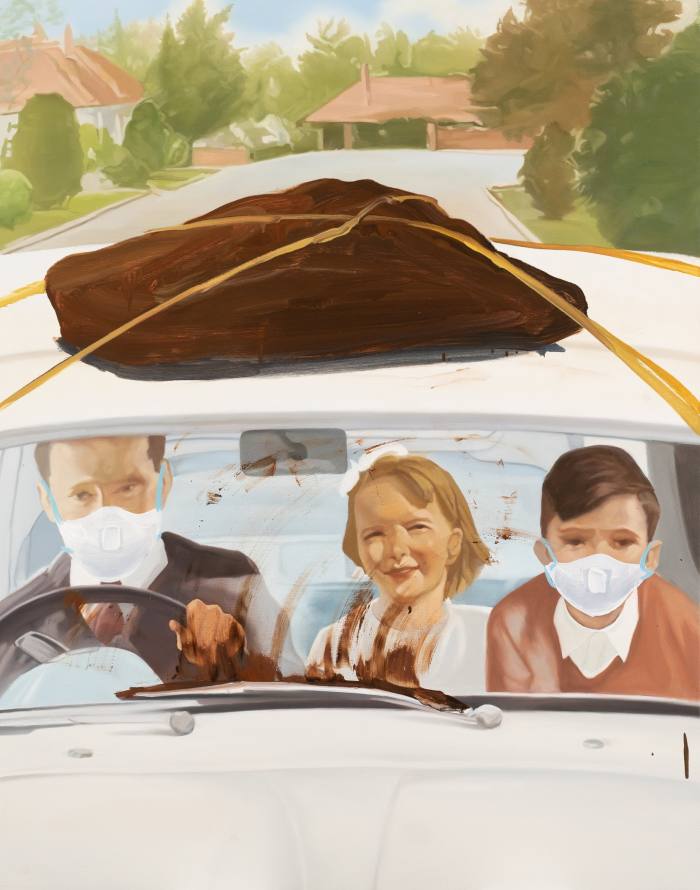
Tala Madani, who was born in 1981 in Tehran but now lives in LA, has been exhibiting her outrageously funny, politically caustic paintings and animations since the mid-2000s. She has long shown herself to be a deeply skilful painter, even virtuosic, as visitors to her mid-career survey Biscuits at the Museum of Contemporary Art, Los Angeles can judge, although her ability sometimes manifests in surprising ways. She has established herself as a master of the faecal smear, just as she is adept at painting the prismatic effects of projected light.
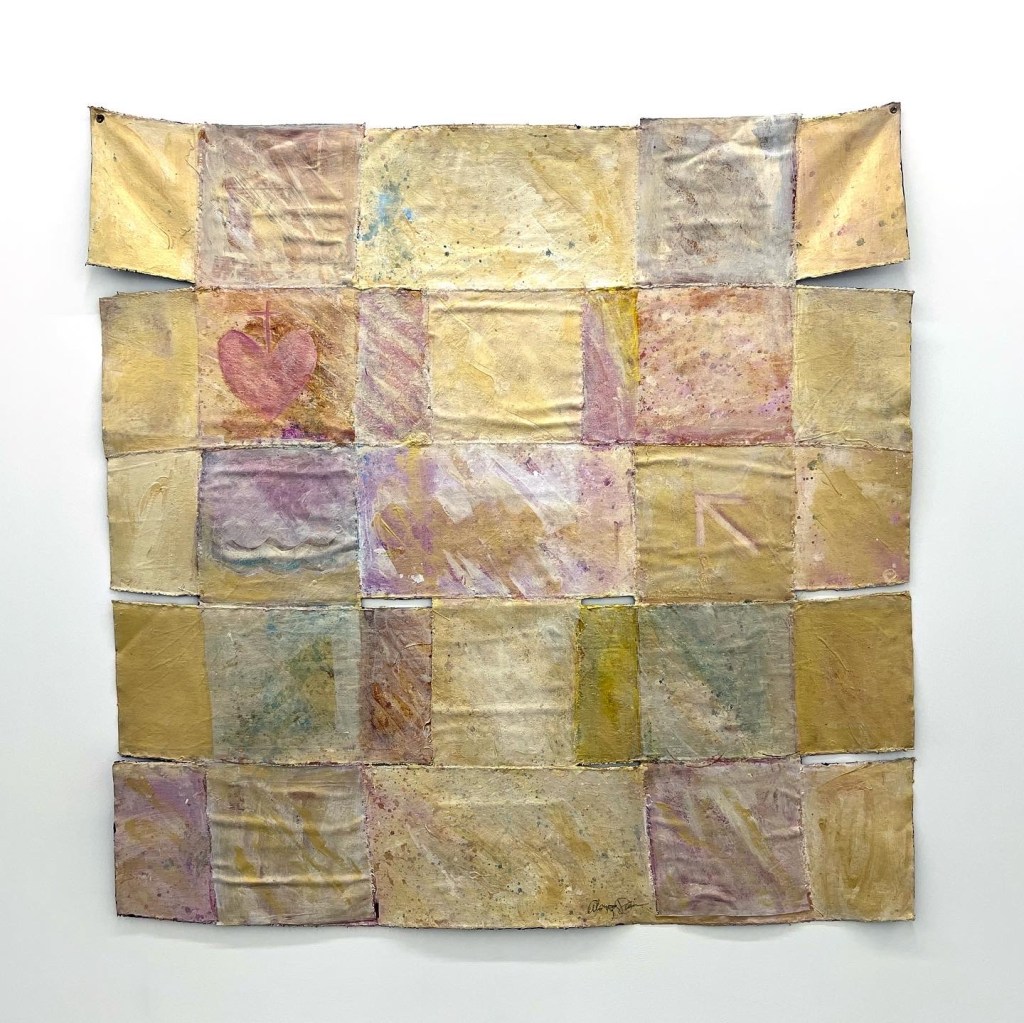
Alonzo Davis, King’s Peace Cloth, 1985, acrylic on woven canvas, 1.4 × 1.4 m. Courtesy: the artist and Parrasch Heijnen, Los Angeles
If you had dipped even a toe in the Black art world of 1970s and ’80s Los Angeles, you would have known the Brockman Gallery. Opened in 1967 by artist brothers Alonzo and Dale Davis, it occupied a storefront in Leimert Park, a middle-class enclave in South Los Angeles, and showed mainly Black artists. (Non-profit Art + Practice now runs its public programmes in the space.) Canonical figures exhibited there, including David Hammons, Senga Nengudi, John Outterbridge, Noah Purifoy and Betye Saar, making the Brockman Gallery easily as important – and arguably more interesting – than the world-famous Ferus Gallery, even though it remains little known outside its community. In 1987 Alonzo Davis stepped away from the gallery – and from Los Angeles – to concentrate on his art practice. Given his contribution to the city, it’s shocking that this is his first solo exhibition in LA since 1984.
Once upon a time, everybody knew Bingo. In San Francisco in the 1970s, it’s said she couldn’t walk down the street in North Beach or Chinatown without someone calling out her name. Bernice Bing, the statuesque artist known to most as Bingo, was easy to spot in her sharp zoot suits, boots and jet-black hair. She was born in Chinatown in 1936; when it became the heart of the Beat movement in the 1950s, she found herself at the centre of a community that was not only wildly hedonistic but also close-knit, pluralistic, non-judgemental, socially progressive and spiritually visionary. Later, she worked with at-risk youth in the area, including gang members whom she persuaded to take part in art workshops. She helped found the South of Market Cultural Center (SOMAR, now known as SOMArts), which she ran in the 1980s. Why, then, is Bing – who died in 1998 – so little known today?
When the Museum of Modern Art in New York reinstalled its collection in 2019, amid widespread critical acclaim for the institution’s revisionist canon, one pairing in particular hit the headlines: Faith Ringgold’s American People Series #20: Die (1967) hanging next to Pablo Picasso’s Les Demoiselles d’Avignon (1907).



 Jonathan Griffin