Jonathan Griffin

Criticism and essays on art and culture

Tag: josef albers

Ruth Asawa

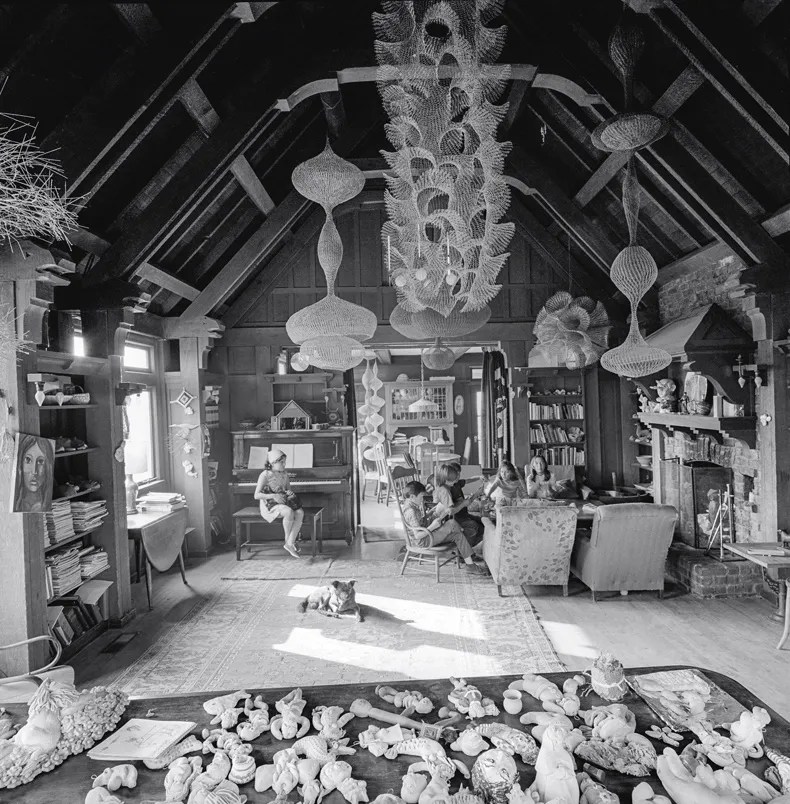
The living room of Ruth Asawa’s home in the Noe Valley neighbourhood of San Francisco, photographed by Rondal Partridge in 1969. Photo: © 2025 Rondal Partridge Archive

The black-and-white photograph shows a wood-panelled room with a pitched roof of dark redwood beams. A low table is pushed cosily up against a large brick hearth, and around it several children sit in easy chairs, one reading, others busily engaged in craft activities. At a piano, a girl strokes a cat, while a dog basks in the sunlight that slants across a large rug. This peaceful scene is the San Francisco living room of the artist Ruth Asawa (1926–2013), photographed in 1969. Asawa is nowhere to be seen, but her art is everywhere. Most conspicuous are the hanging wire sculptures for which Asawa is best known. Resembling elaborate lanterns or lighting fixtures, or biomorphic models of seed-pods or chrysalises, or complex fishing nets, or baskets, these sculptures fill the darkened space beneath the high rafters with miasmic, playful movement, catching the light as it filters through the window.

Read the rest of this entry »

Weaving Histories

The impact of pre-Columbian techniques and designs on 20th-century artists

1_17_1

Detail of tunic with stepped triangles, Nazca Culture, South Coast, c.700-800, scaffold weave, camelid wool, 186 x 123 x 6 cm. Courtesy: Yale University Art College, New Haven

Sheila Hicks was a student at  Yale when she took a class on pre-Columbian art in the mid-1950s. At the time, there was only one book in the library on Andean textiles,  Raoul d’Harcourt’s Textiles of Ancient Peru and their Techniques (1934) — still essential reading on the subject  — and she saw that Anni Albers had checked it out. Hicks was captivated by the textiles produced by Andean tribes in the centuries before the Spanish Conquest of 1532, as well as those predating the Incas who ruled for the preceding 100 years. ‘The richness of the pre-Incaic textile language is the most complex of any textile culture in history,’ she has said.1 The study of Andean textiles is virtually mandatory for anyone serious about weaving. Even before the Early Nazca period (approximately 1‒450), almost all weaving techniques — such as kelim, interlocking and eccentric tapestry; pattern weaves, weft scaffolding, twining and plaiting; lace, brocade, wrapped weaving and double cloth — were already known. Hicks was impressed by how, before written language, these ancient peoples organized ideas through thread. Her own earliest weavings — such as Muñeca (1957), which is titled after the woven dolls found in Andean tombs — were simply ‘attempts to understand material structures’.2 Read the rest of this entry »