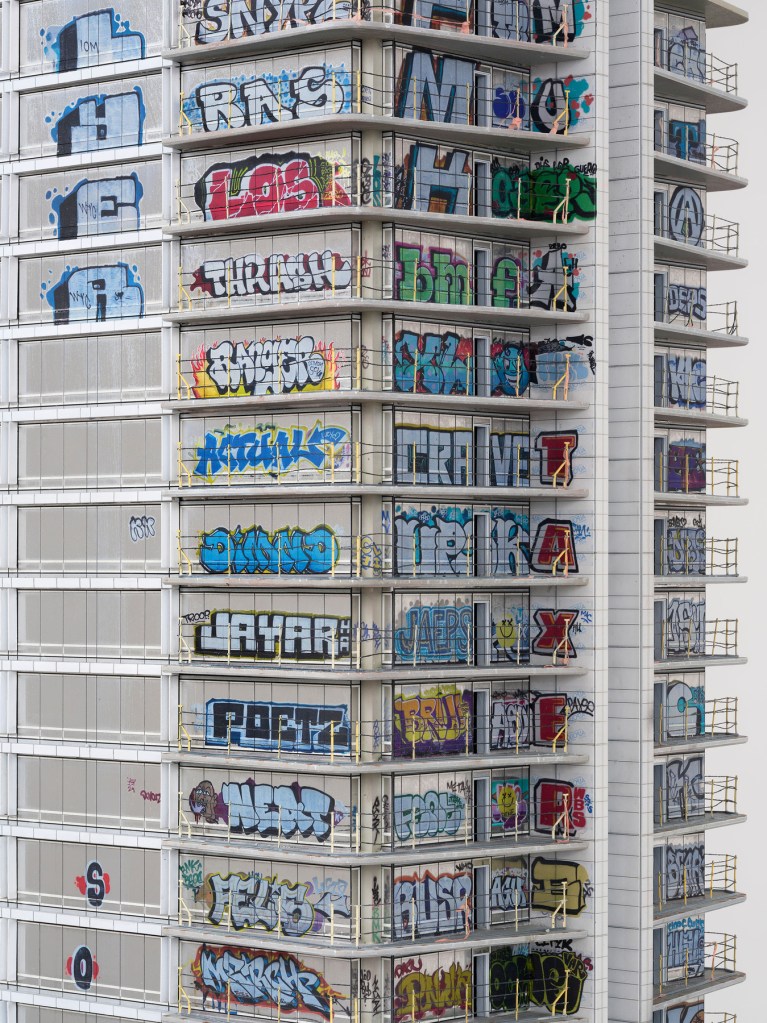
Sayre Gomez, “Oceanwide Plaza,” 2025-26. Courtesy David Kordansky Gallery
Early in 2024, graffiti artists broke into the half-finished Oceanwide Plaza skyscraper development in downtown Los Angeles, scaled dozens of flights of stairs and, over a few days, covered much of the towers’ exterior with spray paint. Colorful tags — “Sorak,” “Libre” or “Suave,” more than six feet tall — were emblazoned on mirrored glass windows of nearly every floor.
“I don’t consider myself a creative person at all,” Greta Waller tells me, in the kitchen of her south Los Angeles bungalow, despite abundant evidence to the contrary.
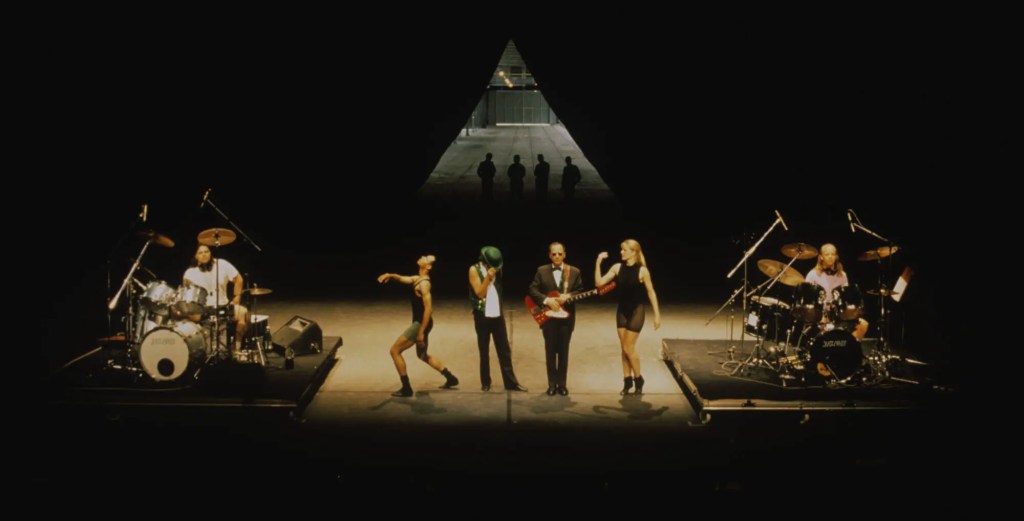
A performance of “Beat of the Traps” in Vienna in 1992. Credit: Anita Pace, Stephen Prina, and Mike Kelley Foundation for the Arts/Licensed by VAGA at Artists Rights Society (ARS), NY
On a dance mat in a cavernous rehearsal space in downtown Los Angeles, the actor Abbott Alexander put on a battered green bowler hat, last worn onstage 33 years ago. Nearby, two drummers perched behind their kits and, to the side, two dancers stretched against the wall.
I FIRST SAW an artwork by Mike Kelley before I was able to recognize it as such. On the wall of a dorm room at the rural English boarding school I attended, someone had pinned a poster for Sonic Youth’s 1992 album Dirty: a photograph of a stuffed toy crocheted from orange yarn, an alien with antennae and a bashful smile.
In the cultural history of Los Angeles, it’s an indelible scene: the 19-year-old Edward Ruscha and his friend, the musician Mason Williams, tearing down Route 66 in a customised Ford from Oklahoma to Los Angeles. Ruscha’s arrival in 1956 in the still-young city and his excitement at its signs and buildings, its colours and its surfaces, inflected most of his art over the coming decades. Even if his enthusiasm is sometimes tempered by unease, or a wry quizzicality, Ruscha is generally considered the artist-laureate of Los Angeles.
The story, as literary theorist Peter Brooks has observed, is today’s dominant cultural form. To Brooks, this “overabundance” of narrative is worrying: he criticizes the deference of virtually all strands of culture (not only literature, TV, and movies but art, museology, and—especially—news media) to the persuasive rhetorical power of the story.1 I share many of his concerns. “The universe is not our stories about the universe,” he writes, “even if those stories are all we have.”2
Merlin James, Arrivals, 2007-08. Acrylic and mixed materials on canvas, 25 5/8 x 26 5/8 inches. Image courtesy Sikkema Jenkins & Co, New York, Chris Sharp Gallery, Los Angeles, and the artist
My attention is more or less guaranteed by any exhibition that offers, within the initial sweep of its first gallery, a painting of an airport luggage carousel; a near-monochrome canvas, composed from grubby, rectilinear sections; a close-up picture of a blowjob; and a boisterous abstraction incorporating a tail-wagging dog and a swipe of glitter.
‘never, never ever, never in my life, never in all my born days, never in all my life, never’ is and is not a posthumous exhibition. Kaari Upson passed away only in August of last year; many of us are still coming to terms with her loss. But to think of this, her first solo show in Los Angeles in over a decade, only in the memorializing terms of the posthumous tribute is distracting, limiting and inaccurate. Comprising work produced between 2015 and 2021, it was planned, in part, by the artist herself, but was repeatedly pushed back due to the pandemic. It was Upson who came up with that exclamatory title.
‘Rain in Rifle Season, Distributions from Split-Interest Trusts, Price Includes Uniform, Never Hit Soft, 2003’, 2021, archival pigment print, 102 × 135 cm. All images courtesy of the artist
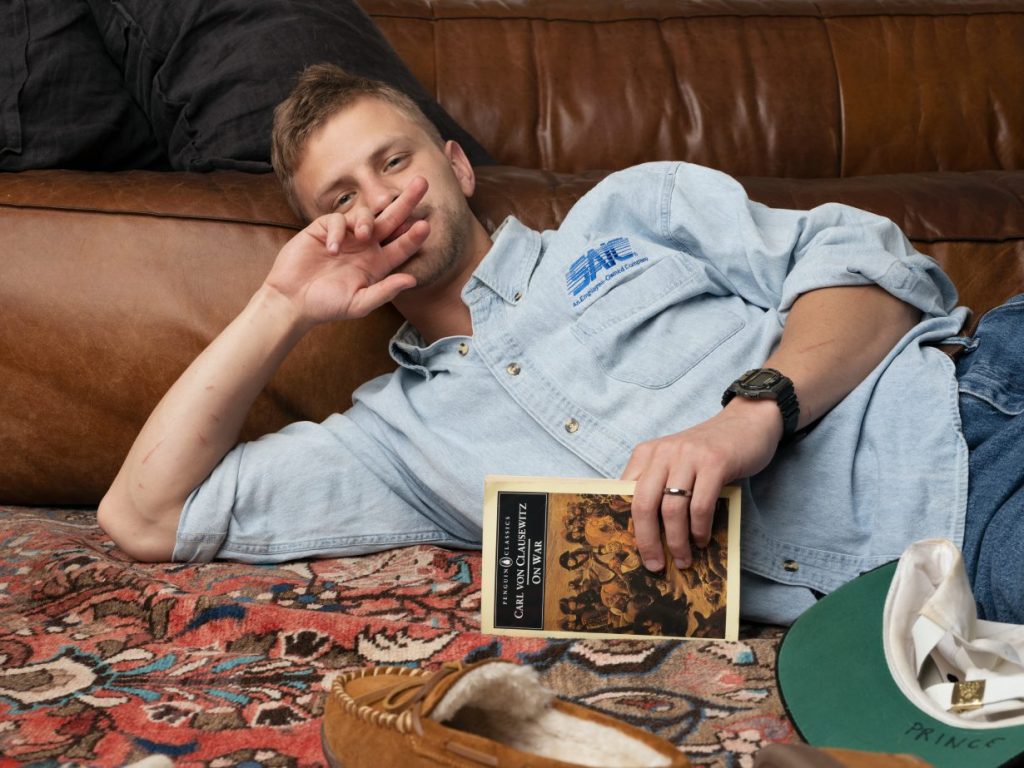
The handsome blonde man in the photograph reclines on a wrinkled Persian rug, an arm’s length from the camera. His smiling eyes gaze fondly into ours. Maybe he’s about to say something. But what?
Suzanne Lacy, Los Angeles, 2022. Yudi Ela for The New York Times
On a cold day last December, sitting outside her studio in Santa Monica, Calif., the artist Suzanne Lacy talked excitedly about the coming year. In Manchester, England, exhibitions of her work were already open at the Whitworth Art Gallery and the Manchester Art Gallery. She looked forward to a prestigious fellowship at the University of Manchester in the spring.

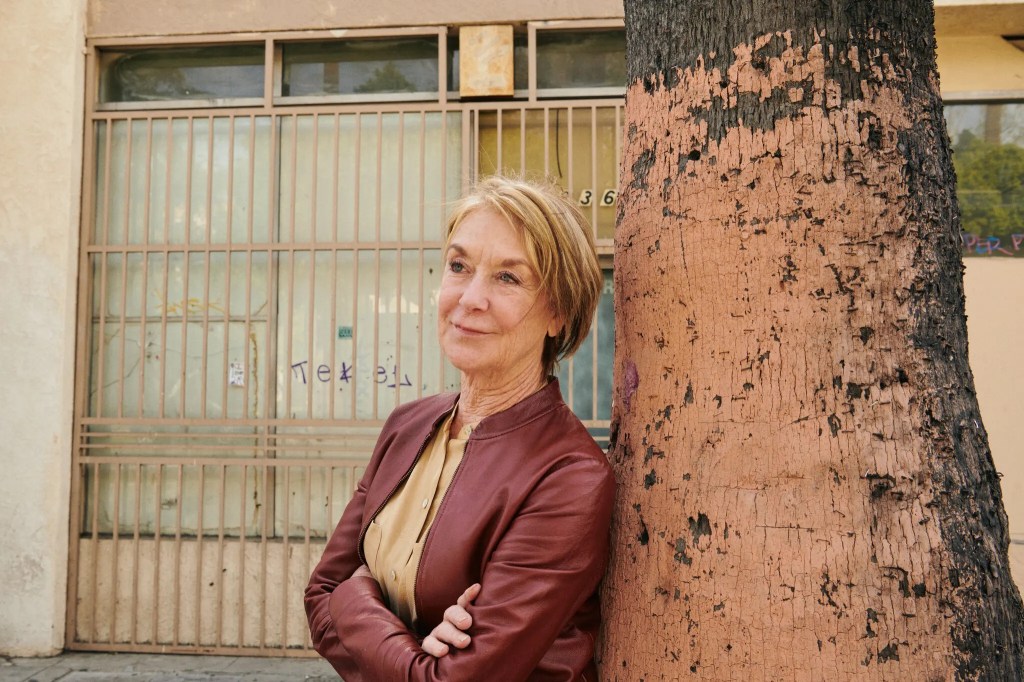
 Jonathan Griffin