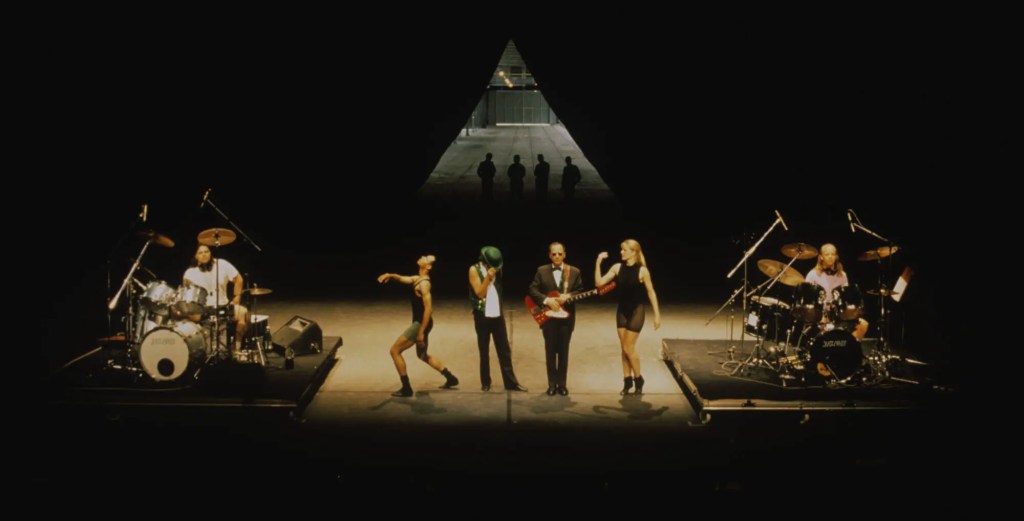
A performance of “Beat of the Traps” in Vienna in 1992. Credit: Anita Pace, Stephen Prina, and Mike Kelley Foundation for the Arts/Licensed by VAGA at Artists Rights Society (ARS), NY
On a dance mat in a cavernous rehearsal space in downtown Los Angeles, the actor Abbott Alexander put on a battered green bowler hat, last worn onstage 33 years ago. Nearby, two drummers perched behind their kits and, to the side, two dancers stretched against the wall.
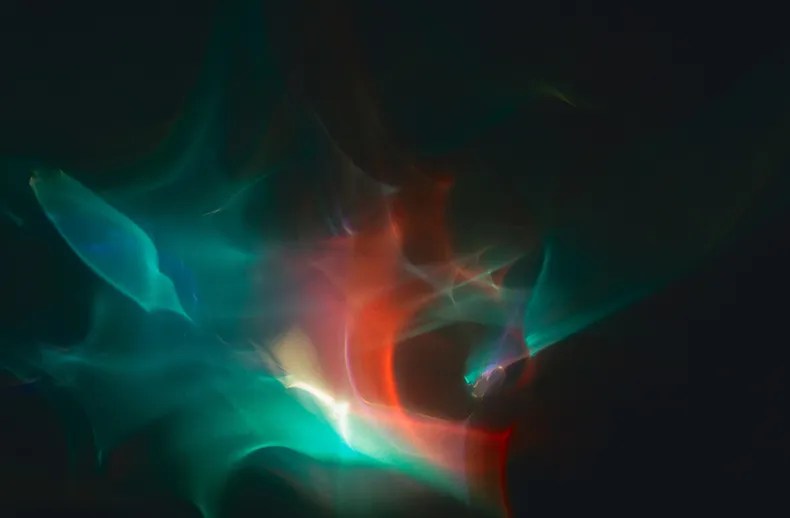
Lumia Suite, Op. 158 (1963–64), Thomas Wilfred. Museum of Modern Art, New York
Between 1964 and 1981, visitors to New York’s Museum of Modern Art (MoMA) could sit in a darkened room and contemplate opalescent wisps of colour drifting slowly across a screen. The installation, tucked in the museum’s basement, was a favourite among regulars. At times, the screen – eight feet wide and six high – was filled with diaphanous skeins of pale yellow, green, blue or pink, while at other times the light dwindled, letting most of the picture fall into darkness. It was mesmeric, unlike anything else in the museum. Unlike, probably, anything yet made in the history of humankind.
When the Museum of Modern Art in New York reinstalled its collection in 2019, amid widespread critical acclaim for the institution’s revisionist canon, one pairing in particular hit the headlines: Faith Ringgold’s American People Series #20: Die (1967) hanging next to Pablo Picasso’s Les Demoiselles d’Avignon (1907).
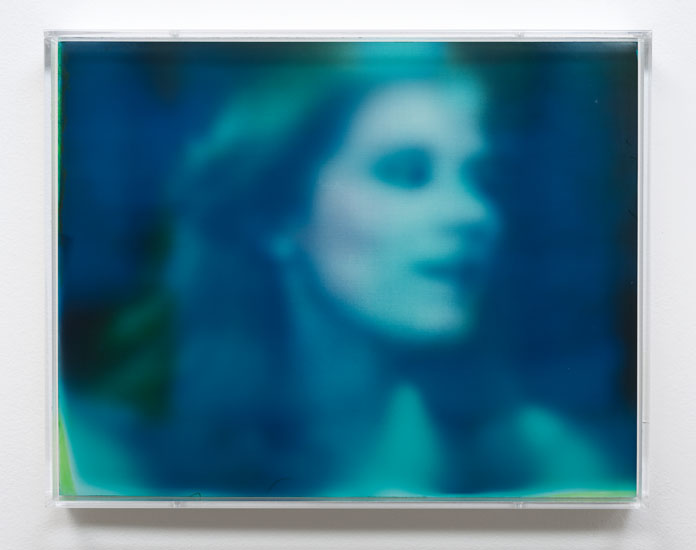
Robert Heinecken liked to describe himself not as an artist or a photographer but as a “paraphotographer.” He explained that he used the term like “paralegal” or “paramedic”: knowing only enough about his field “to keep someone out of trouble until the real guys show up.” Read the rest of this entry »

 Jonathan Griffin