Jonathan Griffin

Criticism and essays on art and culture

Tag: San Francisco

Ruth Asawa

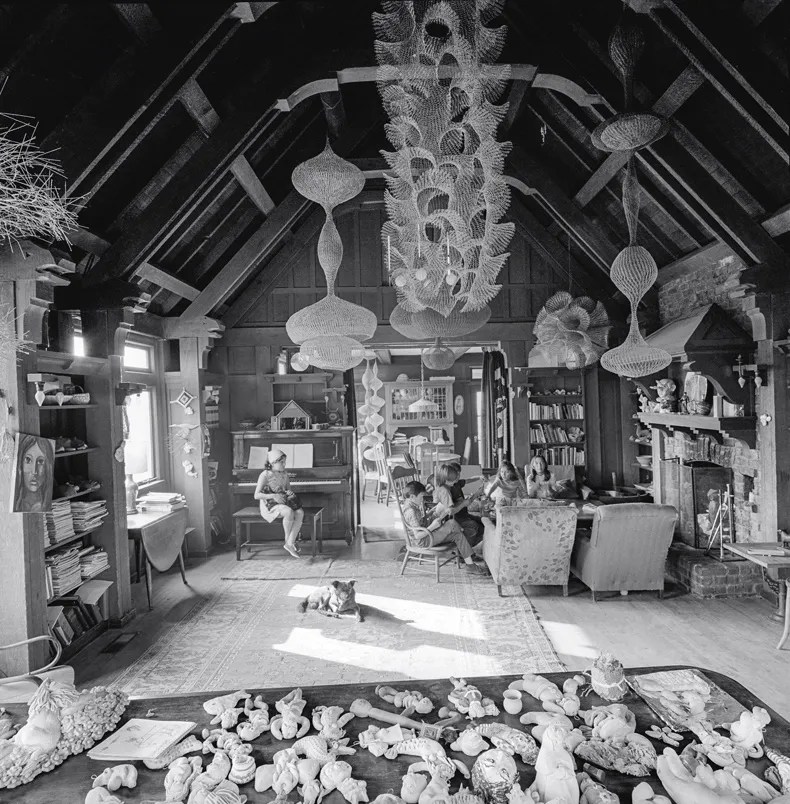
The living room of Ruth Asawa’s home in the Noe Valley neighbourhood of San Francisco, photographed by Rondal Partridge in 1969. Photo: © 2025 Rondal Partridge Archive

The black-and-white photograph shows a wood-panelled room with a pitched roof of dark redwood beams. A low table is pushed cosily up against a large brick hearth, and around it several children sit in easy chairs, one reading, others busily engaged in craft activities. At a piano, a girl strokes a cat, while a dog basks in the sunlight that slants across a large rug. This peaceful scene is the San Francisco living room of the artist Ruth Asawa (1926–2013), photographed in 1969. Asawa is nowhere to be seen, but her art is everywhere. Most conspicuous are the hanging wire sculptures for which Asawa is best known. Resembling elaborate lanterns or lighting fixtures, or biomorphic models of seed-pods or chrysalises, or complex fishing nets, or baskets, these sculptures fill the darkened space beneath the high rafters with miasmic, playful movement, catching the light as it filters through the window.

Read the rest of this entry »

Bernice Bing

A Lady and a Road Map, 1962, by Bernice Bing (American, 1936– 1998). Oil on canvas. Asian Art Museum of San Francisco, Museum purchase, 2020.26. © Estate of the Artist. Photograph © Asian Art Museum of San Francisco.

Once upon a time, everybody knew Bingo. In San Francisco in the 1970s, it’s said she couldn’t walk down the street in North Beach or Chinatown without someone calling out her name. Bernice Bing, the statuesque artist known to most as Bingo, was easy to spot in her sharp zoot suits, boots and jet-black hair. She was born in Chinatown in 1936; when it became the heart of the Beat movement in the 1950s, she found herself at the centre of a community that was not only wildly hedonistic but also close-knit, pluralistic, non-judgemental, socially progressive and spiritually visionary. Later, she worked with at-risk youth in the area, including gang members whom she persuaded to take part in art workshops. She helped found the South of Market Cultural Center (SOMAR, now known as SOMArts), which she ran in the 1980s. Why, then, is Bing – who died in 1998 – so little known today?

Read the rest of this entry »

The History of Technology

Jessica Silverman Gallery, San Francisco

Philipp Timischl

When Aristotle imagined a technological future in which ‘every instrument could accomplish its own work’, it was to the weaver’s shuttle and the lyre-player’s plectrum that he turned for examples. It is probably just coincidence but, in ‘The History of Technology’, woven fabrics and the sonorous tones of a stringed instrument featured prominently. Read the rest of this entry »