Jacqueline Humphries
by Jonathan Griffin
Aspen Museum of Art
Writers from Marcel Mauss and Georges Bataille to Lewis Hyde have contributed to the notion of art as a veiled gift, with strings attached. Generosity and withholding are not antitheses; many of the best artworks are both withholding—in their minimalism, obscurantism, or elusiveness—and, despite their outward reserve, unexpectedly generous.
The paintings (and occasional sculptures) of Jacqueline Humphries are like this. Humphries emerged in the 1980s, a devotee of abstract painting at a time when both painting and abstraction were, in many quarters, considered moribund. In the four decades since, she has stuck to her guns, in recent years retooling abstraction for the screen age. Her commitment is now paying off with institutional and market recognition.
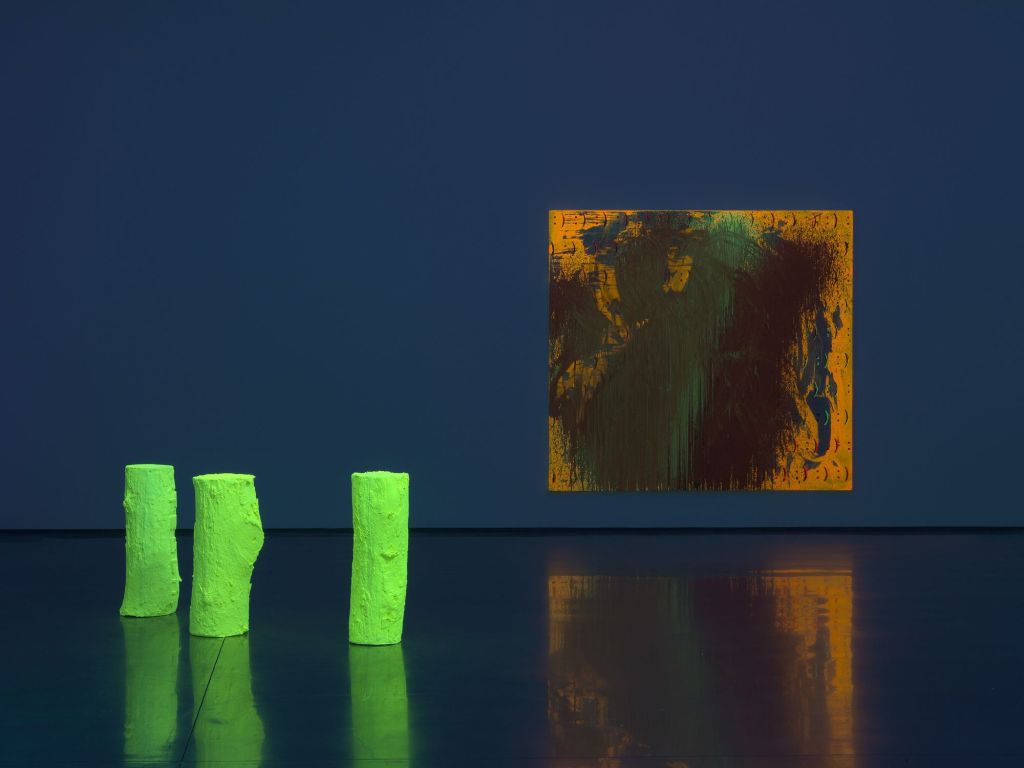
If I tell you that five large paintings in her survey exhibition at the Aspen Art Museum are installed so visitors cannot stand in front of them, but only glimpse them distantly reflected in mirrors, you might reasonably interpret her gesture as withholding. You might have a similar response when you learn that the entire basement floor of her show is illuminated only in blacklight, and that, while some paintings in fluorescent pigments fairly glow on the dark walls, at least one, which bears no fluorescent paint on its surface, is almost invisible.
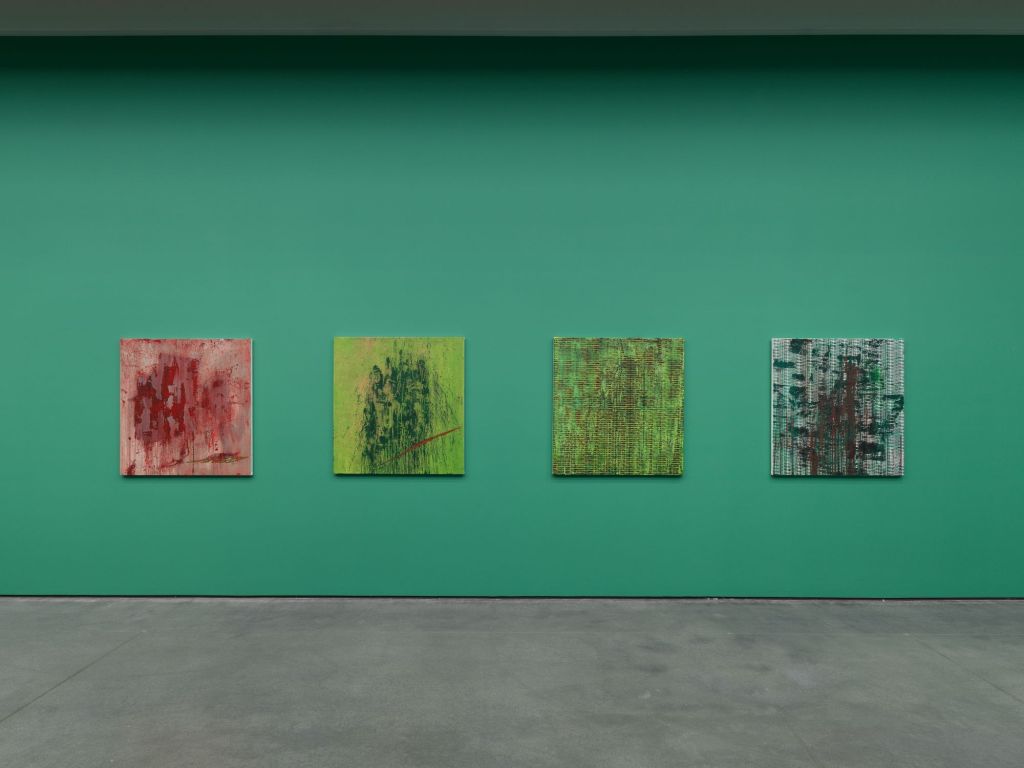
Speaking of invisibility, the walls of another gallery are painted in green-screen emerald, similar (though never identical) to certain of the paintings hung on them. They summon the idea of invisibility while never achieving it—not even close. Humphries’s paintings are richly textured, haptic objects, coated with layers of paint which the artist scrapes on through silkscreens or stencils, often in a half-tone dot pattern. Her subject matter, in the main, consists of tropes of gestural abstraction: splashes, drips, smears, scratches, and big, bold brush marks. These are another instance of camouflage; in this gallery, the splashes are appropriated from the protests of climate activists, who hurled paint (and tomato soup) over masterpieces in museums.
Judgment, in Humphries’s work, is largely withheld. The paintings give no indication of her moral or political position on such protests, which have been derided even by those who hold a general sympathy toward the causes they aim to highlight. The primary mode of Humphries’s output, which has often been contextualized since she emerged in the 1980s within the once-purported death of painting, is one of agnosticism.
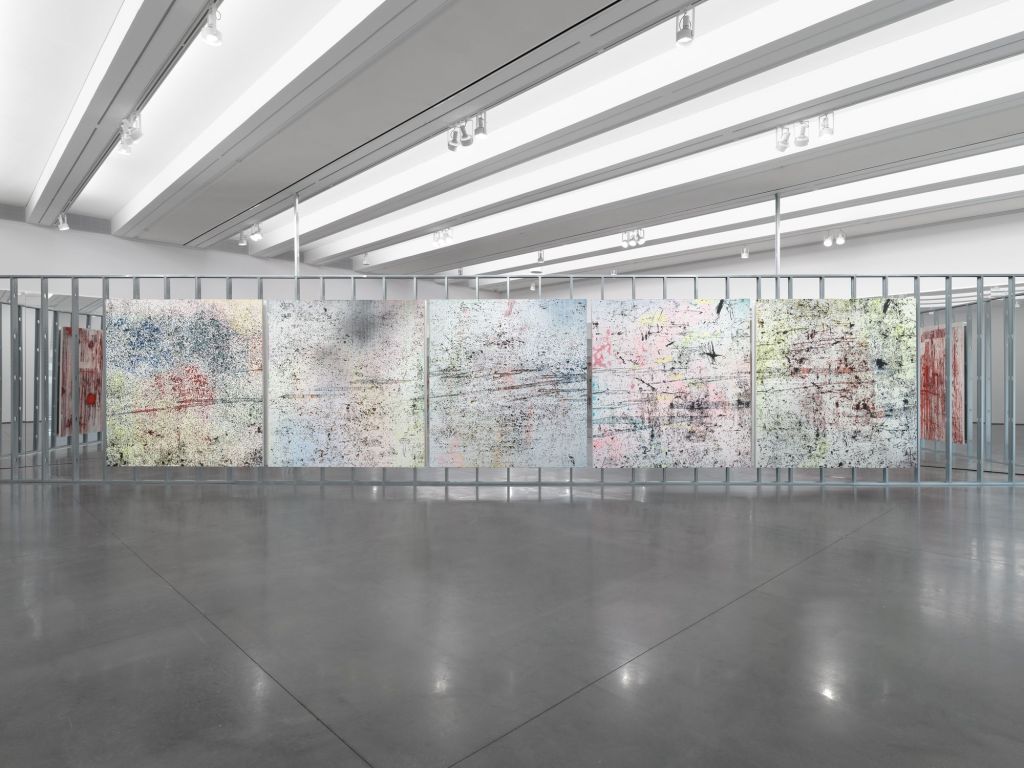
In the past, Humphries has used bloody forensic photographs and slasher movie stills as referents for her artful splashes. More disturbing, in this exhibition, is her liberal adoption of the logo of Tesla, which she skews and silkscreens onto many works, most notably the five large paintings that greet visitors to this exhibition. These are mounted on a frame of steel drywall studs, without drywall; they hover a few inches off the floor, bisecting the gallery at an angle and cordoning off a triangular zone (inaccessible to the viewer) beyond them. On the back sides of these paintings are mounted five other paintings, also Tesla-branded, facing away from us; only thanks to the mirrored walls can we see them at all.
It felt like a genuine deprivation not to be able to scrutinize, up close, the surfaces of those paintings. On their front-facing partners, the texture is fascinating, since it reveals, incrementally, the complex layering process that produced the allover, dispersed effects of the finished works.
To fuss over process and texture might seem trivial when there is a Tesla logo emblazoned on a painting’s lower right corner, as with TSLA2 (2025). Humphries even imprinted the logo onto fluorescent yellow resin casts of logs, sculptures which glowed in the black-lit basement—the only dud works in the exhibition, shown up by the evanescent sublimity of the barely legible abstract paintings in the same space. Given Elon Musk’s divisive, erratic behavior and his recent corrosive adventures in the US federal government—not to mention the ubiquity of his car brand among the collector class, glaringly evident on the streets of Aspen—the logo is a vexing addition to Humphries’s otherwise temperate work.
But Humphries has used language, symbols and signs in a similar way in the past. (Though never quite so provocatively.) In 2021 she made a suite of five paintings, almost the same dimensions as these new Tesla canvases, bearing a ghostly transcription of the logo of the Neiman Marcus department store. At the time, the august retail giant had just filed for bankruptcy, laid low by the pandemic and e-commerce. In the context of a Chelsea gallery, where Neiman Marcus (2021) was first exhibited on a steel frame similar to the one in this exhibition, the work implied a critique of art’s commodity status. But it remained ambiguous: was it nostalgically lamenting the loss of a beloved store, or contending, portentously, that galleries are bound for a similar fate? Both perhaps.
That work and these new Tesla paintings are compelling because of their in-betweenness. They would be boring, and limp, as protests. Instead, the logos are much-needed grit in the cogs of otherwise well-oiled machines. (Humphries has often acknowledged the mechanistic production of her paintings, as well as their handmade qualities.) In a talk at the opening of her exhibition, she referred to the value of bad ideas. “Bad ideas can make really good art,” she said, “and good ideas can make really bad art.” A painting is always, inevitably, more than just the quality of its ideas, and this is the rousing, generous principle that the otherwise agnostic Humphries really seems to believe in.
First published: e-flux Criticism, January 13 2026
 Jonathan Griffin