Patrick Jackson
by Jonathan Griffin
François Ghebaly, Los Angeles
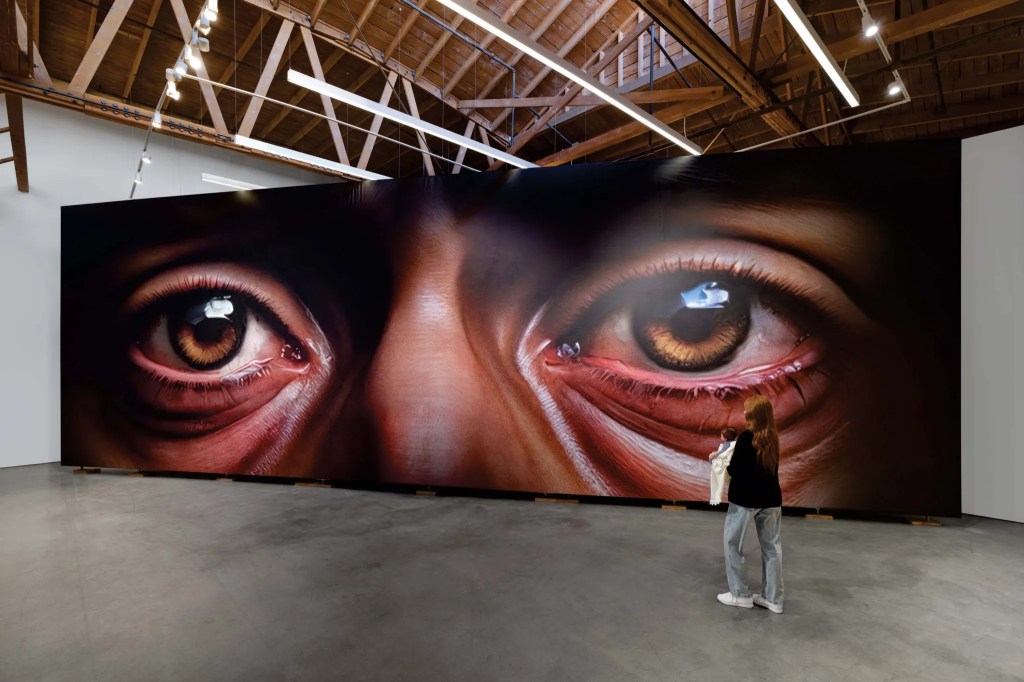
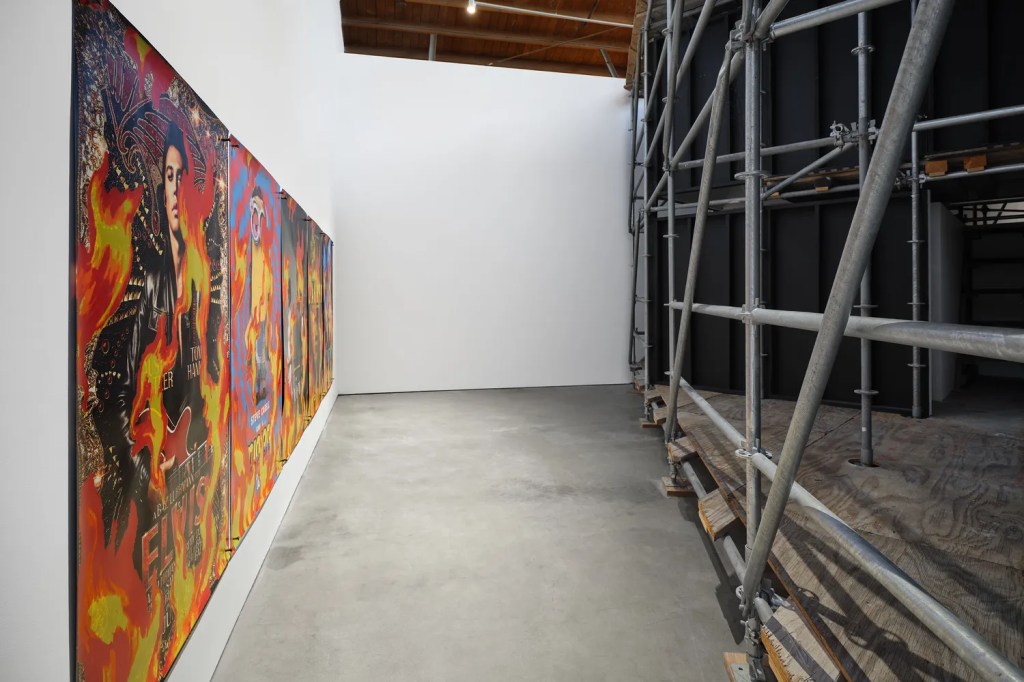
Patrick Jackson did not make the cobwebs that, on my visit to his show, tangled around the scaffolding supporting his billboard sculpture Memorial, 2026, but he didn’t brush them away, either. Visitors who venture behind the giant forty-four-foot-wide printed image that splits the gallery diagonally encounter a “behind-the-scenes” area of dusty and cramped corridors that establishes a complicated set of relations between frontality and interiority, contrivance and authenticity, desire and disappointment. The exhibition’s title directs us to the artist’s position: “All Signs Fail.”
Featuring an arresting image of bloodshot, teary eyes, Memorial peers at viewers even before they’ve entered the gallery; before, indeed, they have passed through an installation by late artist Alexis Smith in an adjacent space, which Jackson had a hand in curating. (Jackson’s partner, artist Erin Calla Watson, manages Smith’s estate; together, they designed the shows to work together.) Smith’s Rapido, 1975, consists of a model railway running around the perimeter of a given space—here set off by the massive eyeball framed by the doorway into Jackson’s exhibition.
The press release for “All Signs Fail” discloses that Jackson appropriated the image for Memorial from a 2024 advertisement by the AIDS Healthcare Foundation; he simply removed the phrase that once ran across the image, EYE SYPHILIS IS SERIOUS. Up close, the printed billboard assumes a synthetic velvety sheen, and whether the picture originated as a photograph of someone’s eyes or was generated via AI is unclear. Either way, despite its representation of pathological symptoms, it has a sanitized smoothness that is entirely at odds with the cobwebby structure that holds it up. Visitors can step behind the billboard and climb into a compact two-level maze of white-walled passages and dead ends—all liminal space and no destination—which is not only disorienting but difficult to picture, either photographically or in memory. That is to say, its anti-visuality makes it a space that is felt more than seen—a mind, perhaps, behind a face.
Standing in front of the billboard, gazing not quite at it but obliquely past, is a life-size sculpture of a young mother holding an infant. These are in fact hyperrealistic silicone dolls, the woman an expensive sex doll and the baby a reborn doll made, apparently, for therapeutic purposes. Untitled (Mother and Child), 2026, probes the uncanny valley, in Jackson’s terms, as does the image of the eyes. Both pieces are too perfect to feel real, but are convincing enough, in the dolls’ case especially, owing to the figures’ scale. Indeed, standing next to the dolls, one feels the powerful buzz of living presences. But how are we to relate to these presences? In this moment when technology increasingly blurs the distinction between the human and the inhuman, the question still feels unanswerable.
Around the walls of the gallery is a series of posters, each seemingly pinned to the wall via oversize prop nails. These works are bus-shelter advertisements for recent Hollywood movies, all of them remakes, adaptations, or franchises, which Jackson has painted over with autumn leaves, or silk-screened over with snowflakes or flames. The cartoonish resin nails paradoxically make the photographs of actors look more airbrushed, and Jackson’s additions more clunky. (I think of Mike Kelley’s self-consciously sophomoric drawing style.) Their titles are clunky, too: Mario Galaxy Snow; Minions Flames; Fall Leaves (all 2026).
Those works feel minor in relation to Memorial, which engages not only extremes of physical scale but also scale of ambition: This is a big work about big ideas and big feelings. Its title is ambiguous, though. Is it maybe a memorial to those kinds of artistic ambitions? In past works, Jackson has referenced and reconstituted civic monuments, but this is no memorial in the conventional sense. Instead, it might best be understood as a lament for our lost relationship with images—for failing signs—but also to bodies remade by machines, which also fail.
First published: Artforum, October 2026

