Jonathan Griffin

Criticism and essays on art and culture

Category: Frieze

Evan Holloway

David Kordansky Gallery, Los Angeles

EH-15-022g

It is possible to argue—and, indeed, I heard it argued while visiting this exhibition—that Evan Holloway belongs to the first generation of artists in Los Angeles that did not look outside of California, to New York or to Europe, to define their work, whether through aspiration or through contradistinction. If that sounds like hyperbole, it may not be as far-fetched as it initially seems. In any case, it is undeniable that in the late 1990s, a loose group of L.A. artists—including Holloway, Liz Craft, Jason Meadows, Jeff Ono and Kristin Calabrese—emerged with a distinctly homegrown vernacular. Read the rest of this entry »

Amy Yao

Various Small Fires, Los Angeles

Yo

Every day, about US$1.2 billion worth of cargo flows in and out of the Port of Los Angeles. It is the busiest container port in the US, seconded by the Port of Long Beach, which directly adjoins it. Amy Yao, whose studio is situated near the ports, has to contend with queues of thundering lorries every time she drives to work. Some of their cargo found its way, circuitously, into her exhibition ‘Bay of Smokes’, as indeed it probably does into most exhibitions by most artists in the country. Read the rest of this entry »

Noah Purifoy

Los Angeles County Museum of Art

Noah Purifoy

Noah Purifoy, Earl Fatha Hines, 1990, mixed media, 1.3 x 1 m

There are two entry points – architecturally but also thematically – to ‘Junk Dada’, the exhibition of sculpture by Noah Purifoy housed on the top floor of Renzo Piano’s Broad Contemporary Art Museum, at LACMA, curated by Franklin Sirmans and Yael Lipschutz. Read the rest of this entry »

William Pope.L

The Geffen Contemporary at MOCA, Los Angeles

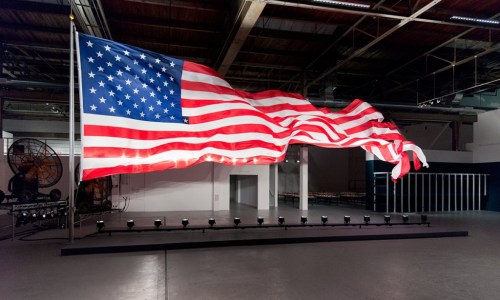
Pope.L-Install-09_1200px-1024x615

The sheer physics involved in keeping something like this off the ground are staggering. The flag is nearly five metres high by 14 metres long, and weighs God knows how much in polyester and reinforced stitching. It should be noted that, in American flag terms, William Pope.L’  s Trinket (2008/2015) is not an XXL or even an XL but, in the warehouse galleries of the MOCA Geffen, where it flies only a couple of metres off the ground and reaches nearly to the ceiling, it feels colossal. Four thundering Ritter fans, their blades as tall as a man, keep it perpetually roiling in the air. Read the rest of this entry »

Fiona Connor

1301PE, Los Angeles

Fiona-Connor_069

Probably the least interesting thing to say about Fiona Connor’s simulacra of community noticeboards, remade from originals encountered by the artist in and around Los Angeles, is that they function as surrogate paintings. But it’s unavoidable, so we might as well get it out of the way. Read the rest of this entry »

Joan Brown

Gallery Paule Anglim, San Francisco

Brown_Year of the tiger_JJ

In 1957, at the age of 18, Joan Brown had her first exhibition of paintings in San Francisco’s 6 Gallery, where two years previously Allen Ginsberg had first given a reading of his poem Howl (1955). It was the advent of the Beat movement, and Brown came of age at its epicentre. Despite her remarkably swift success, she distanced herself from her early expressionist technique the following decade, tackling her subsequent paintings with a renewed degree of finesse and control. As this bifurcated exhibition of works from the mid-1970s and early 1980s makes plain, Brown reinvented herself throughout her career. Read the rest of this entry »

Eric Wesley

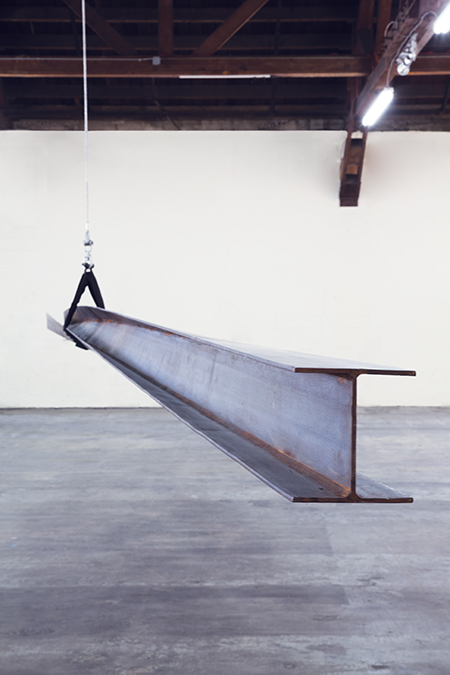
356 S. Mission Road, Los AngelesWesley_I_Beam_U_Channel-cmyk

Ironically, perhaps, for such a wayward, unpredictable and contrarian artist, Eric Wesley has a fondness for numbers and systems. ‘Some Work’, his sardonically titled quasi-retrospective at 356 S. Mission Road, was arranged around a neat numeric structure. A map, printed on the back of the invitation card in lieu of a press release, provided a key. Read the rest of this entry »

The Quiet Life

Artists and the Freedom of the Desert


A couple of miles into the unprepossessing town of Yucca Valley, in the Mojave Desert near Joshua Tree, California, is a turn-off for the Sky Village Swap Meet. There’s a sign, but it’s almost impossible to spot from the main road. Open on Saturdays and Sundays, the swap meet has been run for 35 years by Bob Carr, who stepped back from day-to-day operations earlier this year so he can concentrate on making art. Carr is 76. His masterwork is The Crystal Cave (2004–ongoing), a freestanding grotto made mainly from expanding foam and crystals. Customers at the swap meet can peer through circular windows in the structure’s lumpy brown walls and spy a miniature landscape painted green and brown, through which running water trickles over waterfalls and rock crystals sprout like alien flora. Read the rest of this entry »

Michael E. Smith

After the End

image

Untitled, 2013, pigeon pelt, plastic, 26 × 10 cm. Courtesy: the artist, Michael Benevento, Los Angeles, Clifton Benevento, New York, Susanne Hilberry Gallery, Detroit, KOW, Berlin, and ZERO, Milan 

At the start of Michael E. Smith’s recent monograph, published in 2013 to accompany his exhibition at the Ludwig Forum in Aachen, there is a black page with two QR codes printed in white. Underneath each are the capitalized inscriptions: ‘BEETLEJUICE’ and ‘FOR HEADS’. This is the artist’s preface to the book. Read the rest of this entry »

Alex Becerra

LTD, Los Angeles

Becerra

Alex Becerra is a young painter who seems to value freedom over pretty much everything else, even at the expense of such musty old notions as moral responsibility or restraint. Left to its own devices, his mind goes, most often, to the naked human form: to pictures of fulsome ladies in compromising positions, up-skirt shots caught in mirrors, women with legs akimbo, examining themselves. In this exhibition, Pablo Picasso’s Les Demoiselles d’Avignon (1907) is evoked more than once. Becerra makes unapologetically reckless pictures that are, at their best, thrilling to look at and, at their worst, vexing to think about. In this exhibition, there is never a dull moment. Read the rest of this entry »