Jonathan Griffin

Criticism and essays on art and culture

Category: Review

The History of Technology

Jessica Silverman Gallery, San Francisco

Philipp Timischl

When Aristotle imagined a technological future in which ‘every instrument could accomplish its own work’, it was to the weaver’s shuttle and the lyre-player’s plectrum that he turned for examples. It is probably just coincidence but, in ‘The History of Technology’, woven fabrics and the sonorous tones of a stringed instrument featured prominently. Read the rest of this entry »

Daniel von Sturmer

Young Projects, Los Angeles

danielvonsturmer-cinemacomplex

Upstairs in the polished, air-conditioned and usually deserted corridors of West Hollywood’s huge Pacific Design Center, time seems to move at a slower pace than on the noisy summertime streets outside. Where better, then, for an extensive survey of the patient studio experiments of Melbourne-based video artist Daniel von Sturmer? Read the rest of this entry »

Korakrit Arunanondchai

Arunanondchai7

The Mistake Room, Los Angeles

I seem to be in the minority in my cautious enjoyment of Korakrit Arunanondchai’s spectacular installation Letters to Chantri #1: The lady at the door/The gift that keeps on giving (2014) (made in collaboration with transgender artist boychild). Most people I spoke to professed to hating it. Arunanondchai is a divisive figure, as is any young artist who rises rapidly to international prominence on waves of hyperbole and who enjoys the rewards of a buoyant market enamoured with large abstract paintings made by people with unusual biographies. Read the rest of this entry »
Josh Mannis

Thomas Solomon Gallery, Los Angeles04 - Upstairs, Downstairs

A couple lie naked on a rug with their feet lolling in the air. She smokes; he holds his chin in his hands and gazes sideways at her, a quiet smile on his lips. They’ve probably just had sex. She is looking directly at us, or she would be – except her large, oval eyes have been entirely blacked out by the artist. They are unnerving empty holes. Read the rest of this entry »

Tony Greene

MAK Center for Art and Architecture, Los Angeles

Tony Greene, …understand…, 1989  Courtesy of Judie Bamber  © The Estate of Tony Greene

Tony Greene, …understand…, 1989
Courtesy of Judie Bamber © The Estate of Tony Greene


When Tony Greene made the 20-odd works in this exhibition, all dated between 1987 and 1990, he knew he was dying of AIDS. This very fact makes even his least political paintings almost unbearably poignant. Greene’s art is devastating and immediate because it is his answer to a question that everyone should consider from time to time: What would you make if you knew you only had a few years to live? Read the rest of this entry »

Joe Goode

Kohn Gallery, Los Angeles

goode_flatscreennature

Joe Goode has long made pictures designed to be looked through, not at. His work is deadpan, and seemingly innocuous. The LA Times critic William Wilson, in 1971, called it ‘neutrality-style art’. Perhaps this mildness is why he never got quite as much attention as his childhood friend Ed Ruscha, who also does deadpan but who usually cuts his neutrality with non-sequiturs (often verbal) that are arresting and funny. Goode only trades in the very lightest of humorous touches – a milk bottle painted mauve, for instance, placed on a shelf in front of a mauve monochrome canvas. That was his early Milk Bottle series, (1961-2), still amongst his best-known work. Read the rest of this entry »

Portland2014

Various venues, Portland, OregonPortland2014

In the April issue of frieze, Dan Fox prefaced his review of the 2013 Carnegie International with some observations about the perplexing lack of consensus around what, today, a biennial is actually for. ‘Portland2014’ is the third in this current formulation (the Oregon Biennial ran from 1949 until 2006) but its agenda and format are still, evidently, very much up for grabs. Read the rest of this entry »

John Tweddle

Kayne Griffin Corcoran, Los Angeles

Tweddle_1742_large

John Tweddle is one of those artists who never really fitted into any scene he found himself in. The astonishing, eccentric body of work that he has produced during his lifetime may be both the cause and effect of this condition. Born in 1938, he left rural Kentucky to go to art school in Kansas City and Atlanta, then moved to New York at the end of the 1960s. A decade later, appalled by the commercial art world, he turned his back on the city and moved back South. Today he lives and works in Santa Fe, New Mexico, which seems about right for an artist of his bent. Read the rest of this entry »

Frances Stark

Marc Foxx, Los Angeles

Stark06_fs_2014_from_therealstarkiller_429

About three years ago, something unexpected happened in Frances Stark’s art. After two decades of making work about herself––about her anxieties and obsessions, her identity crises and motivational struggles––she started making work about other people. Stranger still, her subjects became, in most instances, young men of color.  Read the rest of this entry »

Raster Raster

Aran Cravey, Los Angeles

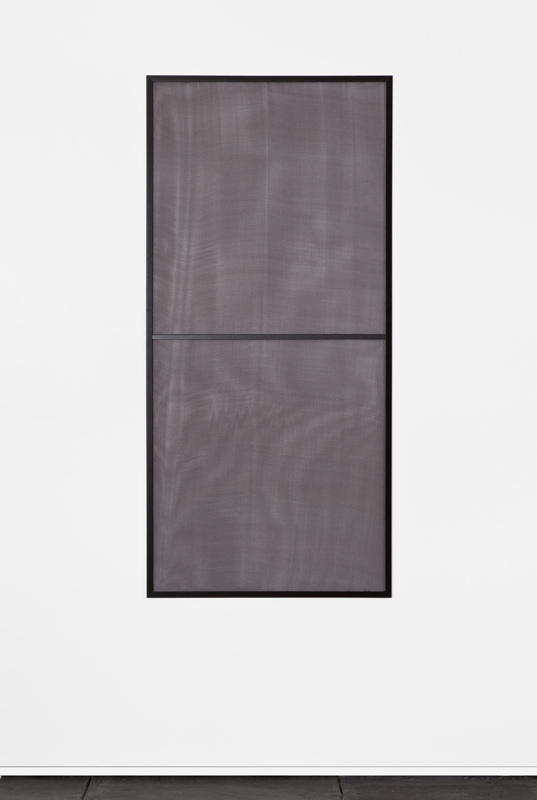
Artie Vierkant, Air filter and method of constructing same 18, 2013, US Patent 8118919 B1, aluminum, charcoal fiberglass mesh, organza, 68 x 32 in

Artie Vierkant, Air filter and method of constructing same 18, 2013, US Patent 8118919 B1, aluminum, charcoal fiberglass mesh, organza, 68 x 32 in

Any post-Postmodernists who dared hope that contemporary art had become ‘post-movement’ must have been dispirited, in recent years, to see the tag ‘post-Internet’ growing in ubiquity. Art magazines have done their best to nail down a definition of this vague field, in some cases recruiting the same curators who are bold enough to try to identify its principal characteristics and exponents in group exhibitions. Read the rest of this entry »