Jonathan Griffin

Criticism and essays on art and culture

Category: Review

Jeffry Mitchell

Ambach and Rice, Los Angeles
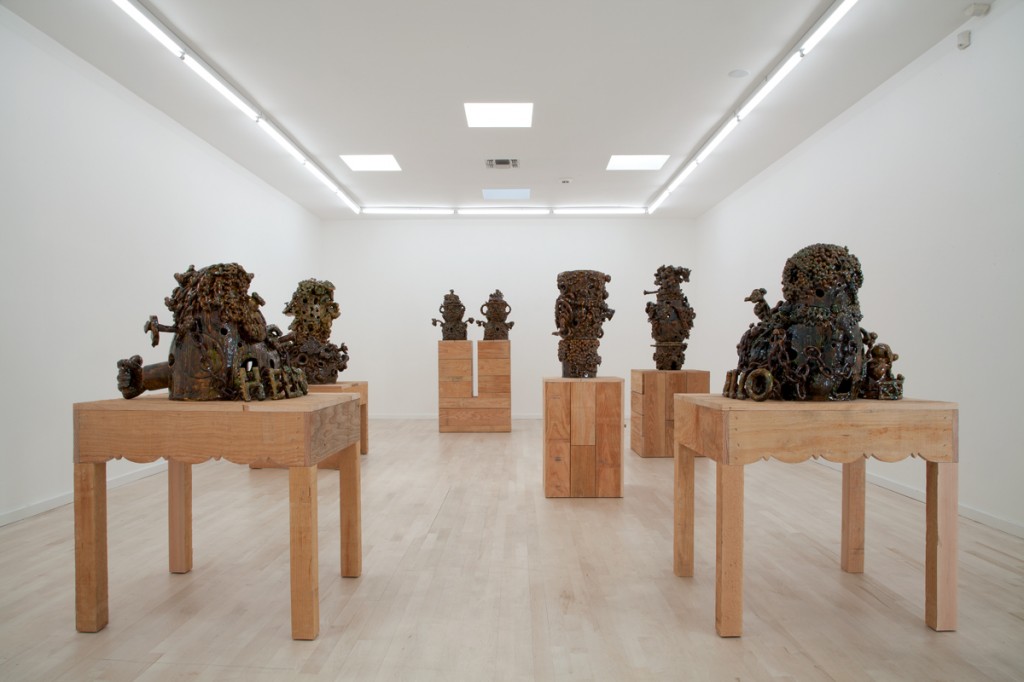
I’ve never met Jeffry Mitchell, but having seen his art, I’d imagine him to be a chunky fellow. Not fat, just well built. I’d also imagine him to be extravagantly hairy. Google reveals my hunches to be correct in the first instance, wrong in the second. Read the rest of this entry »

Paul McCarthy

The Box, Los Angeles

The doubling begins immediately. An exhibition across town, organized by MOCA and James Franco, called “Rebel,” themed (incredibly) around Franco’s resemblance to James Dean, finds its evil twin in “Rebel Dabble Babble.” It began with Franco inviting Paul McCarthy to collaborate on a project based on Rebel Without a Cause (1955), and ended up with McCarthy and his son Damon creating house-sized sets in their studio, staging auditions, filming, and performing in scenes with actors (who played hybrids of cinematic characters and the actors who originally played them) and, ultimately, shooting scenes for a pornographic version of Rebel Without a Cause featuring an actor named James Deen, who, like Franco, is a dead ringer for its original tragic star. A watered-down version of the project remains in MOCA’s exhibition, but at The Box it unfurls into full exhaustive glory. Read the rest of this entry »

Sanya Kantarovsky

Marc Foxx Gallery, Los Angeles

In Sanya Kantarovsky’s painting Events (2012), a kneeling figure clutches his head and grasps a sheet of paper. The unfortunate conductor in Sinfonia #2 (2012) is frozen in horror as a gust of wind sends his music flying about his head. An empty table and chair awaits the protagonist in A New Talented Writer, while the man from An Episode from History (both 2012) smokes at his desk, gazing into the distance and hoping for inspiration. Read the rest of this entry »

Pietro Roccasalva

David Kordansky Gallery, Los Angeles

Pietro Roccasalva’s work poses problems to those looking for legible meaning. Although his visual language of recurrent symbols and metaphors looks very much like it should be in some way translatable, most of its etymologies are so deeply entombed in Roccasalva’s eccentric logic that even those closest to him – assistants and gallerists, for instance – are sometimes at a loss to decode it. Read the rest of this entry »

David von Schlegell

China Art Objects Galleries, Los Angeles

For all those (myself included) requiring an introduction to David von Schlegell’s art, the sculpture Five Birds and its attendant Untitled Study for Five Birds (both 1988) greeted visitors at the entrance to his exhibition. Birds in flight, cobbled from shards of aluminium tube and hanging on monofilament, cast fluttering shadows over the cut-paper studies on the wall behind. These were far from the most sophisticated works in the show, but they announced, for the uninitiated, the artist’s fascination with dichotomies of form and weightlessness, land and air, the man-made and the natural. Read the rest of this entry »

Nathan Hylden

Richard Telles Fine Art, Los Angeles

The facetious joke – or is it a wry compliment? – about white monochrome paintings is that they hardly differentiate themselves from the walls they hang on. Despite choosing as his pictorial subject rectangles of blank white wall, Nathan Hylden worked hard to make the paintings in his exhibition ‘So There’s That’ as unblank and as unneutral as possible. Read the rest of this entry »

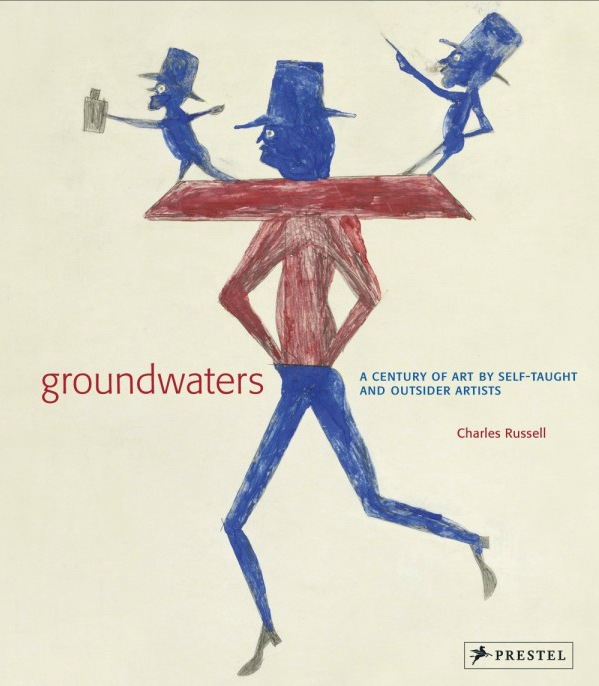
Groundwaters

A Century of Art by Self-Taught and Outsider Artists

by Charles Russell; Prestel, New York

Some call it outsider art; others prefer self-taught. Still others insist on distinguishing between folk art and naïve art, or the less pejorative terms vernacular art and visionary art. Then there’s Art Brut, Neuve Invention and art therapy. Confusion and disagreement have come to reign over this fervently debated world. Charles Russell’s authoritative new survey attempts to clear up some of the muddle. Read the rest of this entry »

Under the Big Black Sun: California Art 1974–81

Museum of Contemporary Art, Los Angeles

John Divola, Zuma #9 (1978/2006)

Events sometimes tell their own story. 1974: Richard Nixon resigns; Patty Hearst is kidnapped by left-wing terrorists; the U.S. oil crisis continues. 1975: Saigon falls; Gerald Ford survives two assassination attempts, both in California. 1976: Chairman Mao dies. 1977: Elvis Presley dies; Jimmy Carter is sworn in. 1978: Californian cult, the Peoples Temple, commits mass suicide in Jonestown, Guyana; Harvey Milk and George Moscone are shot in San Francisco; Proposition 13, limiting Californian property taxation, is passed. 1979: Three Mile Island nuclear disaster; the U.S. embassy in Tehran is seized; revolution in Nicaragua; Soviet Union invades Afghanistan, reigniting the Cold War. 1980: the U.S. and other countries boycott the Summer Olympics in Moscow; John Lennon is murdered. 1981: assassination attempt on the Pope; Egyptian president Anwar Sadat is assassinated; AIDS is identified; Ronald Reagan is sworn in as president. Read the rest of this entry »

Bobbi Woods

Annie Wharton Los Angeles

Seven ninths of Bobbi Woods’ exhibition ‘COMA (so fine)’ is, ostensibly, exactly the same. She has sprayed identical movie posters with black enamel, masking out only the title, Coma, which stands out in dull, lithographed black against the oily gloss of Woods’ paint. Read the rest of this entry »

Richard Jackson

David Kordansky Gallery, Los Angeles

Richard Jackson’s preferred brand of paint is called BREAK-THROUGH. ‘A new paint chemistry,’ boasts the label, ‘The tradition continues!’ Half-empty tins of BREAK-THROUGH, in primary colours, lay around his cataclysmic installation The Little Girl’s Room (2011), his first solo show in Los Angeles for 20 years. The rest had been pumped through tubes threaded into the penis of an inverted, pink fibreglass unicorn, and exploded out of its anus. Red, yellow and blue paint is spattered all over the floor, the walls, the ceiling and the unicorn himself.

Read the rest of this entry »