Jonathan Griffin

Criticism and essays on art and culture

Category: Review

Thomas Helbig

China Art Objects Galleries, Los Angeles
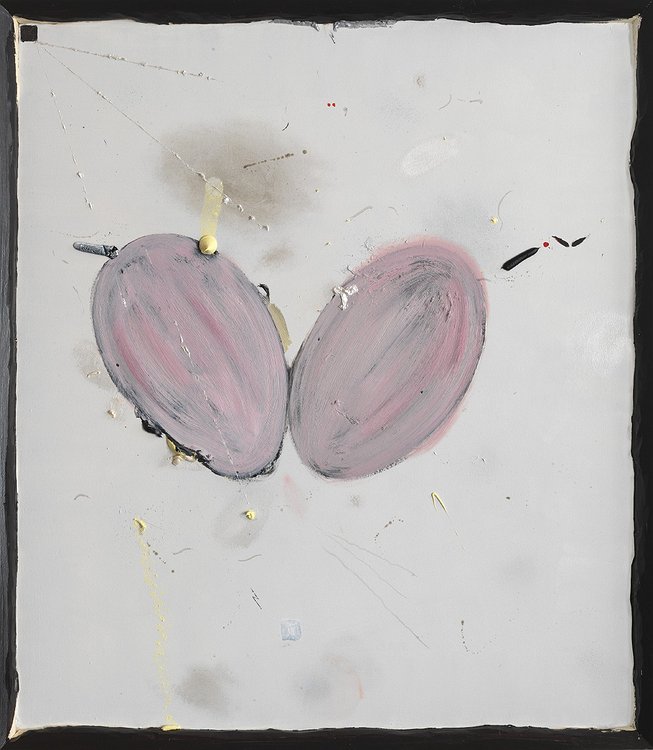
There is a moment in Thomas Helbig’s exhibition ‘Use Your Relatives’ that I can’t stop thinking about. A large oil painting comprises two pale pink egg shapes on a dirty white ground. The forms touch – kiss – at one edge; as we approach, the mess around them clarifies into a constellation of distinct, deliberate marks. In its lower left corner, a caterpillar-sized lozenge of paint, straight from the tube, has rolled from the point where it was applied and come to rest against the bottom edge of the frame, leaving sticky lemon-yellow tracks across the surface of the painting. Where it began, another squeeze of paint has been applied, making the trail double-headed and seemingly offering an inversion of the work’s downward gravitational pull.
Read the rest of this entry »

Andrew Lord

Milton Keynes Gallery, UK

Eighteen Mexican Pieces (1993) Photo: Andy Keate

At the end of Milton Keynes Gallery’s exhibition of work by Andrew Lord, upstairs past three galleries of exquisitely installed ceramics, plaster sculptures and drawings, is a one hour 43 minute-long video of Lancastrian morris dancers performing in blackface. Lord, a Lancashire-born artist now living in New York, has said that ‘Making objects has been a way for me to understand things I’ve found incomprehensible’. Britannia Coconutters dance through Bacup, Easter Sunday (2009) is one of a series of films made by the artist over the past three years in and around the area in which he was raised. Despite his incomprehension, it is possible that Lord recognises something of the tradition’s defiant oddness, and its anachronism, in his own practice.

Read the rest of this entry »

Amanda Ross-Ho

Cherry & Martin, Los Angeles

In the work of Amanda Ross-Ho, bigger is not necessarily better. Her exhibition ‘A Stack of Black Pants’ is packed with images, objects and interventions, some of it grand in scale and some nearly invisible. One of the show’s pivotal pieces isn’t even acknowledged in the list of works: it consists of five tiny pieces of haberdashery – a zipper, an earring, a couple of unidentified bits of jewellery and a gold heart – fixed directly to the wall. Between them, a ruled pencil line connects one to the other; all roads, however, lead to the heart, which is positioned to one side. It looks like a symbolic diagram.

Read the rest of this entry »

Jen DeNike

The Company, Los Angeles

In occultism, the verb ‘to see’ usually refers not to the ordinary processes of visual apperception but to psychic insight. ‘Seers’, as those gifted in this area are known, sometimes adopt the practice of scrying – an ill-defined process of divination that uses repetitive gestures around substances such as crystals, mirrors or water to conjure visions from beyond.

Read the rest of this entry »

Nick Relph

Overduin & Kite, Los Angeles

There’s a song by the band Silver Jews that contains the line: ‘Punk rock died when the first kid said / “Punk’s not dead. Punk’s not dead.”’ The man often credited with inventing Punk in the UK, Malcolm McLaren, died earlier this year. New York-based British artist Nick Relph’s exhibition was, in one sense, a tribute to McLaren’s enduring influence, and in another, an examination of the way that this short-lived countercultural movement has been mummified – or, worse, reanimated into a walking corpse – in the years since someone first insisted that ‘Punk’s not dead’.

Read the rest of this entry »

Aaron Curry

David Kordansky Gallery, Los Angeles

Featuring condensation in advertisements for soft drinks or beer is a great way of bringing the inside out: droplets of water on a bottle, can or glass are an index of the cool, refreshing contents within. Somewhere in this visual archetype’s DNA we might also trace the contradictory associations of sweat (our own) and the unsullied freshness of morning dew on grass.

Water droplets covered the walls of Aaron Curry’s exhibition ‘Two Sheets Thick’ at David Kordansky Gallery. Unlike the glinting moisture in Coca-Cola advertisements, however, these were dully printed onto large sheets of cardboard in uneven shades of grey, resembling the output of a failing photocopier. This, as with many things in ‘Two Sheets Thick’, was something of an illusion. They were in fact reproductions of photorealist drawings that the artist made by hand using a digital stylus (an oxymoronic tool if ever there was one), subsequently enlarged and screen-printed onto primed sheets of card. A fair degree of craftsmanship attended images that went out of their way to look dashed-off.

Read the rest of this entry »

Support Group

Cottage Home, Los Angeles

‘it’s all about …’ trilled the perky, lower case script, ‘gaylen gerber!’. The text ran across two billboards affixed to the exterior of Cottage Home, the former cinema that has served as a project space for three commercial galleries: Kathryn Brennan Gallery, China Art Objects and Thomas Solomon Gallery. For what it’s worth, ‘Support Group’ took place at the instigation of the latter, although Solomon’s contribution seems to have been limited to inviting critic Michael Ned Holte to curate the show, which featured none of Solomon’s gallery artists. This was just the first sequence in a complicated game of authorial ‘pass the parcel’, in which no one, it seemed, quite knew who would be the one with the package in their hands when the music stopped.

Read the rest of this entry »

Bob Law


Karsten Schubert and Thomas Dane Gallery, LondonIn 1959, Bob Law lay in a Cornish field and wondered how to describe the space he was in. His solution was a series of drawings in which figurative elements – such as trees or houses – are arranged along a doddery pencil line at the perimeter of the paper. A year later, Law had distilled this approach to his signature device: the rectangular perimeter alone, bounding empty space, sometimes accompanied by a date, a title or his name, always in block capitals. Read the rest of this entry »

Duncan Campbell

Chisenhale Gallery, London

I might as well park it out front: to most people, the name DeLorean will forever be linked to time travel- specifically to the car modified for that purpose by ‘Doc’ Brown in the Back to the Future films (1985–1990). In Duncan Campbell’s film Make It New John (2009), we travel back to the late 1970s, when flamboyant American motor industry supremo John DeLorean elected to manufacture his new company’s only car – the DMC-12 — in West Belfast.

Read the rest of this entry »

Ben Rivers


A Foundation, Liverpool, UK

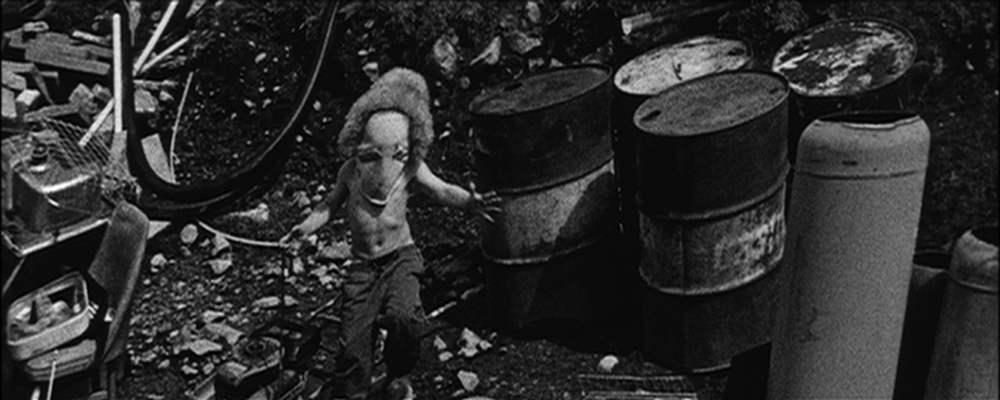
Ben Rivers makes films about latter-day hermits and pioneers – usually men – who have chosen to exist at an ideological and geographical remove from the rest of society. The London-based artist journeys into the depths of private, imperfect, perhaps misguided but defiantly hopeful worlds. His use of a wind-up Bolex camera and hand-processed film seems not just to be a matter of interpretation, but the only appropriate response to the jerry-rigged and hamstrung lifestyles he is permitted to witness. Read the rest of this entry »