Jonathan Griffin

Criticism and essays on art and culture

Pietro Roccasalva

David Kordansky Gallery, Los Angeles

Pietro Roccasalva’s work poses problems to those looking for legible meaning. Although his visual language of recurrent symbols and metaphors looks very much like it should be in some way translatable, most of its etymologies are so deeply entombed in Roccasalva’s eccentric logic that even those closest to him – assistants and gallerists, for instance – are sometimes at a loss to decode it. Read the rest of this entry »

David von Schlegell

China Art Objects Galleries, Los Angeles

For all those (myself included) requiring an introduction to David von Schlegell’s art, the sculpture Five Birds and its attendant Untitled Study for Five Birds (both 1988) greeted visitors at the entrance to his exhibition. Birds in flight, cobbled from shards of aluminium tube and hanging on monofilament, cast fluttering shadows over the cut-paper studies on the wall behind. These were far from the most sophisticated works in the show, but they announced, for the uninitiated, the artist’s fascination with dichotomies of form and weightlessness, land and air, the man-made and the natural. Read the rest of this entry »

Alex Israel

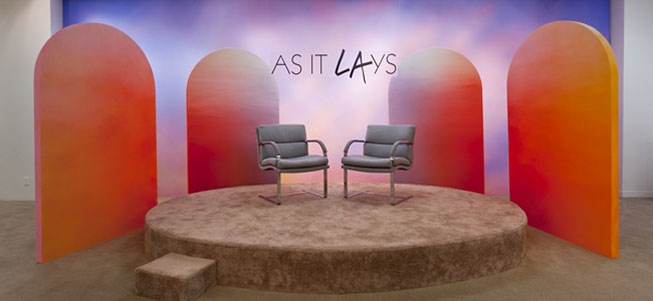
'As It Lays', 2012. Photograph: Joshua White

The last question that Alex Israel asks each of his celebrity subjects in his video interview series ‘As It Lays’ (2012) is the same: ‘What do you want the world to know about [subject’s name]?’ A surprising number have exactly the same response: ‘Nothing.’ Surprising, because these are people whose very livelihood relies on public visibility, and who are voluntarily submitting to the Los Angeles-based artist’s deadpan interrogation. Their answer points to the open secret of the celebrity system: that the illusion of self-exposure can be the best defence for intensely private personalities. Read the rest of this entry »

Physica Sacra

While doing research for my forthcoming book Itinera Alpina (a collaboration with Ben Branagan – watch this space) I came across an image that stopped me in my tracks. It was an 18th-century engraving, showing a massive veiny liver apparently floating over a bucolic pastoral landscape, bordered by an elaborate Rococo frame. I found it reproduced in a book (in German) about 18th-century Zurich. Neither Ben nor I had any idea how or why such an image would come into being, or what it meant, but we were captivated by its weirdness, and it became an inspirational touchstone as we put together our book. Read the rest of this entry »

Nathan Hylden

Richard Telles Fine Art, Los Angeles

The facetious joke – or is it a wry compliment? – about white monochrome paintings is that they hardly differentiate themselves from the walls they hang on. Despite choosing as his pictorial subject rectangles of blank white wall, Nathan Hylden worked hard to make the paintings in his exhibition ‘So There’s That’ as unblank and as unneutral as possible. Read the rest of this entry »

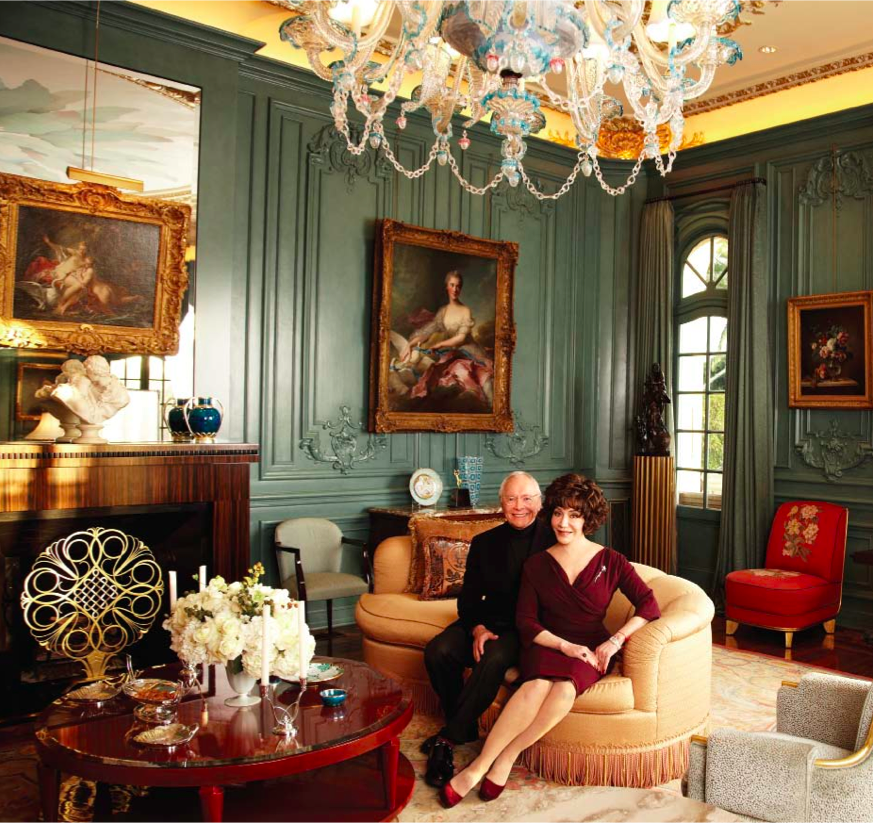
Stewart and Lynda Resnick

Photograph: Amanda Friedman

A chapter in Lynda Resnick’s book Rubies in the Orchard: How to Uncover the Hidden Gems in Your Business is titled ‘The One True Copy of Jackie Kennedy’s Real Fake Pearls’. Resnick tells the story of how, in 1996, Sotheby’s auctioned the estate of Jackie Kennedy Onassis, including her iconic three-strand pearl necklace. It didn’t matter that the pearls were imitation, and that the young Jacqueline Bouvier had picked them up at Bergdorf Goodman for around $35. They were listed by Sotheby’s at $200–$300. Resnick was determined to have them, and persuaded her husband Stewart to bid all the way to the jaw-dropping closing price of $211,000. The couple were the subject of ridicule in the national press. Read the rest of this entry »

Kaari Upson

Life Study

Kaari Upson admits she’s told this story so many times, in so many different ways, that it’s become hard to get it straight any more. Her changing recollection of events has now superseded hard truth. Journalists and critics, falling over themselves to retell the incredible tale, also invariably bungle their facts, and so further pollute her memories. She’ll do her best though. Here goes. Read the rest of this entry »

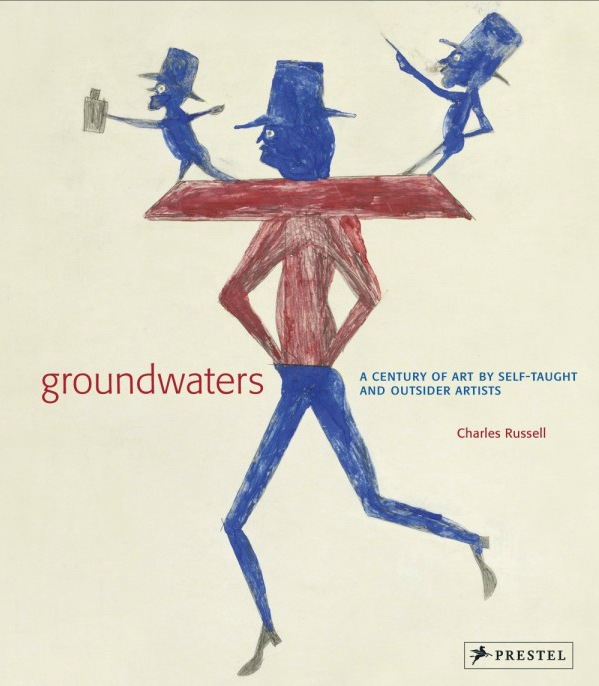
Groundwaters

A Century of Art by Self-Taught and Outsider Artists

by Charles Russell; Prestel, New York

Some call it outsider art; others prefer self-taught. Still others insist on distinguishing between folk art and naïve art, or the less pejorative terms vernacular art and visionary art. Then there’s Art Brut, Neuve Invention and art therapy. Confusion and disagreement have come to reign over this fervently debated world. Charles Russell’s authoritative new survey attempts to clear up some of the muddle. Read the rest of this entry »

Undead and/or Dead Living: The New Social Category

Mateo Tannatt on Zombies

 
Mateo Tannatt’s diverse artworks are hard to summarise in general terms. However, one frequent point of departure for the artist is the idea that public urban space – particularly corporate space – is a stage for involuntary performance by all those who use it. Tannatt has made installations, photographs, paintings and films; for the recent Performa 11 biennial in New York, he devised Pity City Ballet, a performance resembling a television talk show which took place in the lobby of the Saatchi & Saatchi headquarters in Manhattan. The following exchange, with the art critic Jonathan Griffin, developed over the weeks leading up to that performance. Griffin and Tannatt are both based in Los Angeles. Read the rest of this entry »

Peter Shire

Photograph: Tim Street Porter

Mid-Century Modified


‘The famous photograph’, as Peter Shire calls it, hangs over the dining table in his Los Angeles home. It shows the moment that his parents, Henry and Barbara, first met. The story is almost too good to be true: she was working for the San Francisco longshoremen’s union, he for IATSE – the union for technicians working in the theatre and entertainment industries. At a longshoremen’s fundraiser, a photographer snapped Henry delivering magazines to Barbara’s table. This being 1946, the early days of McCarthyism and Communist paranoia, the photographer sent one copy of his picture to Peter’s parents and one to the FBI. Peter, an artist famous for his work with the 1980s’ design collective Memphis, was born about nine months later.

Read the rest of this entry »