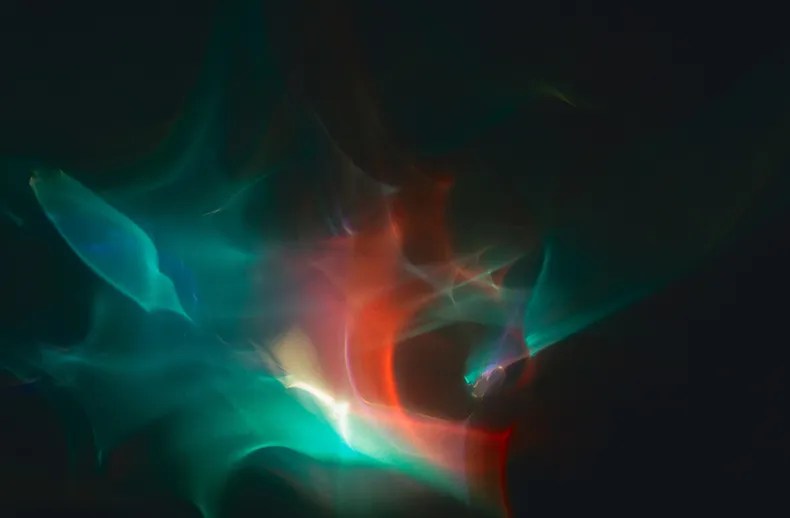
Lumia Suite, Op. 158 (1963–64), Thomas Wilfred. Museum of Modern Art, New York
Between 1964 and 1981, visitors to New York’s Museum of Modern Art (MoMA) could sit in a darkened room and contemplate opalescent wisps of colour drifting slowly across a screen. The installation, tucked in the museum’s basement, was a favourite among regulars. At times, the screen – eight feet wide and six high – was filled with diaphanous skeins of pale yellow, green, blue or pink, while at other times the light dwindled, letting most of the picture fall into darkness. It was mesmeric, unlike anything else in the museum. Unlike, probably, anything yet made in the history of humankind.
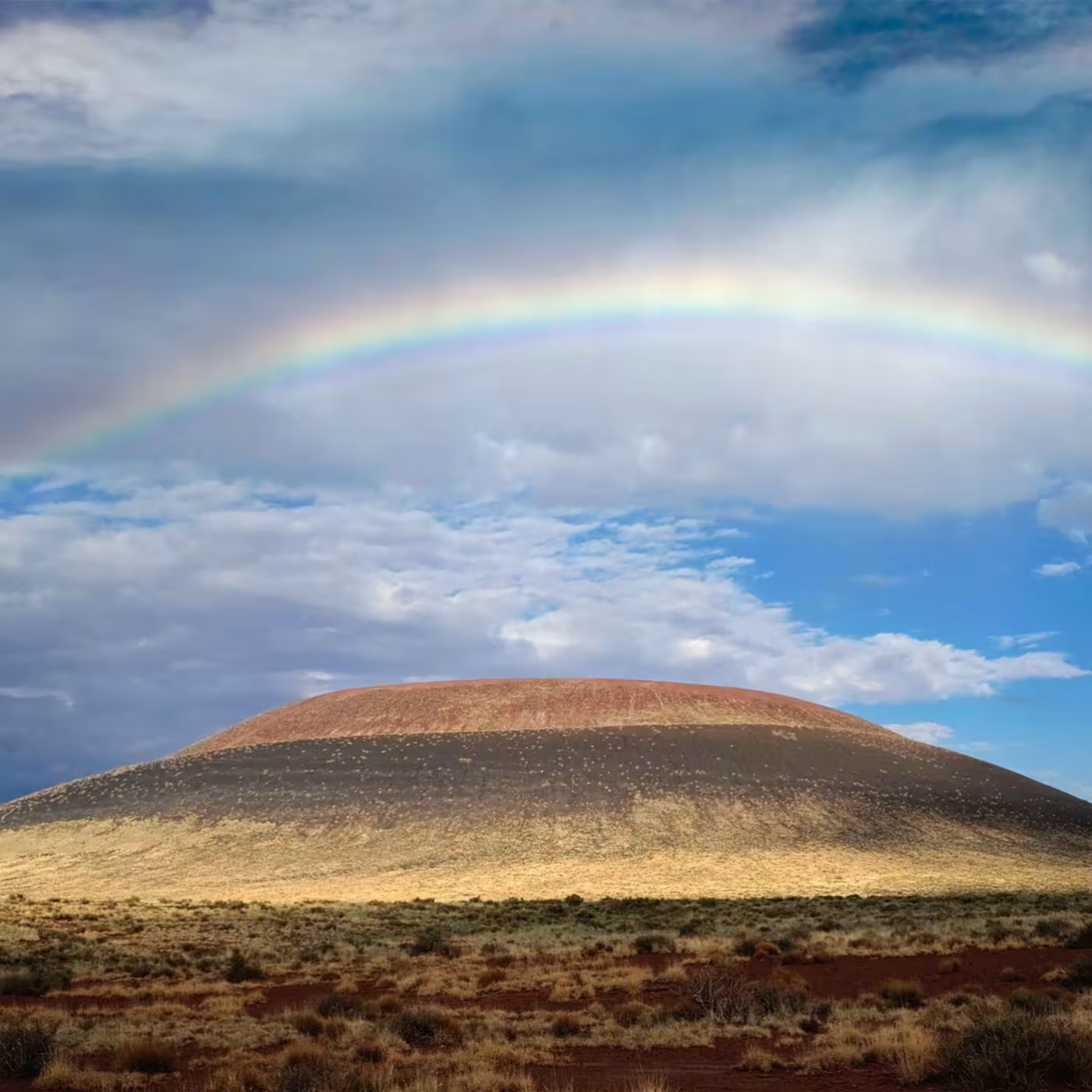
The high terrain of the Walking Cane Ranch in north-central Arizona, between the Painted Desert and the Little Colorado River and the San Francisco Peaks, is astoundingly beautiful. Flaxen grasses dust black and red volcanic gravel, which rises in huge, soft mounds — extinct volcanoes, the newest of which last erupted in 1066.
James Turrell, 81, the owner of this ranch and one of America’s most beloved artists, calls it “a land between”.
Sometimes, you only notice something when it’s gone. In the past few months, I have become aware of the absence, in a growing number of artists’ work, of narrative—in particular, narrative about these artists’ biographies or identities. Much of this work is abstract, often purely abstract, and it seems that more and more people, myself included, are lately being drawn to this type of nonobjective and nonliteral work. Historically, abstraction in visual art developed along two parallel avenues: the distortion of things seen in the world (Paul Cézanne, Pablo Picasso) and the invention of entirely nonobjective forms (Kazimir Malevich, Wassily Kandinsky, Hilma af Klint). The contemporary work I have been noticing is, by and large, aligned with the latter stream of abstraction. In something of a departure from the dominance of identity-centered figuration in recent years, much contemporary abstraction is being made by artists of color who are resistant to foregrounding their identities through narrative. As mixed-media artist Teresa Baker described her abstract paintings to me, she noted that it is work that “should speak for itself. I shouldn’t have to give words to it.” Her position is echoed by Rema Ghuloum, a painter based in Los Angeles, who told me: “I really want the work to speak for itself.”
In Diana Thater’s survey “The Sympathetic Imagination,” organized by the National Gallery’s Lynne Cooke and LACMA’s Christine Y. Kim and gathering work made between 1992 and the present, the artist floods many of her exhibition spaces with colored light. This technique and its philosophical implications may remind visitors of James Turrell’s use of light in his 2013-14 LACMA retrospective. Color is fundamentally illusory; it is humans who make the sky blue, thanks to the cones in our retinas. Further, in an environment saturated with blue light, every other perceptible color is revealed to be contingent. The absolute purity of nature is impossible, Thater shows; all is culture, or something between nature and culture. Read the rest of this entry »
In the Skyspace meeting room at Kayne Griffin Corcoran gallery in Los Angeles, James Turrell is telling me about the Antikythera Mechanism. In the spring of 1900, a group of Greek sponge divers discovered the sunken wreck of a Roman cargo ship off an island in southern Greece. Among the coins, jewelry, glass and statuary that they recovered was a corroded hunk of bronze and wood, about a foot in width. An archaeologist at the time suggested it might be an astronomical clock, but its complexity did not fit with its estimated date—a century before Christ. Read the rest of this entry »
“This used to be my studio!” announces James Turrell to the customers of Starbucks in Ocean Park, Santa Monica. The coffee drinkers seem nonplussed. Little do they know that this white-haired, extravagantly bearded figure has a triumvirate of retrospectives this summer at the Los Angeles County Museum of Art, the Museum of Fine Arts, Houston, and the Guggenheim Museum, New York, as well as a solo exhibition at LA’s Kayne Griffin Corcoran gallery.


 Jonathan Griffin