Jonathan Griffin

Criticism and essays on art and culture

Month: February, 2020

Alice Tippit

Grice Bench, Los Angeles

AT-6_1340_c

Dress, 2019, Oil on canvas, 18 x 22 in, courtesy Grice Bench, Los Angeles

Groins abound in Alice Tippit’s exhibition of paintings and drawings at Grice Bench. They are not always easy to see, however – or rather, they disappear at second glance. What, you might ask yourself, is so crotchlike about that upside-down vase (Peer, all works 2019), that candle (Cinch), or that stick of dynamite (Safe)? Tippit is a master of the now-you-see-it, now-you-don’t school of visual innuendo, of drawing-room indecency, of wordplay that seems outrageously funny even if, on reflection, you can’t exactly say why.

Read the rest of this entry »

Lauren Halsey

Screen Shot 2020-02-11 at 5.15.37 PM

Lauren Halsey’s Martin Luther King Jr. Day parade float, January 2016. Courtesy: the artist and David Kordansky Gallery, Los Angeles

In January 2016, Lauren Halsey made a float for the Martin Luther King Jr. Day parade in the South-Central Los Angeles neighbourhood where she grew up. She rented a 15-metre flatbed truck, which was delivered to her mother’s house. Halsey realized, with some dismay, that she had about 48 hours to decorate it, and only a vague idea of what she planned to do. Read the rest of this entry »

‘With Pleasure: Pattern and Decoration in American Art, 1972–85’

Museum of Contemporary Art, Los Angeles

MOCA_2019_12_03_023_v2.jpg,1000

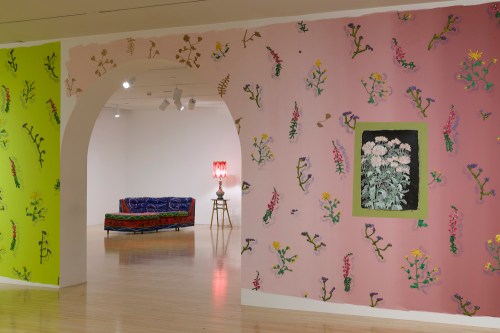
View of “With Pleasure: Pattern and Decoration in American Art 1972—85” at the Museum of Contemporary Art, Los Angeles, 2019–20. Image courtesy of the Museum of Modern Art, Los Angeles. Photo by Jeff Mclane.

Pattern and Decoration (P&D), a tendency which crystallized into a movement in New York in the mid-1970s, is one of the few movements of modern art to have self-designated, rather than been identified either by critical champions (think of Germano Celant and Arte Povera) or by sneering skeptics (Finish Fetish, Fauvism). Its members, though heterogeneous in their work, were united in their artistic tastes and temperament: they espoused a maximalist aesthetic that drew from global traditions and sources, also often aligned with feminist art practices that embraced domestic handicrafts. They had no manifesto, but critical allies including Amy Goldin and John Perreault have written eloquently about their work and aims. According to Perreault, “Pattern painting is non-Minimalist, non-sexist, historically conscious, sensuous, romantic, rational, decorative. Its methods, motifs, and referents cross cultural and class lines.”1 Read the rest of this entry »