Jonathan Griffin

Criticism and essays on art and culture

Category: Review

George Herms: Xenophilia

MOCA at the Pacific Design Center, Los Angeles

George Herms must get tired of being referred to as the last of his generation. Born in 1935, he was amongst the youngest of the Beats and a pioneer of the California Assemblage movement. Like many of his peers he saw his lack of art school training as no impediment to combining found objects in the way that he might compose a poem, or jam with jazz musicians. By reputation, and by the evidence of his unkempt but literary art, he’s a free spirit, a mystic. He stands (especially in younger minds) for a now rare artistic archetype, pure of heart and innocent of commercial ambition. Herms is regarded with affection, and, as ‘George Herms: Xenophilia (Love of the Unknown)’ proposes, his work remains a touchstone for a slew of artists working today. Read the rest of this entry »
Michael E. Smith

Michael Benevento, Los Angeles

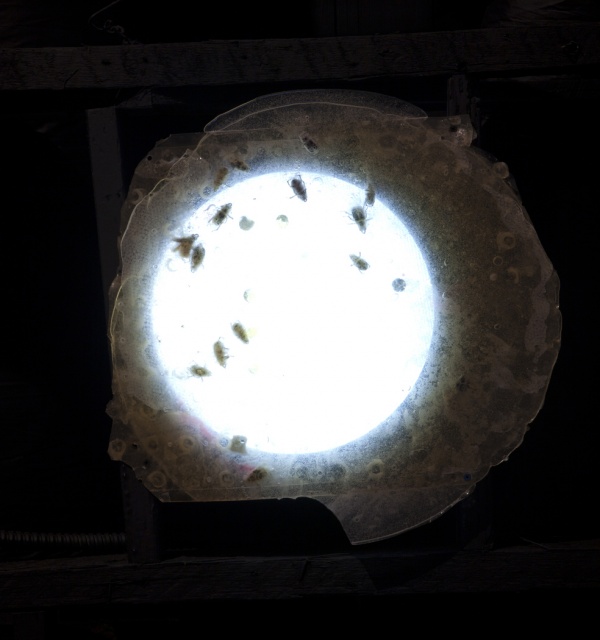
Sometimes artists’ biographies become so central to the reception of their art that they threaten to overwhelm it entirely. Michael E. Smith’s association with the blighted post-Fordist city of Detroit has become almost impossible to separate from his tender but trashed sculptures, paintings, videos and installations.

Read the rest of this entry »

David Snyder

Michael Benevento, Los Angeles

‘That old defence – an inch deep smile and a suitcase out the back window.’ It’s a great line, and it comes halfway through David Snyder’s exhibition ‘Face Forward’. To give it a bit of context, we must step away from the CD player from which it emanates, back out through the doorway in the wooden façade that spans the middle of the space, past another CD player and another yammering voice, out the door of the gallery and onto the street.

Read the rest of this entry »

Mike Kelley

Gagosian Gallery, Beverly Hills

Kandor 18 B (2010), photograph: Fredrik Nilsen

‘Portrait of the Artist as Superhero’

In 2000, Mike Kelley made a film titled Extracurricular Activity Projective Reconstruction #1 (Domestic Scene). It was the first of a series of works that reanimated photographs of carnivalesque performances he found in high school yearbooks such as plays or fancy dress days; he saw them, he said, as ‘rituals of deviance’.[i] Some were simply photographs; others comprised installations, video performances and original music. In 2005, he presented the series in his acclaimed exhibition ‘Day is Done’ at Gagosian Gallery in New York. (Matthew Higgs breathlessly suggested at the time that it was ‘the best show ever’.[ii])

Read the rest of this entry »

Analia Saban

Thomas Solomon Gallery, Los Angeles

Analia Saban’s exhibition strives to entertain, despite its obvious handicap: all the paintings are grey. Within this austere limitation, Saban finds diverse and ingenious ways of dismantling the procedure of painting. By dispensing with colour (unless you insist that grey is a colour too), she directs our attention to paint’s constructive rather than representational qualities. Read the rest of this entry »

Henry Taylor

Blum & Poe, Los Angeles

The colour black is, notionally, an absolute. As a racial classification, however, black consists of myriad shades of grey, though it continues to absolutely define many Americans’ lives. In Henry Taylor’s work it appears both as a colour and a condition. In each instance, the Los Angeles-based artist proves black to be a potent but inadequate term when talking about the realities of people’s daily existence.

Read the rest of this entry »

Jim Lambie

Goss Michael Foundation, Dallas

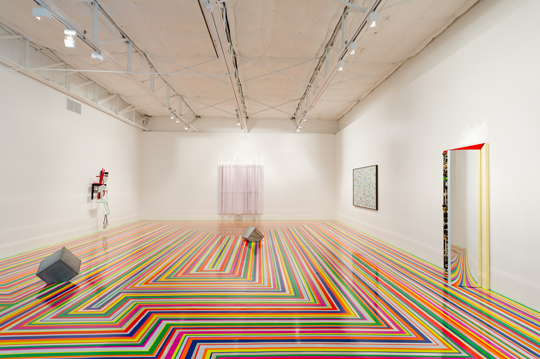
Jim Lambie made his first ‘Zobop’– the multicoloured, multilayered vinyl floor installation for which he is most widely recognised – in 1999. If a thing’s worth doing, the saying goes, it’s worth overdoing; for his exhibition at the Goss Michael Foundation in Dallas, the Glasgow-based artist reprised his 2004 iteration of the work, Zobop Fluoro, in the foundation’s expansive new premises. (His exhibition was the first solo presentation after an inaugural group show.)

Read the rest of this entry »

All of This and Nothing

Hammer Museum, Los Angeles

The Hammer Invitational is a biannual survey exhibition that has never called itself a biennial. That is about to change: next year it will be superseded by the new Los Angeles Biennial, organized jointly by the Hammer Museum and LAXART. For the time being, however, it remains an impressionistic report on the weather over LA’s contemporary art landscape. The latest incarnation, ‘All of This and Nothing’, is notable for including only seven artists (out of a selected 14) who currently live in LA; Hammer curators Douglas Fogle and Anne Ellegood, in their first exhibition together, are more interested in identifying the global currents of influence and parity that pass through the city. Read the rest of this entry »
Paul Stoelting

Pepin Moore, Los Angeles

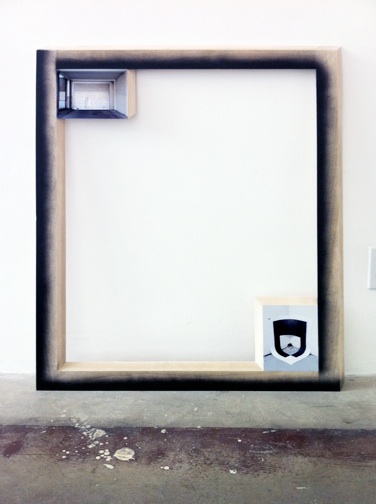
Paul Stoelting’s sculptures always seem to be sliding away from you. Objects that at first appear relatively straightforward – a length of timber, a picture frame – soon reveal themselves to be unstable, skewed and evasive. Stoelting’s exhibition Content Aware is dominated by a series of sculptures that look like supports for paintings: rectangular frames of wood hung on or propped against the wall. Closer inspection reveals the wood to be uniformly bevelled at 45 degrees, giving the impression that the object is oriented towards a vanishing point somewhere beyond one or the other of its corners. Since the frames hang against the wall on (what one assumes is) a deliberately ugly, pragmatic block screwed into the masonry, those rectangles whose bevels slope upwards are incapable of hanging without sliding off. Hence their positioning on the floor.

Read the rest of this entry »

Nathan Mabry

Cherry & Martin, Los Angeles

The unresolved debate around the work of Nathan Mabry seems to hinge on a question of belief: to what extent does Mabry mean what he says? Is the cynical humour and teenage innuendo in his work an expression of a mind deeply concerned with the unstable meanings and values of cultural artefacts, or is the artist just playing wilfully, provocatively dumb?

Read the rest of this entry »