Jonathan Griffin

Criticism and essays on art and culture

Category: Review

Jason Rhoades

Hauser & Wirth, Los Angeles

dywyMjQwO2gsMTI2MDtxLDgwO2YsaHdsYS8yMDE3LzAzLzI4LTIwMTcwMjE1X0hXU19SaG9hZGVzLU1NXzA2Ny00ZDMwYmEuanBn

Jason Rhoades, My Madinah. In pursuit of my ermitage…, 2004, Mixed media, Dimensions variable © The Estate of Jason Rhoades Courtesy the estate, Hauser & Wirth and David Zwirner Photo: Fredrik Nilsen

Will there come a day when Jason Rhoades’s giant lexicon of euphemisms for female genitalia – typically manifested in coloured neon letters, several inches high, strung throughout his installations – no longer has the power to offend? Will adherents of the Muslim faith one day become so laissez-faire that they no longer mind that, in Rhoades’s installation My Madinah. In pursuit of my ermitage… (2004), these neon words are dangled from the ceiling above a parody of a mosque, with old towels laid out on the floor instead of prayer rugs? Not to mention the sensitivities of Native Americans, who are invited to witness dubiously authentic embroideries and dream-catchers, acquired in bulk as raw material for Rhoades’s The Black Pussy … and the Pagan Idol Workshop (2005) and Tijuanatanjierchandelier (2006), tangled with Moroccan ornaments, Mexican serape blankets and ‘slippery nipple’ mugs, amongst other tourist tat.
Read the rest of this entry »

Olga Balema

Hannah Hoffman Gallery, Los Angeles

olga-balema-install-19_300dpi

Olga Balema, A thing filled with evil streams, 2016, Wood, latex, Magic Sculpt, cell phone motors, batteries, 31x8x7 inches. Courtesy Hannah Hoffman Gallery

I was laughing even before I entered the gallery. Beside the door to Hannah Hoffman, a notice announced the title of Olga Balema’s exhibition: ‘On the Brink of My Sexy Apocalypse’. There was certainly nothing laugh-out-loud funny in the show, but Balema’s work has an electric material intelligence and sense of the unexpected that might be termed, inadequately, wit. Read the rest of this entry »

Question the Wall Itself

Walker Art Center, Minneapolis

fullsizeoutput_585f

Marc Camille Chaimowicz, Here and There, 1978, installation view, Walker Art Center, 2016

Do not make your way to ‘Question the Wall Itself’, the Walker Art Center’s survey of artists’ work with interior architecture and decor, if you are looking for ideas for new curtains in the back bedroom. The only fabric samples on display belong to the collection of the late Seth Siegelaub, sourced from Oceania and Africa, and are hand-painted on brown barkcloth. On second thought, actually, this is a great place to get ideas for your curtains. Read the rest of this entry »
Terence Koh

Moran Bondaroff, Los Angeles

beam-05_0022_Layer-2-1000x595

Over the decade and a half of his career to date, Terence Koh has generated so many myths that it is now nearly impossible to begin thinking about his work without first acknowledging the tales of his personal and professional decadence in New York during the pre-crash mid-aughts, or the story of his apparent atonement when he faded from hypervisibility following his 2011 show “nothingtoodoo” at Mary Boone, New York, retreating with his partner to a mountaintop in the Catskills. The legend is threadbare from retelling; you’re at a computer—if you don’t already know it, Google him. Better, instead, to start with some facts about Terence Koh in 2017. Read the rest of this entry »

Concrete Islands

Kayne Griffin Corcoran, Los Angeles

100b20ef55806b995bfac84b422009cd

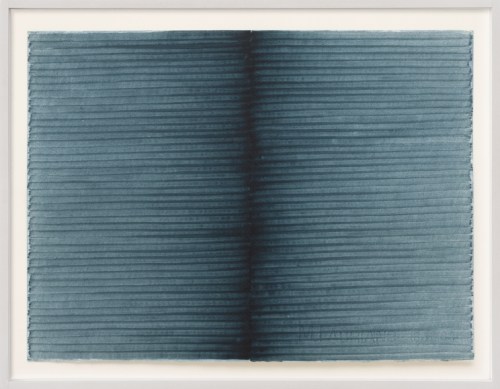
Irma Blank, Radical Writings, Exercitium, 1988, Acrylic on card, 11 1/8 x 15 inches


Writing is full of holes. Holes between the letters, within the letters, between the words and sentences and paragraphs, holes between thoughts and intentions and meaning. Writing is as much not there as it is there. It is a wonder that it holds itself together at all. Much doesn’t. Read the rest of this entry »

Tamara Henderson

REDCAT, Los Angeles

tamara-henderson_16204327537

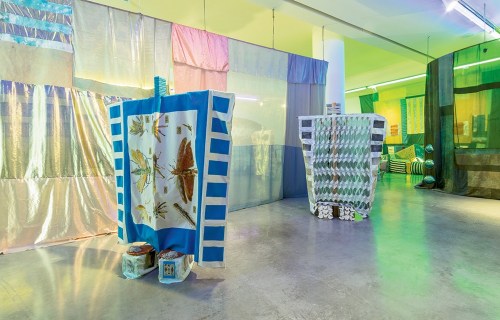
Canadian artist Tamara Henderson’s exhibition “Seasons End: Panting [sic] Healer” drew on journeys both geographic and psychic, and had all the dislocating strangeness of a theater wardrobe or prop room. The dense agglomeration of sculptures, installations, fabric tapestries, and paintings (all 2016) was an expansion of Henderson’s presentation earlier this year at the Glasgow International, the work for which she began developing during a residency in Arbroath, Scotland, in 2015. Material for the exhibition was also gathered in Turkey; in the sculpture Seasons End Vehicle, a ramshackle motorcar has stuffed into pockets in its trunk a map of Istanbul, in addition to a leaflet listing tourist attractions near Inverness.  Read the rest of this entry »

Betye Saar

Roberts & Tilton, Los Angeles

Betye Saar, Museum Het Domein, Sittard, the Netherlands, 2015.

Betye Saar, Pause Here – Spirit Chair, 1996, Mixed media assemblage with metal garden chair and neon, 31.5 x 24.5 x 20.5 in

Betye Saar’s double exhibition at Roberts & Tilton coincides with the opening of her career survey at the Fondazione Prada, Milan. The first exhibition, titled Black White (which opened a month before the second exhibition), is a more concise presentation in the gallery’s project space that arranges assemblage sculptures and collages spanning from the present back to an early etching by the artist – now a nonagenarian – from 1964. Blend, the second and more generously spaced display (actually including fewer works), occupies the main gallery. Its focus is the major mixed media installation Mojotech (1987), which stretches nearly 7.5 metres along one wall and was the outcome of a residency Saar undertook at the List Visual Arts Center at the Massachusetts Institute of Technology (MIT), in Cambridge. Read the rest of this entry »

SITElines.2016

Site Santa Fe, New Mexico

javier_tellez-3

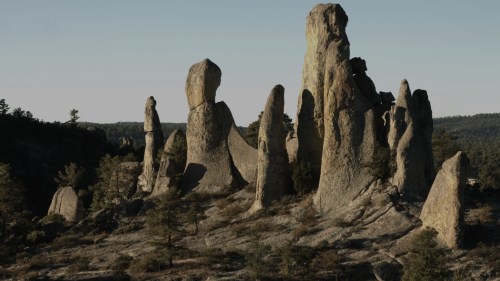
Javier Tellez, To Have Done with the Judgment of God, 2016, digital film, 37 minutes

On the campus of the Santa Fe Indian School (SFIS), about a mile from SITE Santa Fe, one of Italian architect Paolo Soleri’s most important buildings is crumbling behind a chain-link fence, out of bounds to students and the public alike. The extraordinary cast-concrete Paolo Soleri Amphitheater was commissioned in 1964 by Lloyd Kiva New, the Cherokee cofounder of the Institute of American Indian Arts. New’s vision for the school was to use Native American heritage as the basis for contemporary artistic expression. Conservative Pueblo tribal leaders were skeptical of this approach, however, and in 1981 the All Indian Pueblo Council routed the school from its premises and replaced it with the more traditional SFIS, which had formerly occupied the campus and, after a complicated history (it was originally a government institution devoted to forced assimilation, for instance) and a dissolution, was being reformed under the leadership of the Pueblo tribes. Read the rest of this entry »

Ry Rocklen

headplanter3rr72dpi

Ry Rocklen, Head Planter, 2016, Terracotta, sonotube and paint, 48 x 18 x 18 inches    Courtesy the artist and Honor Fraser Gallery, Los Angeles. Photo by Brian Forrest

Humility has been a consistently appealing quality in Ry Rocklen’s work over his decade-long career. Even when it approaches bling – as with his polished bronze cast of a punctured Humvee wheel (Untitled Hummer Flat, 2014) ­– his work is inflected with a down-home wit and a self-deprecating localism. Rocklen, an LA native who also studied in the city, is more entitled than most to call it his muse. The press release for ‘L.A. Relics’, incredibly the artist’s first exhibition in Los Angeles since 2009, curiously notes that his memories of the 1984 LA Olympics were particularly influential on the series that shares the show’s title. Read the rest of this entry »

Tinseltown in the Rain

Telles Fine Art, Los Angeles

tinseltown1

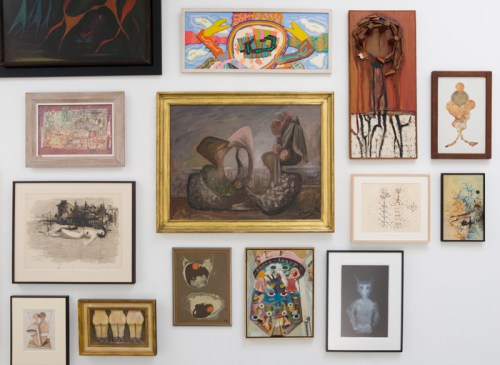
Man Ray once commented that ‘there was more surrealism rampant in Hollywood than all the surrealists could invent in a lifetime’. The line comes to us via William Copley, who, in 1949, exhibited canonical works by Max Ernst, René Magritte, Man Ray and others in a short-lived gallery in Beverly Hills, to almost universal indifference. There were, however, a handful of Los Angeles artists who took notice, including Lorser Feitelson, Helen Lundeberg, Peter Krasnow and Knud Merrild. These artists and many more are brought together by curator Max Maslansky in ‘Tinseltown in the Rain: The Surrealist Diaspora in Los Angeles 1935–69’. Read the rest of this entry »