Jonathan Griffin

Criticism and essays on art and culture

Hanne Darboven

Sprüth Magers, Los Angeles

hda_install_sm_la_2016_61

Hanne Darboven, For Abraham Lincoln, 1989, 776 sheets, 29,5 x 21 cms each, mounted on 97 70 x 100 cm plates, with 8 sheets each. © Hanne Darboven Foundation, Hamburg / ARS, New York 2016; Courtesy Sprüth Magers and Crone Gallery. Photo: Joshua White, 2016

Rows of numbers instill in me a sickening panic. I got that feeling, familiar from childhood mathematics lessons and annual tax returns, in Hanne Darboven’s current exhibition at Sprüth Magers, Los Angeles. Read the rest of this entry »
Tinseltown in the Rain

Telles Fine Art, Los Angeles

tinseltown1

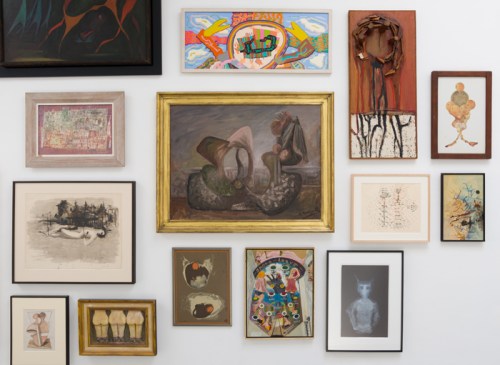
Man Ray once commented that ‘there was more surrealism rampant in Hollywood than all the surrealists could invent in a lifetime’. The line comes to us via William Copley, who, in 1949, exhibited canonical works by Max Ernst, René Magritte, Man Ray and others in a short-lived gallery in Beverly Hills, to almost universal indifference. There were, however, a handful of Los Angeles artists who took notice, including Lorser Feitelson, Helen Lundeberg, Peter Krasnow and Knud Merrild. These artists and many more are brought together by curator Max Maslansky in ‘Tinseltown in the Rain: The Surrealist Diaspora in Los Angeles 1935–69’. Read the rest of this entry »

Sterling Ruby

sterling-ruby

Sterling Ruby, DEEP FLAG (5532), 2015, Bleached fleece and elastic, 174 1/2 × 316 inches © Sterling Ruby Photo by Thomas Lannes

I am waiting for Sterling Ruby in a supermarket parking lot on the east side of Los Angeles, and wondering what kind of car he drives. Black Range Rovers and Teslas are popular with successful artists in LA. But the 44-year-old Ruby projects something of the image of a showman, so when a custom 1980s Cadillac with chrome rims pulls in, I think for a moment it might be him. On the other hand, Ruby is a father of three, so perhaps pragmatism wins out: a Mercedes estate or even — who knows — a Volvo.

Read the rest of this entry »

Pentti Monkkonen

Jenny’s, Los Angeles

pentti

Pentti Monkkonen, T.R.E.A.M. (2016). Wood, sand, acrylic, and aluminum

Before there were art schools and galleries in Los Angeles, there were murals. The tradition has a long and distinguished history, dating from the city’s eighteenth-century Hispanic founders, and it continues to thrive and evolve. LA-based artist Pentti Monkkonen’s exhibition of new works (all 2016) at Jenny’s smartly engaged with this history, drawing on retrospective time frames both micro and macro.

Read the rest of this entry »

Carl Cheng

Cherry and Martin, Los Angeles

cheng_erosion_machine_4_detail_jmc_web

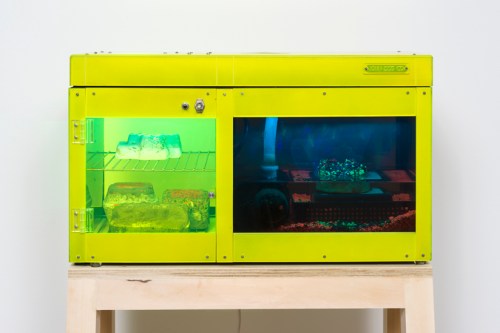
Carl Cheng, Erosion Machine (detail), 1969, Plexiglas, metal racks and fittings, plastic, water pump, LED lights, black light, pebbles, 4 erosion rocks and wood base, 38 x 64 x 23 cm. All images courtesy: the artist and Cherry & Martin, Los Angeles

In 1967, the year he graduated from the University of California, Los Angeles, Carl Cheng registered the trade name John Doe Co. and, soon after, began stamping it on his sculptures. Up to this point, much of Cheng’s work had a formal relationship to photography – he was taught by the influential artist-photographer Robert Heinecken, who was instrumental in widening the field – but, as John Doe Co., Cheng began producing objects that seem more like crackpot inventions than image-based sculptures. Read the rest of this entry »
Weaving Histories

The impact of pre-Columbian techniques and designs on 20th-century artists

1_17_1

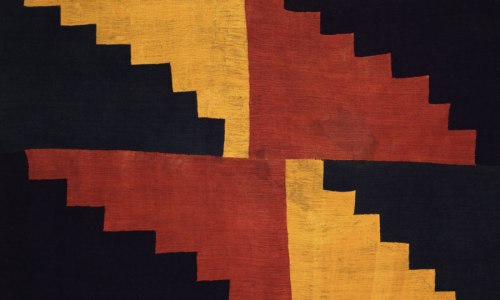
Detail of tunic with stepped triangles, Nazca Culture, South Coast, c.700-800, scaffold weave, camelid wool, 186 x 123 x 6 cm. Courtesy: Yale University Art College, New Haven

Sheila Hicks was a student at  Yale when she took a class on pre-Columbian art in the mid-1950s. At the time, there was only one book in the library on Andean textiles,  Raoul d’Harcourt’s Textiles of Ancient Peru and their Techniques (1934) — still essential reading on the subject  — and she saw that Anni Albers had checked it out. Hicks was captivated by the textiles produced by Andean tribes in the centuries before the Spanish Conquest of 1532, as well as those predating the Incas who ruled for the preceding 100 years. ‘The richness of the pre-Incaic textile language is the most complex of any textile culture in history,’ she has said.1 The study of Andean textiles is virtually mandatory for anyone serious about weaving. Even before the Early Nazca period (approximately 1‒450), almost all weaving techniques — such as kelim, interlocking and eccentric tapestry; pattern weaves, weft scaffolding, twining and plaiting; lace, brocade, wrapped weaving and double cloth — were already known. Hicks was impressed by how, before written language, these ancient peoples organized ideas through thread. Her own earliest weavings — such as Muñeca (1957), which is titled after the woven dolls found in Andean tombs — were simply ‘attempts to understand material structures’.2 Read the rest of this entry »

Benjamin Carlson

Park View, Los Angeles

parkview-2016-06-13_005_lores

What more obvious subject could there be for a painting that deconstructs the mechanics of representation than a still life in front of a window? The window, as a picture within a picture, traditionally stands as a proxy for the painting – the painting’s self-image, as it were – while the still life has for centuries been a convenient armature for everything from allegories of mortality to investigations into optical perception. Read the rest of this entry »

Joan Snyder

Parrasch Heijnen Gallery, Los Angeles

image6

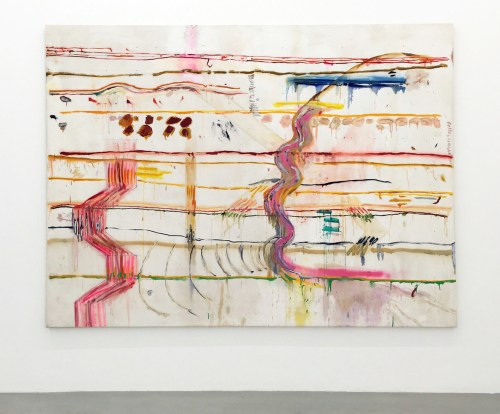
The New York-based painter Joan Snyder came to attention quite suddenly, in 1971 at the age of thirty-one, when she exhibited a body of work that she referred to as her ‘stroke paintings’. These large canvases, both abstract and expressionist, though ambivalent towards the orthodoxies of the masculine Abstract Expressionist movement, arranged discontinuous strokes of different colours on horizontal grids. Snyder’s Spring 1971 (1971), which introduces her exhibition at Parrasch Heijnen Gallery, is a classic work from this pivotal moment in her career. Read the rest of this entry »

Routine Pleasures

MAK Center, Los Angeles

01 Routine

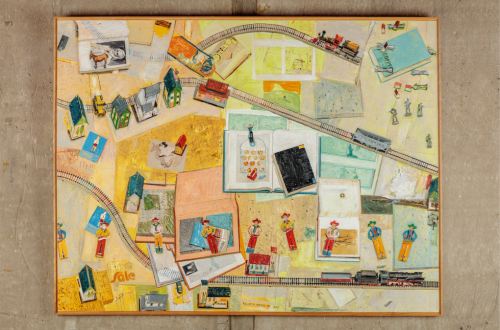
Manny Farber, Birthplace: Douglas, Ariz. (1979). Oil on board. Image courtesy of the MAK Center and Doug Simay. Photo: Joshua White.

How would you like to be labeled a termite? Or rather, to cite the term that Manny Farber coined in 1962, a “termite artist”? Farber—the San Diego painter and film critic who died in 2008—was writing in the now defunct magazine Film Culture, expanding on his opposing terms “termite art” and “white elephant art.” Read the rest of this entry »

Los Angeles Reflections

Alex Israel and Brett Easton Ellis, Gagosian, Beverly Hills

Catherine Opie, MOCA Pacific Design Center, Los Angeles

“West Hollywood”, AA|LA, Los Angeles

img-overview-los-angeles-reflections-1_111402771057

Alex Israel and Bret Easton Ellis: Different Kind of Star, 2016, acrylic and UV ink on canvas, 7 by 14 feet; at Gagosian Beverly Hills. © Alex Israel and Bret Easton Ellis; image courtesy iStock and Gagosian Gallery. Photography: Jeff McLane.

Type “Los Angeles” into the search box of iStockphoto.com and you will see over seventy thousand images, many of which look very much the same. For the works in a recent exhibition at Gagosian in Beverly Hills, Alex Israel spent what must have been many grueling hours scouring the database, finally selecting a group of images that distill the clichés underwriting the romantic fantasy that—for some—is Los Angeles. He then UV-printed the photos on large panoramic canvases, with words by Bret Easton Ellis, his collaborator for the show, displayed across them. Read the rest of this entry »