Jonathan Griffin

Criticism and essays on art and culture

The Surrealist Bungalow: William N. Copley and the Copley Galleries (1948-49)

William N. Copley with his own paintings in Paris, 1951, two years after he closed the Copley Galleries and left Los Angeles. Photo: Mike De Dulmen. Courtesy the Estate of William N. Copley.

William N. Copley with his own paintings in Paris, 1951, two years after he closed the Copley Galleries and left Los Angeles. Photo: Mike De Dulmen. Courtesy the Estate of William N. Copley.

“No one in their right mind would have considered trying to open a Surrealist gallery in the California environment, which, of course, is what we decided to do late one whiskied evening,” wrote the artist and collector William N. Copley. “In the white haze of the morning after, we were both too proud to perish the thought.” 1 Read the rest of this entry »

Carnegie International 2013

Carnegie Museum of Art, PittsburghCI130362_swords

“You can’t bring culture to people, you can only bring it out of them.” That’s Robert Rauschenberg, in a 1968 manifesto titled “Proposals for Public Parks” which the curators of the 2013 Carnegie International—Daniel Baumann, Dan Byers, and Tina Kukielski—have reprinted in the catalog for their exhibition. Rauschenberg’s assertion poses a ticklish problem for the trio, whose assigned mission it has been (as first mandated by Andrew Carnegie in 1895) to bring culture to the people of Pittsburgh. Invigorated by Rauschenberg’s paradox, they have installed an edition of the Carnegie International (last held in 2008) that is both deeply rooted in its historical and geographical situation, and expansive in its purview. Artists from Switzerland and England lure visitors into the museum with eye-catching outdoor sculptures while, inside, the first work one encounters is by Polish artist Paulina Olowska, who has borrowed a collection of puppets from a Pittsburgh theater. Elsewhere, art from New York, Tehran, Zagreb, and Johannesburg seeks to connect the far-flung with the close at hand. And—notwithstanding the peripatetic art crowd that descended on Pittsburgh for the exhibition’s gala opening—it is the local audience that the 2013 Carnegie International seems designed to address. Read the rest of this entry »
Sean Kennedy


Thomas Duncan Gallery, Los Angeles

Sean Kennedy

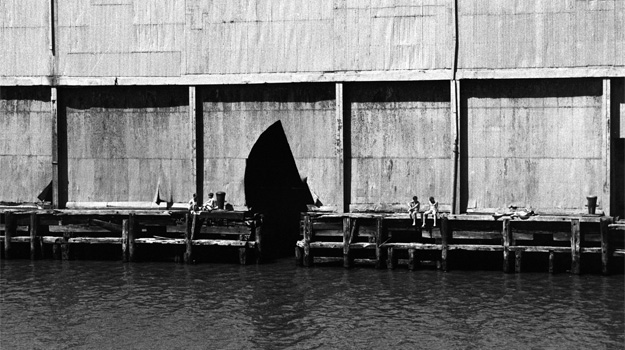
Sean Kennedy is not a great painter. His brushwork is hesitant, his mark-making is sloppy and inconsistent, and his colouration, though vivid, seems uninterested in harmony. Against these odds, however, he has created a suite of great paintings. If indeed paintings is what they are. Read the rest of this entry »

Lucie Stahl


Lucie Stahl

JONATHAN GRIFFIN Is the scanner a photographic tool for you, or is it more to do with collage?

LUCIE STAHL I’m quite an impatient person so the immediacy of working with a scanner is nice. It is of course a bit like making photograms but without the inconvenience of having to stand around in a darkroom full of chemicals all day. It gives me time to do a lot of stuff I’d rather be doing than making art. I’m often asked about the process and presentation of photography in relation to my work and my use of the scanner, but my work is not necessarily about photography. Of course it is unavoidable but it’s just not something I think about. I think more about the stuff that surrounds us in general. Photography is one of those things. I don’t really distinguish between the frame and the content. Read the rest of this entry »

Frances Stark

Frances-Bobby-Jesus's-Alma-Mater_web

“What is this? 
This is me writing.”

So begins a text Frances Stark wrote in 2002, part of a handmade publication titled The Unspeakable Compromise of the Portable Work of Art. For two decades Stark has been writing about writing, and making art about the vexing processes of artistic production. If that sounds limited in scope or overly solipsistic, then consider the range of themes that this activity has, in Stark’s hands, enlisted. From performance anxiety and creative block to exhibitionism (peacocking, as she often characterizes 
it), to the art market and artist community, to pedagogy, her favorite music and books, her sexuality, and her family, the Los Angeles–based Stark has never lacked for material. Everything in her life has the potential 
to be incorporated into her art. Her collage Push, 2006, shows exhibition invitation cards flying through her mail slot like a horizontal tornado. Read the rest of this entry »

Close Encounters

Do initiatives like the Google Art Project help us see more – or less?

Brueghel-tower-of-babel

These days, websites have trailers. The ‘teaser’ video on YouTube for the Google Art Project opens, sedately enough, with a painting hanging on a wall. From middle distance, Pieter Breughel the Elder’s The Tower of Babel (1563) looks as if the colossal edifice is collapsing rather than growing. But then the camera zooms in, drawing closer and closer to the painting, eventually coming so close that it bursts through a tiny dark window in the tower. Whammo! Read the rest of this entry »

John Wesley


David Kordansky Gallery, Los AngelesJohn Wesley 3


When John Wesley makes paintings of women, which he does very often, he makes paintings about men. Against powder-blue backgrounds, he floods their lithe bodies with a flat shade of pale pink, except for a hotter tone used for lips, nails and nipples. These are pictures of heterosexual male desire. When men appear, they tend to be woefully disproportioned and eccentrically dressed. His women, by contrast, are the sylphs of an imagination fired by the dreamy perfection of women in magazines and dampened by the comic pathos of real-life encounters. Read the rest of this entry »

Ed Fornieles


Mihai Nicodim Gallery, Los AngelesFornieles

If Britney Rivers didn’t exist, someone would have to invent her. She is the epitome of Generation Y narcissism and vapidity, a creature who gives fullest expression to her life on Facebook and Instagram, whose pronouncements are specially keyed to half-bored, half-horny social media browsers. Her Tweets include such gems as: ‘Cute guy emails 2 ask me out on coffee date but “sent from droid” so now i’m like :-/’. I’m Facebook friends with her. You should be too. Read the rest of this entry »
Seeds of Destruction

A History of Iconoclasm in British Art

Dead Christ (1500–20) Courtesy: The Mercers' Company

Dead Christ (1500–20)
Courtesy: The Mercers’ Company

In 1957, the artist Gustav Metzger mounted an exhibition of damaged art in King’s Lynn. ‘Treasures from East Anglian Churches’ was a selection of sacred artefacts that had been attacked during the period of iconoclasm between the English Reformation in the 1530s and the Commonwealth of 1649–60 when Britain, under the Puritan Oliver Cromwell, was effectively a republic. Metzger already knew plenty about annihilation. Born to Jewish parents in Nuremburg, he was evacuated via Kindertransport to England in 1939 at the age of twelve, just as Nazi Germany was engaging in genocide against its own people. His parents disappeared soon after. In the 1950s he was involved in activism, first with the Committee for Nuclear Disarmament and then as a founder of the Committee of 100. Later he made art born of material violence; nylon panels that he corroded with acid, and liquid crystal projections that melted and reformed under the heat of the projectors. He called it Auto-Destructive Art.

Read the rest of this entry »

Urs Fischer

Museum of Contemporary Art, Los AngelesUrs Fischer Horses Dream of Horses 2004

When asked about scale in a recent interview, Urs Fischer said that ‘the physical size of the art work doesn’t make it big or small.’ The scale of an object, he argued, is the size it assumes in the viewer’s mind; not its size in the gallery space. Fischer has become known for making very large art works – often from seemingly small ideas – as well as small works based on big ideas. This discrepancy has won him as many admirers as detractors. Read the rest of this entry »