Jonathan Griffin

Criticism and essays on art and culture

Alika Cooper

Night Gallery, Los Angeles

NG_cooper_upbraid_IMG_6841

A blacked-out gallery, with opening hours of 10pm to 2am, is liable to give the art on its walls a certain transgressive frisson. Night Gallery is such a location. For more than two years, it has staged exhibitions in a space that seems more like a club than a gallery. ‘Upbraid’ by Alika Cooper – the final show at its original Lincoln Heights premises before it moves into whitewashed architecture and daytime hours – both plays up to and dissents from the louche tone of the space. Read the rest of this entry »

Andrea Longacre-White

Various Small Fires, Venice, CA

 Andrea L-W3

One day, someone will curate an exhibition of antique digital art that features iPhones, iPads, Photoshop effects, email threads and inkjet prints. The glass and chrome gadgets will seem hopelessly quaint. (‘How did we ever carry this stuff around?’ we’ll ask each other, incredulously.) The work of Andrea Longacre-White will probably be included in the show. Read the rest of this entry »

Frames of Reference

In recent years, the work of self-taught artists has come to be contextualized within larger narratives of contemporary art. How is Outsider Art best understood and what does this definition mean when ‘inside’ and ‘outside’ become blurred? How does it relate to fraught issues of education and exclusion, originality and exploitation? Jonathan Griffin invited Robert GoberMatthew HiggsPaul Laffoley and David Maclagan to discuss these questions.

John Hiltunen, Untitled, 2012, collage, 30 × 21 cm

Read the rest of this entry »

Rachel Foullon

ltd los angeles, Los Angeles

In contrast to an art gallery, a barn is designed more for efficient storage than for carefully poised display. Rachel Foullon has transformed the white space of ltd los angeles into an uncannily refined vision of a barn, and filled it with artworks old and new, some rescued from her archive and some made specially for the exhibition. Read the rest of this entry »

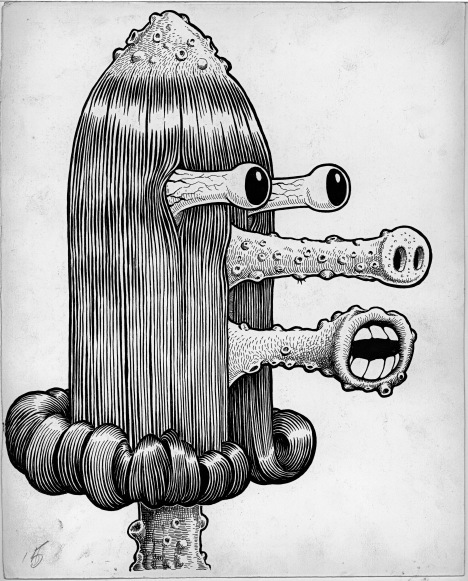
On the Grotesque

Basil Wolverton, Heap, 1955
© The Wolverton Estate. Courtesy Gladstone Gallery, New York

The grotesque got its name by mistake. When, one day in fifteenth-century Rome, a young man fell into a hole in a hillside, he assumed he’d discovered a Roman grotto. He fetched a lantern and found wild frescoes over the grotto’s walls: half-human, half animal figures, with legs and arms transforming into curling vines or ornamental volutes. In fact, he had stumbled upon Nero’s buried Villa Aurea, the raised floor level giving the rooms a grotto-like appearance. Nevertheless, the term “grotteschi” stuck as a label for this newly discovered style that radically dissented from the classical restraint to which the Renaissance had hitherto adhered. Read the rest of this entry »

ACIREMA

Honor Fraser, Los Angeles


Have you figured it out yet? It took me a while. ‘ACIREMA’ is America spelt backwards; this exhibition, curated by Cesar Garcia, takes as its conceptual motif the famous drawing by Uruguayan artist Joaquín Torres-García of South America upside down. América Invertida (Inverted America) (1943) does not feature in the exhibition. Instead, curator Garcia has convened eight artists from South and Central America born since 1980 who, he argues, ‘actively challenge the conventional framing and contextualizing mechanisms through which their practices are often situated’. Read the rest of this entry »

Standard Operating Procedures

Blum and Poe, Los Angeles

What is the difference between a “standard operating procedure” and a formula, an algorithm, a set of instructions, a program, a system, a recipe or a run book? This exhibition, which takes SOPs as its theme, never makes it quite clear. But its curator, Piper Marshall, contends in her press release that “Today, SOPs are determining the conditions of everyday life,” through such esoteric formulations as search engines, dating sites, self-help books, and targeted advertising.

Read the rest of this entry »

Made in L.A.

Hammer Museum, LAXART, and LA Municipal Art Gallery, Los Angeles

Who needs another biennial? Los Angeles does, according to the Hammer Museum. The reason: ‘Simply put, the artists,’ says Hammer curator Anne Ellegood in her catalogue essay. While artists are undeniably thick on the ground in LA, not all are good. The curators of ‘Made in LA 2012’ – Ellegood and Ali Subotnick from the Hammer, joined by Lauri Firstenberg, Malik Gaines and Cesar Garcia from its ‘sister institution’, LAXART – set themselves the challenge of finding 60 biennial-worthy artists who are either emerging or under-recognized. These criteria allowed for the inclusion of several artists born in the 1980s alongside more established elders such as Channa Horwitz, now in her 80s. Read the rest of this entry »

Sara Barker

The things that Sara Barker makes are less like sculptures than spatial drawings. Maybe, in fact, they’re not so much drawings as paintings – surfaces for colour and brush-marks, scraps of collage and daubs of textured filler. Then again, in their emphatically three-dimensional assumption of volume, perhaps they really are more like sculptures than paintings. Read the rest of this entry »

Thomas Houseago

At Thomas Houseago’s studio building in east Los Angeles, which spans a full city block beside the giant concrete trench known as the LA River, the road is closed to traffic. The mechanical arm of a refuse truck is lifting metal dumpsters and tipping their contents into its hopper. White plaster dust billows across the street. Houseago’s team is cleaning up. Once a week, the piles of plaster, hessian, clay, broken sculptures and cracked casts that accumulate in the studio are swept together and cleared out. Houseago used to do this himself; then, when it began to take two days out of each week, he delegated it to assistants. Now he employs a staff of 20, and has five foundries in the US working to cast his prolific output of sculptures in high-strength Tuf-Cal casting plaster or clay into dark bronze or pale, silvery aluminium. Galleries in New York, London, Zurich, Brussels and Glasgow try to keep up with the demands of a growing network of private collectors, as well as those of museums, including the Stedelijk in Amsterdam and the Museum of Contemporary Art in LA.

Read more…

First published: Financial Times, August 17th, 2012