Jonathan Griffin

Criticism and essays on art and culture

William Klein

You might know William Klein for the striking black and white photographs he took for Vogue in the 1950s and 60s, showing couture models cutting through the hubbub of New York and Rome. These, and his documentary street photographs – full of movement and danger and noise – are the subject of a forthcoming exhibition at Tate Modern, shared with the Japanese photographer Daido Moryama. Or perhaps you know him for Mr Freedom, his 1969 political satire about a feckless American superhero in France, or his send up of the fashion industry, Qui êtes-vous, Polly Maggoo?, released three years previously. You might even, if you’re a boxing fan, know his documentary Muhammad Ali: The Greatest 1964-74. Read the rest of this entry »

David Ostrowski

Ltd Los Angeles

David-Ostrowski, F (Jung, Brutal, Gutausehend), 2012, acrylic, lacquer, adhesive foil and cotton on canvas, wood, 87 x 67.3 in (221 x 171 cm)

The day I visit David Ostrowski’s exhibition, it’s raining. The unusually inclement weather seems appropriate for these battered, defeated-looking paintings. I am reminded of the terrible storm that hit New York recently. Ostrowski’s work corresponds to images of Chelsea-gallery employees hauling drenched canvases out of waterlogged crates. Read the rest of this entry »

Dianna Molzan

molz

Every painting — every good painting, at least — is a problem. This problem can come in all shapes and sizes: a problem with the world, a problem with painting, a problem with one’s self. Whether it’s the curious vibrational effect of two colors in proximity to one another or the crisis of consumer capitalism, a painting embodies or responds to the impetus for its own creation. Not all paintings solve their problems; most don’t even come close. Many create more problems. That’s okay. Read the rest of this entry »
Learning by Heart

Ken Price, Echo (1997) ©2012 Ken Price, photo ©2012 Fredrik Nilsen

Ken Price, Echo (1997) ©2012 Ken Price, photo ©2012 Fredrik Nilsen

Adrian Searle once claimed, in the pages of this magazine: ‘Everything I know, I think I’ve learnt from artists.’ In wondering, as I often have, whether what he said could be true and, if so, whether it could be true for me too, I’ve found myself asking what an education solely directed by art and artists would consist of. Read the rest of this entry »

Alika Cooper

Night Gallery, Los Angeles

NG_cooper_upbraid_IMG_6841

A blacked-out gallery, with opening hours of 10pm to 2am, is liable to give the art on its walls a certain transgressive frisson. Night Gallery is such a location. For more than two years, it has staged exhibitions in a space that seems more like a club than a gallery. ‘Upbraid’ by Alika Cooper – the final show at its original Lincoln Heights premises before it moves into whitewashed architecture and daytime hours – both plays up to and dissents from the louche tone of the space. Read the rest of this entry »

Andrea Longacre-White

Various Small Fires, Venice, CA

 Andrea L-W3

One day, someone will curate an exhibition of antique digital art that features iPhones, iPads, Photoshop effects, email threads and inkjet prints. The glass and chrome gadgets will seem hopelessly quaint. (‘How did we ever carry this stuff around?’ we’ll ask each other, incredulously.) The work of Andrea Longacre-White will probably be included in the show. Read the rest of this entry »

Frames of Reference

In recent years, the work of self-taught artists has come to be contextualized within larger narratives of contemporary art. How is Outsider Art best understood and what does this definition mean when ‘inside’ and ‘outside’ become blurred? How does it relate to fraught issues of education and exclusion, originality and exploitation? Jonathan Griffin invited Robert GoberMatthew HiggsPaul Laffoley and David Maclagan to discuss these questions.

John Hiltunen, Untitled, 2012, collage, 30 × 21 cm

Read the rest of this entry »

Rachel Foullon

ltd los angeles, Los Angeles

In contrast to an art gallery, a barn is designed more for efficient storage than for carefully poised display. Rachel Foullon has transformed the white space of ltd los angeles into an uncannily refined vision of a barn, and filled it with artworks old and new, some rescued from her archive and some made specially for the exhibition. Read the rest of this entry »

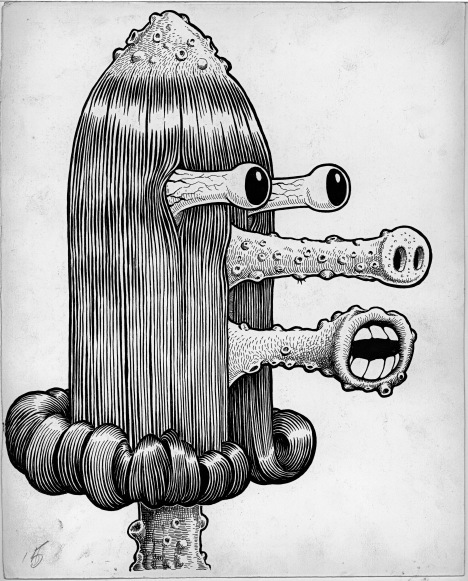
On the Grotesque

Basil Wolverton, Heap, 1955
© The Wolverton Estate. Courtesy Gladstone Gallery, New York

The grotesque got its name by mistake. When, one day in fifteenth-century Rome, a young man fell into a hole in a hillside, he assumed he’d discovered a Roman grotto. He fetched a lantern and found wild frescoes over the grotto’s walls: half-human, half animal figures, with legs and arms transforming into curling vines or ornamental volutes. In fact, he had stumbled upon Nero’s buried Villa Aurea, the raised floor level giving the rooms a grotto-like appearance. Nevertheless, the term “grotteschi” stuck as a label for this newly discovered style that radically dissented from the classical restraint to which the Renaissance had hitherto adhered. Read the rest of this entry »

ACIREMA

Honor Fraser, Los Angeles


Have you figured it out yet? It took me a while. ‘ACIREMA’ is America spelt backwards; this exhibition, curated by Cesar Garcia, takes as its conceptual motif the famous drawing by Uruguayan artist Joaquín Torres-García of South America upside down. América Invertida (Inverted America) (1943) does not feature in the exhibition. Instead, curator Garcia has convened eight artists from South and Central America born since 1980 who, he argues, ‘actively challenge the conventional framing and contextualizing mechanisms through which their practices are often situated’. Read the rest of this entry »