Jonathan Griffin

Criticism and essays on art and culture

Category: Uncategorized

Gina Beavers

Beavers 4_12

Gina Beavers, Memphis BBQ (looks like a Gina Beavers), 2013, acrylic on canvas, 40 x 40 cm. Courtesy: the artist and Michael Benevento, Los Angeles; photograph: Jeff McLane

Modelling the surface of a picture into a 3D relief, with contours that boost the image with real shadows and highlights, is a technique so crassly obvious that it is a wonder you don’t see it more often – not only in art but in visual culture in general. Why not, in order to snag the attention of easily distracted viewers, just make images that physically pop out from the wall? Read the rest of this entry »

Katy Grannan


april-and-robert-on-mattress-under-9th-street-bridge-modesto-ca-2013-c-katy-grannan-courtesy-fraenkel-gallery-san-francisco-and-salon-94-new-york_RezWT_W1600_H1199_H1199_Q85

April and Robert on Mattress Under 9th St Bridge, Modesto, CA, 2013, © Katy Grannan Courtesy Fraenkel Gallery, San Francisco and Salon 94, New York


For the past five years, Katy Grannan has been driving 100 miles south almost every week from her home in Berkeley on the edge of San Francisco Bay to Modesto in California’s Central Valley. Like other cities along State Route 99 – Stockton, Merced, Fresno, Bakersfield – Modesto is one of those places that tourists driving between San Francisco and Los Angeles pass through without stopping. The Central Valley is where, in the 1930s, John Steinbeck set The Grapes of Wrath and Dorothea Lange took her famous photographs of migrant sharecroppers. Both were beacons for Grannan during the making of The Nine, her first feature-length film, which will be screened in London next week. Read the rest of this entry »

Elaine Cameron-Weir

Venus, Los Angeles

12-snakewithsexualinterestinowntail_ECWE015_install_hr

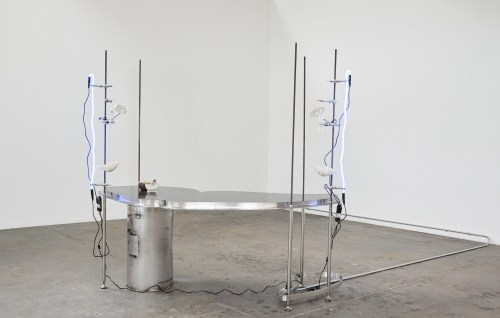
The 14,500 square-foot former warehouse occupied by Venus, two blocks east of the Los Angeles River, is one of the largest spaces for showing art in the city. For certain artists, it must seem problematically vast. Earlier this year, Marianne Vitale responded to the building’s challenge by filling it with 60 tonnes of railway track and stacks of massive pine posts. The fine sculptures of Elaine Cameron-Weir, however, typically operate at the level of the jeweller’s worktable or the scientist’s lab bench. Her exhibition Snake With Sexual Interest in Own Tail could be read as an essay on the elasticity of our perception of scale. Surprisingly, in this outsize building, it worked. Read the rest of this entry »

Walk Artisanal

3716 Eagle Rock Boulevard

mastersxfrontx001xRVDx0920xjpg.1800

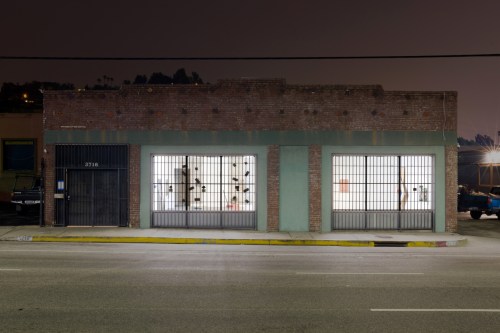
It’s no secret that the eastside of Los Angeles is gentrifying fast, and that most of us in the contemporary art community wring our hands in weak perplexity over the part that we play in the process. Nevertheless, many residents of Glassell Park were happy to see a new coffee shop open on Eagle Rock Boulevard in early 2015. Yelp reviewers have approved of the “clean and creative atmosphere.” (“Super chill place and the quality of people is very high as well,” wrote Anthony E.) Notwithstanding the “rude” servers, the clientele seems broadly to approve of the new establishment. Read the rest of this entry »

The Ocular Bowl

Kayne Griffin Corcoran Gallery, Los Angeles

2556_large

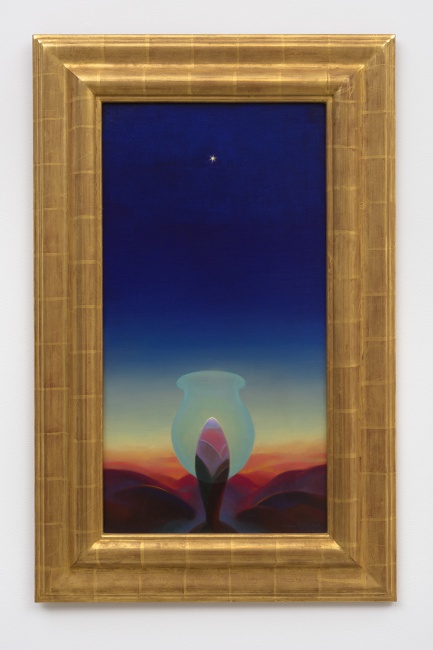
Agnes Pelton, Star Gazer, 1929

The eye, wrote Jacques Lacan in his essay ‘The Line and the Light’, ‘is a sort of bowl’ which light is wont to overflow. ‘A whole series of organs, mechanisms, defences’arerequired to deal with this excess; the shrinking pupil, in bright conditions, ‘has to protect what takes place at the bottom of the bowl.’ Read the rest of this entry »

Evan Holloway

David Kordansky Gallery, Los Angeles

EH-15-022g

It is possible to argue—and, indeed, I heard it argued while visiting this exhibition—that Evan Holloway belongs to the first generation of artists in Los Angeles that did not look outside of California, to New York or to Europe, to define their work, whether through aspiration or through contradistinction. If that sounds like hyperbole, it may not be as far-fetched as it initially seems. In any case, it is undeniable that in the late 1990s, a loose group of L.A. artists—including Holloway, Liz Craft, Jason Meadows, Jeff Ono and Kristin Calabrese—emerged with a distinctly homegrown vernacular. Read the rest of this entry »

SPRAY

CMF_009

John Knuth, Angeles Crest, 2015

Ultimately, it’s about God, or at least a whiff of the divine. And also about not getting shit on your hands.

Read the rest of this entry »

Prospect.3

Various venues, New Orleans

Paul Gauguin, Under the Pandanus (I Raro te Oviri), 1891, oil on canvas, 98 × 121 × 9 cm

It is odd to reflect that the idiosyncratic Prospect is the United States’ largest international art biennial. Its first iteration, in 2008, received an enthusiastic critical response but was still finding its infrastructural feet – as was New Orleans only three years after Hurricane Katrina or ‘the great storm’ (people in the city prefer not to humanize it with a name). Read the rest of this entry »

Jamian Juliano-Villani

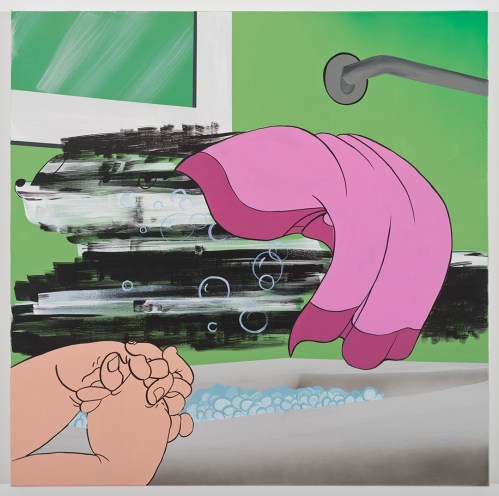
"Before Supper", 2013, Acrylic on Canvas, 24"x24"

The riotous, lurid paintings of Jamian Juliano-Villani speak in a language familiar from popular culture, but they articulate things never dreamt even by the most twisted imagination. Aliens having sex, suicidal trousers, and deviant Japanese river imps are just a few of the images that populate her paintings. Despite her work’s irreverent tone, Juliano-Villani is involved in a serious, introspective exploration of her own psyche, of the ethics of appropriation, and of the possibilities for contemporary painting.

We spoke in her Brooklyn studio in May 2014. Read the rest of this entry »

Portland2014

Various venues, Portland, OregonPortland2014

In the April issue of frieze, Dan Fox prefaced his review of the 2013 Carnegie International with some observations about the perplexing lack of consensus around what, today, a biennial is actually for. ‘Portland2014’ is the third in this current formulation (the Oregon Biennial ran from 1949 until 2006) but its agenda and format are still, evidently, very much up for grabs. Read the rest of this entry »