Jonathan Griffin

Criticism and essays on art and culture

SITElines.2016

Site Santa Fe, New Mexico

javier_tellez-3

Javier Tellez, To Have Done with the Judgment of God, 2016, digital film, 37 minutes

On the campus of the Santa Fe Indian School (SFIS), about a mile from SITE Santa Fe, one of Italian architect Paolo Soleri’s most important buildings is crumbling behind a chain-link fence, out of bounds to students and the public alike. The extraordinary cast-concrete Paolo Soleri Amphitheater was commissioned in 1964 by Lloyd Kiva New, the Cherokee cofounder of the Institute of American Indian Arts. New’s vision for the school was to use Native American heritage as the basis for contemporary artistic expression. Conservative Pueblo tribal leaders were skeptical of this approach, however, and in 1981 the All Indian Pueblo Council routed the school from its premises and replaced it with the more traditional SFIS, which had formerly occupied the campus and, after a complicated history (it was originally a government institution devoted to forced assimilation, for instance) and a dissolution, was being reformed under the leadership of the Pueblo tribes. Read the rest of this entry »

Ry Rocklen

headplanter3rr72dpi

Ry Rocklen, Head Planter, 2016, Terracotta, sonotube and paint, 48 x 18 x 18 inches    Courtesy the artist and Honor Fraser Gallery, Los Angeles. Photo by Brian Forrest

Humility has been a consistently appealing quality in Ry Rocklen’s work over his decade-long career. Even when it approaches bling – as with his polished bronze cast of a punctured Humvee wheel (Untitled Hummer Flat, 2014) ­– his work is inflected with a down-home wit and a self-deprecating localism. Rocklen, an LA native who also studied in the city, is more entitled than most to call it his muse. The press release for ‘L.A. Relics’, incredibly the artist’s first exhibition in Los Angeles since 2009, curiously notes that his memories of the 1984 LA Olympics were particularly influential on the series that shares the show’s title. Read the rest of this entry »

Hanne Darboven

Sprüth Magers, Los Angeles

hda_install_sm_la_2016_61

Hanne Darboven, For Abraham Lincoln, 1989, 776 sheets, 29,5 x 21 cms each, mounted on 97 70 x 100 cm plates, with 8 sheets each. © Hanne Darboven Foundation, Hamburg / ARS, New York 2016; Courtesy Sprüth Magers and Crone Gallery. Photo: Joshua White, 2016

Rows of numbers instill in me a sickening panic. I got that feeling, familiar from childhood mathematics lessons and annual tax returns, in Hanne Darboven’s current exhibition at Sprüth Magers, Los Angeles. Read the rest of this entry »

Tinseltown in the Rain

Telles Fine Art, Los Angeles

tinseltown1

Man Ray once commented that ‘there was more surrealism rampant in Hollywood than all the surrealists could invent in a lifetime’. The line comes to us via William Copley, who, in 1949, exhibited canonical works by Max Ernst, René Magritte, Man Ray and others in a short-lived gallery in Beverly Hills, to almost universal indifference. There were, however, a handful of Los Angeles artists who took notice, including Lorser Feitelson, Helen Lundeberg, Peter Krasnow and Knud Merrild. These artists and many more are brought together by curator Max Maslansky in ‘Tinseltown in the Rain: The Surrealist Diaspora in Los Angeles 1935–69’. Read the rest of this entry »

Sterling Ruby

sterling-ruby

Sterling Ruby, DEEP FLAG (5532), 2015, Bleached fleece and elastic, 174 1/2 × 316 inches © Sterling Ruby Photo by Thomas Lannes

I am waiting for Sterling Ruby in a supermarket parking lot on the east side of Los Angeles, and wondering what kind of car he drives. Black Range Rovers and Teslas are popular with successful artists in LA. But the 44-year-old Ruby projects something of the image of a showman, so when a custom 1980s Cadillac with chrome rims pulls in, I think for a moment it might be him. On the other hand, Ruby is a father of three, so perhaps pragmatism wins out: a Mercedes estate or even — who knows — a Volvo.

Read the rest of this entry »

Pentti Monkkonen

Jenny’s, Los Angeles

pentti

Pentti Monkkonen, T.R.E.A.M. (2016). Wood, sand, acrylic, and aluminum

Before there were art schools and galleries in Los Angeles, there were murals. The tradition has a long and distinguished history, dating from the city’s eighteenth-century Hispanic founders, and it continues to thrive and evolve. LA-based artist Pentti Monkkonen’s exhibition of new works (all 2016) at Jenny’s smartly engaged with this history, drawing on retrospective time frames both micro and macro.

Read the rest of this entry »

Carl Cheng

Cherry and Martin, Los Angeles

cheng_erosion_machine_4_detail_jmc_web

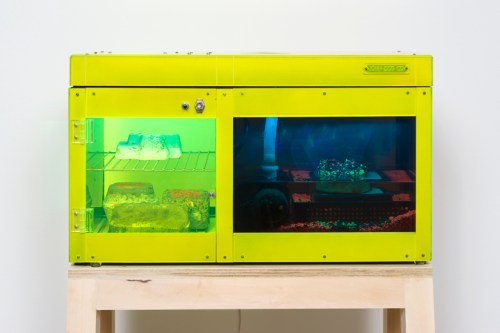
Carl Cheng, Erosion Machine (detail), 1969, Plexiglas, metal racks and fittings, plastic, water pump, LED lights, black light, pebbles, 4 erosion rocks and wood base, 38 x 64 x 23 cm. All images courtesy: the artist and Cherry & Martin, Los Angeles

In 1967, the year he graduated from the University of California, Los Angeles, Carl Cheng registered the trade name John Doe Co. and, soon after, began stamping it on his sculptures. Up to this point, much of Cheng’s work had a formal relationship to photography – he was taught by the influential artist-photographer Robert Heinecken, who was instrumental in widening the field – but, as John Doe Co., Cheng began producing objects that seem more like crackpot inventions than image-based sculptures. Read the rest of this entry »

Weaving Histories

The impact of pre-Columbian techniques and designs on 20th-century artists

1_17_1

Detail of tunic with stepped triangles, Nazca Culture, South Coast, c.700-800, scaffold weave, camelid wool, 186 x 123 x 6 cm. Courtesy: Yale University Art College, New Haven

Sheila Hicks was a student at  Yale when she took a class on pre-Columbian art in the mid-1950s. At the time, there was only one book in the library on Andean textiles,  Raoul d’Harcourt’s Textiles of Ancient Peru and their Techniques (1934) — still essential reading on the subject  — and she saw that Anni Albers had checked it out. Hicks was captivated by the textiles produced by Andean tribes in the centuries before the Spanish Conquest of 1532, as well as those predating the Incas who ruled for the preceding 100 years. ‘The richness of the pre-Incaic textile language is the most complex of any textile culture in history,’ she has said.1 The study of Andean textiles is virtually mandatory for anyone serious about weaving. Even before the Early Nazca period (approximately 1‒450), almost all weaving techniques — such as kelim, interlocking and eccentric tapestry; pattern weaves, weft scaffolding, twining and plaiting; lace, brocade, wrapped weaving and double cloth — were already known. Hicks was impressed by how, before written language, these ancient peoples organized ideas through thread. Her own earliest weavings — such as Muñeca (1957), which is titled after the woven dolls found in Andean tombs — were simply ‘attempts to understand material structures’.2 Read the rest of this entry »
Benjamin Carlson

Park View, Los Angeles

parkview-2016-06-13_005_lores

What more obvious subject could there be for a painting that deconstructs the mechanics of representation than a still life in front of a window? The window, as a picture within a picture, traditionally stands as a proxy for the painting – the painting’s self-image, as it were – while the still life has for centuries been a convenient armature for everything from allegories of mortality to investigations into optical perception. Read the rest of this entry »

Joan Snyder

Parrasch Heijnen Gallery, Los Angeles

image6

The New York-based painter Joan Snyder came to attention quite suddenly, in 1971 at the age of thirty-one, when she exhibited a body of work that she referred to as her ‘stroke paintings’. These large canvases, both abstract and expressionist, though ambivalent towards the orthodoxies of the masculine Abstract Expressionist movement, arranged discontinuous strokes of different colours on horizontal grids. Snyder’s Spring 1971 (1971), which introduces her exhibition at Parrasch Heijnen Gallery, is a classic work from this pivotal moment in her career. Read the rest of this entry »