Jonathan Griffin

Criticism and essays on art and culture

Category: Review

Alice Tippit

Grice Bench, Los Angeles

AT-6_1340_c

Dress, 2019, Oil on canvas, 18 x 22 in, courtesy Grice Bench, Los Angeles

Groins abound in Alice Tippit’s exhibition of paintings and drawings at Grice Bench. They are not always easy to see, however – or rather, they disappear at second glance. What, you might ask yourself, is so crotchlike about that upside-down vase (Peer, all works 2019), that candle (Cinch), or that stick of dynamite (Safe)? Tippit is a master of the now-you-see-it, now-you-don’t school of visual innuendo, of drawing-room indecency, of wordplay that seems outrageously funny even if, on reflection, you can’t exactly say why.

Read the rest of this entry »

Lauren Halsey

Screen Shot 2020-02-11 at 5.15.37 PM

Lauren Halsey’s Martin Luther King Jr. Day parade float, January 2016. Courtesy: the artist and David Kordansky Gallery, Los Angeles

In January 2016, Lauren Halsey made a float for the Martin Luther King Jr. Day parade in the South-Central Los Angeles neighbourhood where she grew up. She rented a 15-metre flatbed truck, which was delivered to her mother’s house. Halsey realized, with some dismay, that she had about 48 hours to decorate it, and only a vague idea of what she planned to do. Read the rest of this entry »

‘With Pleasure: Pattern and Decoration in American Art, 1972–85’

Museum of Contemporary Art, Los Angeles

MOCA_2019_12_03_023_v2.jpg,1000

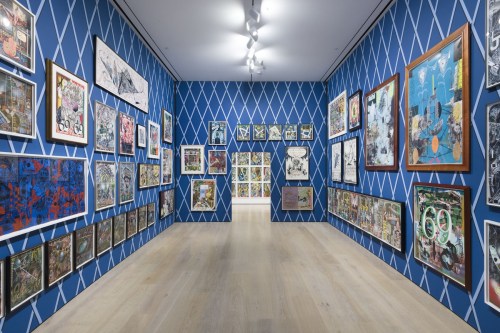
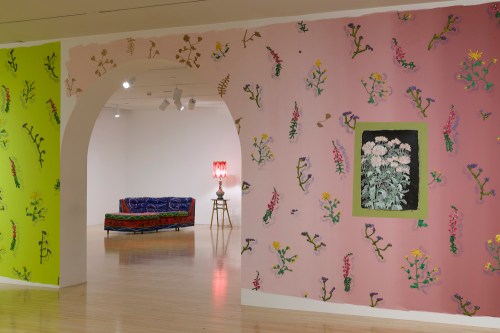
View of “With Pleasure: Pattern and Decoration in American Art 1972—85” at the Museum of Contemporary Art, Los Angeles, 2019–20. Image courtesy of the Museum of Modern Art, Los Angeles. Photo by Jeff Mclane.

Pattern and Decoration (P&D), a tendency which crystallized into a movement in New York in the mid-1970s, is one of the few movements of modern art to have self-designated, rather than been identified either by critical champions (think of Germano Celant and Arte Povera) or by sneering skeptics (Finish Fetish, Fauvism). Its members, though heterogeneous in their work, were united in their artistic tastes and temperament: they espoused a maximalist aesthetic that drew from global traditions and sources, also often aligned with feminist art practices that embraced domestic handicrafts. They had no manifesto, but critical allies including Amy Goldin and John Perreault have written eloquently about their work and aims. According to Perreault, “Pattern painting is non-Minimalist, non-sexist, historically conscious, sensuous, romantic, rational, decorative. Its methods, motifs, and referents cross cultural and class lines.”1 Read the rest of this entry »

Lari Pittman

Hammer Museum, Los Angeles

366ddbf4163a7a0cce978ee62eb3d4f2

Lari Pittman, ‘Declaration of Independence’, Hammer Museum, Los Angeles

You sense his ambition right from the get-go. Not career ambition, necessarily – though that must have been a part of it, and would even have been a political position for a queer Latino painter in 1980s Los Angeles – but an ambition to cover more ground in a single painting than had hitherto seemed possible, or desirable. Read the rest of this entry »

Mary Corse

Los Angeles County Museum of Art

MaryCorse

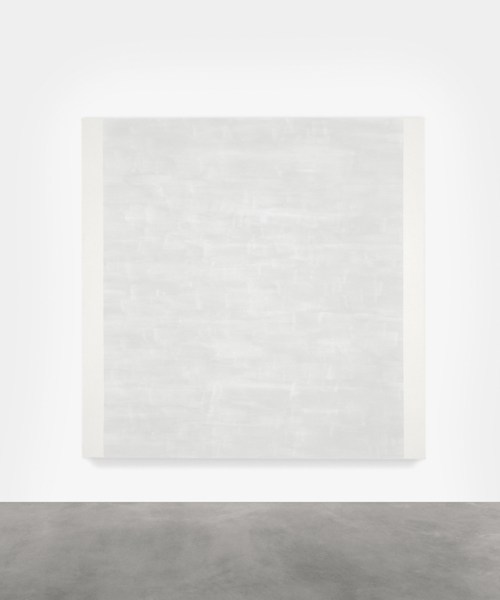
Mary Corse: A Survey in Light, 2019 (installation view, Los Angeles County Museum of Art). © the artist and Museum Associates/LACMA

When good art looks bad in a particular exhibition space, do we fault the artist, the curator, the institution or the architect? Mary Corse’s retrospective A Survey in Light, which travelled from the Whitney Museum of American Art, New York, to the Los Angeles County Museum of Art, is an unsatisfying tribute to the Los Angeles-based painter, who over half a century has devoted herself to a deep but narrowly focused body of work. Read the rest of this entry »

Roy De Forest

Parker Gallery, Los Angeles

rdf-30_untitled-1996_300-1680x1287

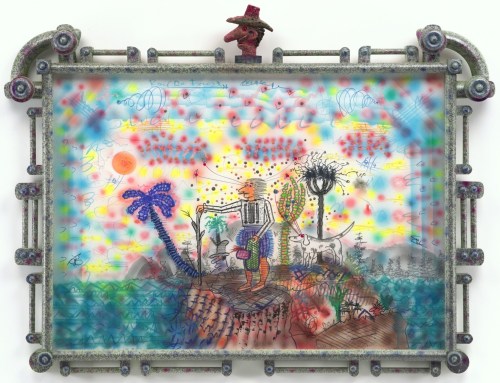
Roy De Forest, Untitled, 1996, Mixed media on paper with artist’s frame, 39.5 x 52 x 4.25 inches, courtesy Parker Gallery, Los Angeles

The categorical distinction between drawing and painting may be absurd, but it persists in both museums and the art market. (Why is a work on canvas superior to a work on paper, regardless of the medium used? Is it simply an issue of conservation?) Nevertheless, the activities of drawing and painting continue to serve distinct functions in most artists’ practices. For the Bay Area painter Roy De Forest, who produced an unparalleled body of work between the 1950s and his death in 2007, drawing was rarely a preparatory exercise for painting, but rather an autonomous, exploratory activity that allowed him to work in a freer and looser style than he could in his acrylic paintings on canvas. Which, if you are familiar with his riotously colourful, compositionally freewheeling paintings, you will understand says quite a lot. Read the rest of this entry »

David Hammons

Hauser & Wirth, Los Angeles

90

‘David Hammons’, 2019, exhibition view. © David Hammons; courtesy: the artist and Hauser & Wirth; photograph: Fredrik Nilsen Studio

Just inside one suite of galleries at Hauser & Wirth is a small display of material related to Ornette Coleman, the late saxophonist and free jazz innovator to whom David Hammons has dedicated the largest survey of his work to date and the first in Los Angeles for 45 years. ‘It was when I found out I could make mistakes that I knew I was on to something,’ said Coleman, who died in 2015. Read the rest of this entry »

Sterling Ruby

Nasher Sculpture Center, Dallas

2013-sterling-ruby-the-cup-urethane

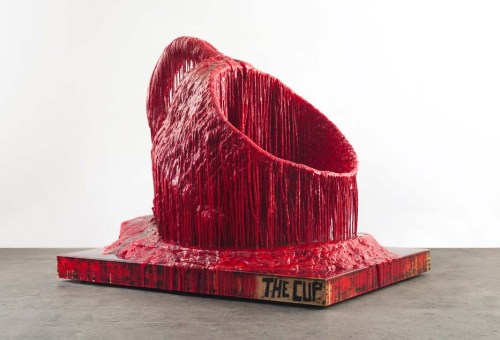
Sterling Ruby, The Cup, 2013, foam, urethane, wood and spray paint, 2.3 × 2.9 × 2.2 m. Courtesy: the artist; photograph: Robert Wedemeyer

The Nasher Sculpture Center is, by many metrics, something of a paradise for art. Designed by Renzo Piano, the building’s travertine walls and barrelvaulted glass ceilings provide a warm, light-filled setting for expensive objects made of steel, stone, wood and bronze. A graceful garden, designed by Peter Walker, is home to sculptures by Pablo Picasso, Anthony Caro and Alexander Calder. Read the rest of this entry »

D’Ette Nogle

Hannah Hoffman, Los Angeles

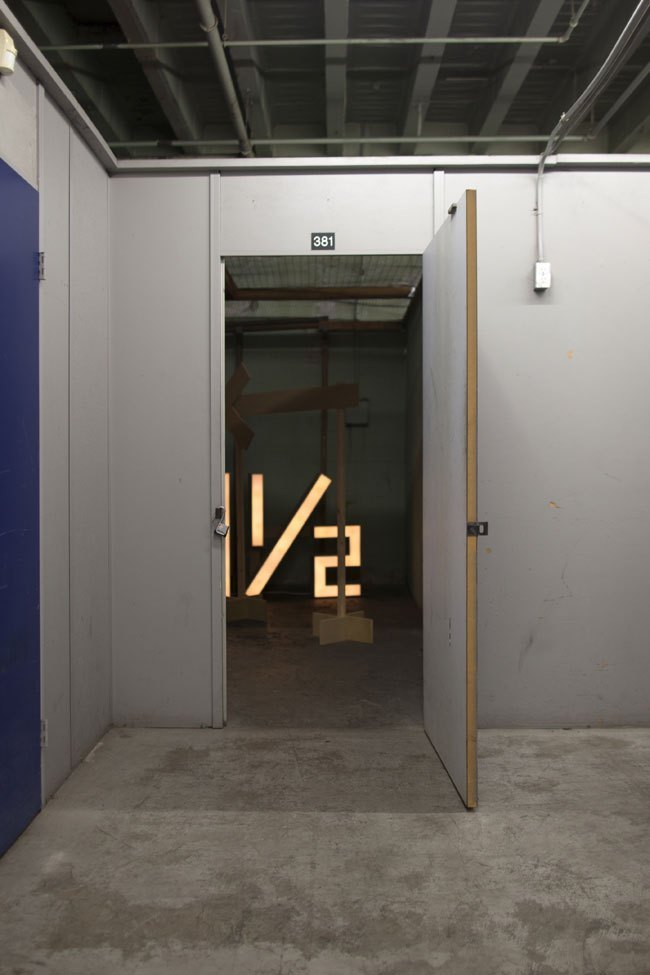
D’Ette Nogle, D’Ette Nogle (installation view) (2019). Image courtesy of the artist, Public Storage, and Hannah Hoffman, Los Angeles.

It’s easy to forget how tranquillisingly reassuring the standard commercial gallery format is until you are obliged to seek out exhibitions in other settings. D’Ette Nogle’s exhibition, titled D’Ette Nogle 2019, is mounted not in the not-yet-refurbished 1952 Paul Revere Williams-designed modernist villa that will soon be Hannah Hoffman’s new home, but in a public storage facility down the street. Access is via the loading bay, then up an unlit stairway. The exhibition is by appointment only, and on my visit, several other viewers shuffle uncertainly through a succession of four storage units separated by dim corridors of padlocked doors. It is like visiting a jail for art.

Read the rest of this entry »

Darren Bader

Blum & Poe, Los Angeles

DB_BPLA_Rasmussen_2018_06

Darren Bader, ‘character limit’, installation view, Blum & Poe, Los Angeles


How much of Darren Bader’s art do we need in the world? The world, after all, is already full of the kinds of objects that Bader brings into his exhibitions: art, words, images, personalities, ideas. Its very fullness is arguably the condition that Bader’s work both critiques and thrives on. “The world is full of objects, more or less interesting; I do not wish to add any more,” Douglas Huebler famously wrote in 1970. The question of whether Bader is adding more objects to the world depends on whether you consider two existing objects placed together to constitute a new object, or just a reconstitution of what was already there. It also depends on whether you consider a near facsimile of an existing object to be a new object. It depends—crucially—on whether an object can consist of language alone.  Read the rest of this entry »